

By 2026, artificial intelligence (AI) will have transitioned from a pilot to a core business capability. Generative AI and machine learning are changing how companies build products, serve customers, and run operations across most industries.
A practical AI strategy rests on a few pillars: business alignment, data and platform readiness, operating model and talent, scalable deployment (including LLMs and edge AI), and responsible governance.
It should connect directly to the company’s overall corporate and business strategy, so AI efforts support broader goals. In many organizations, 2026 is an inflection point: early deployments are just the start, and deeper integration will drive the next wave of value.
AI Strategy Framework
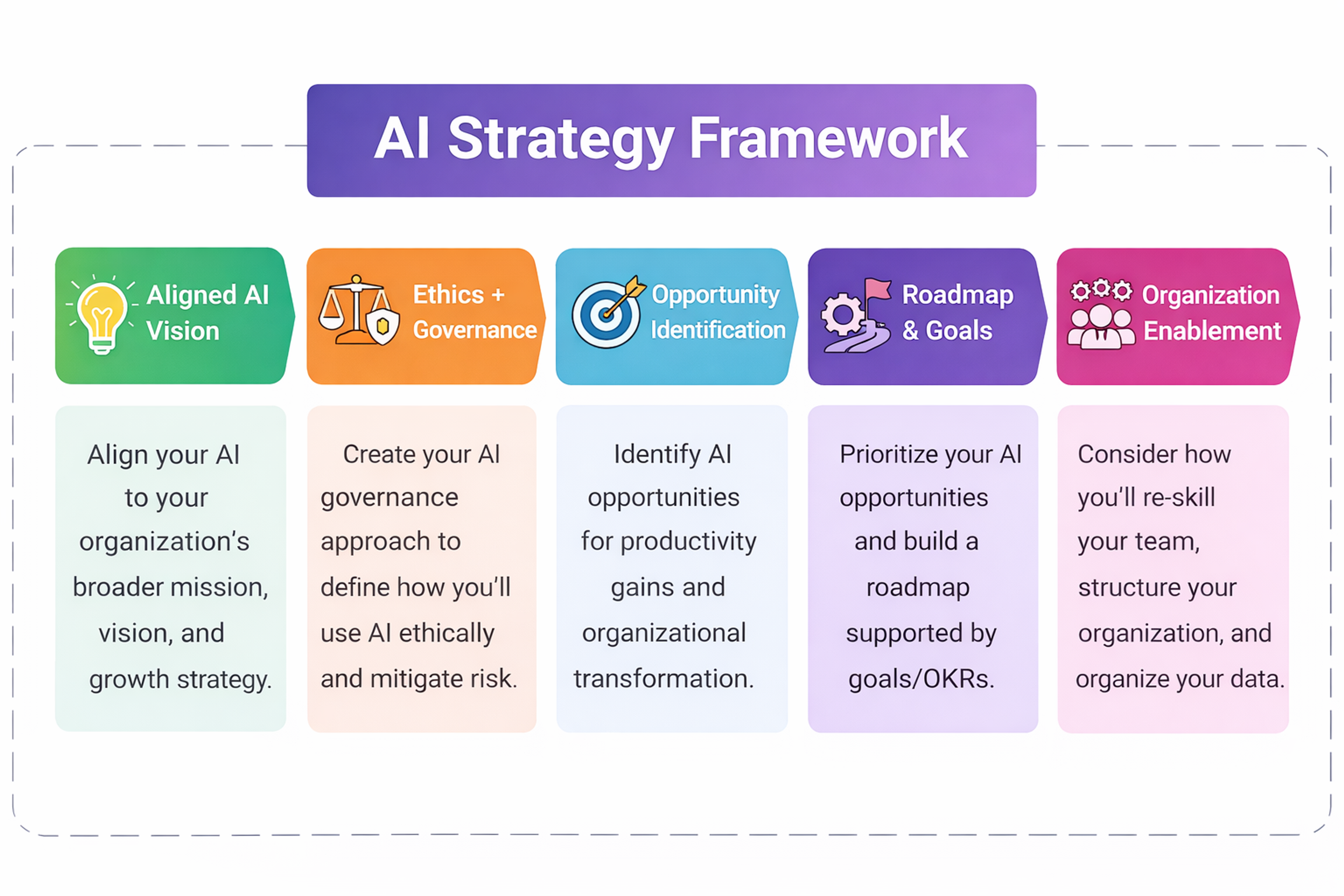
Key Takeaways
- 2026 is the shift from pilots to platforms. Winning companies treat AI as a core capability, not a set of experiments.
- Start with outcomes, not tools. The most scalable programs tie each use case to a business KPI and a clear owner.
- Data and MLOps are the foundation. Reliable pipelines, shared governance, and repeatable deployment and monitoring determine whether AI scales.
- Use a federated model to move faster. Central standards with local execution balances speed, reuse, and control.
- Plan explicitly for LLMs and edge AI. GenAI needs security, grounding, cost controls, and integration. Edge AI needs clear workload placement and device-ready models.
- Responsible AI is a growth enabler. Strong governance, privacy, fairness checks, and compliance readiness increase trust and make production rollouts sustainable.
The AI Imperative in 2026
AI adoption is surging. Deloitte’s 2026 study says companies doubled the share of AI projects in production in six months, and two-thirds report productivity gains. Microsoft also estimates that about 1 in 6 people worldwide used generative AI tools in 2025.
But expectations often outpace results: while 74% of firms hope AI will drive revenue growth, only ~20% report seeing it - partly because many companies use AI to automate existing work instead of redesigning products and decisions. In 2026, the goal is to move beyond isolated pilots and embed AI into core processes, backed by strong infrastructure and governance.
Regulatory and competitive pressures are rising, too. The EU AI Act pushes risk assessments, documentation, and human oversight for high-risk uses (with full enforcement proposed to shift to late 2027, though preparation should start now). In the U.S., bias, transparency, and safety are under increasing scrutiny, alongside a growing patchwork of state rules.
Core Pillars of an AI Strategy
An enterprise AI strategy should integrate the following key pillars:
- Align with business priorities: AI initiatives should start from business outcomes, not technology. Define measurable goals (e.g., faster resolution time, higher conversion, lower fraud) and link each use case to an owner and KPI. This reduces scattered pilots and makes scaling decisions simpler. Selecting AI solutions and tools should be tailored to business needs, ensuring the chosen technologies align with strategic objectives.
- Modernize data and infrastructure: An AI strategy needs a clear data foundation: reliable pipelines, shared governance, and platforms that support experimentation and production. Establish a comprehensive data strategy that covers data sourcing, governance, and lifecycle management. Assess data readiness to ensure your organization has reliable infrastructure and sufficient data quality to implement high-value use cases. Effective data integration is crucial for building AI use cases, enabling consolidation of data from multiple sources for accurate, timely insights and efficient processes. Manage data throughout its lifecycle to maintain quality, security, and compliance.
- Adopt a federated operating model: A common pattern is “central guardrails, local execution.” An AI office or center of excellence (CoE) sets standards (architecture, security, evaluation), while business units run delivery teams close to the domain. This keeps momentum high without losing consistency. Involving relevant teams is essential for aligning AI initiatives with business goals and identifying suitable use cases across the organization.
- Build governance and responsible AI into delivery: Governance is what lets AI scale without stalling. Define who approves what, set review checkpoints for risk, and require documentation for models in production. Treat monitoring as non-negotiable: drift, bias, security, and reliability issues should trigger clear response workflows. Establish AI policies as part of the governance framework, and ensure human oversight and judgment are integrated into high-stakes decisions.
- Upskill and organize talent: Training can’t be limited to data scientists. A 2026 plan usually includes AI literacy for most roles, deeper training for analysts and engineers, and “translators” who connect business needs to technical delivery. Many organizations formalize leadership roles (AI program owner, platform lead, responsible AI lead) to avoid unclear ownership. Data science remains a critical skill set for supporting AI projects, extracting insights, and improving decision-making and operational efficiency.
- Measure, scale, and iterate: Pick metrics that reflect real adoption and value, such as usage, time saved, quality improvements, revenue lift, and risk incidents. Measuring AI performance also helps optimize strategy and understand true impact. Create a repeatable path from pilot to production to rollout so strong use cases do not get stuck in a permanent trial.
Core Pillars of an AI Strategy
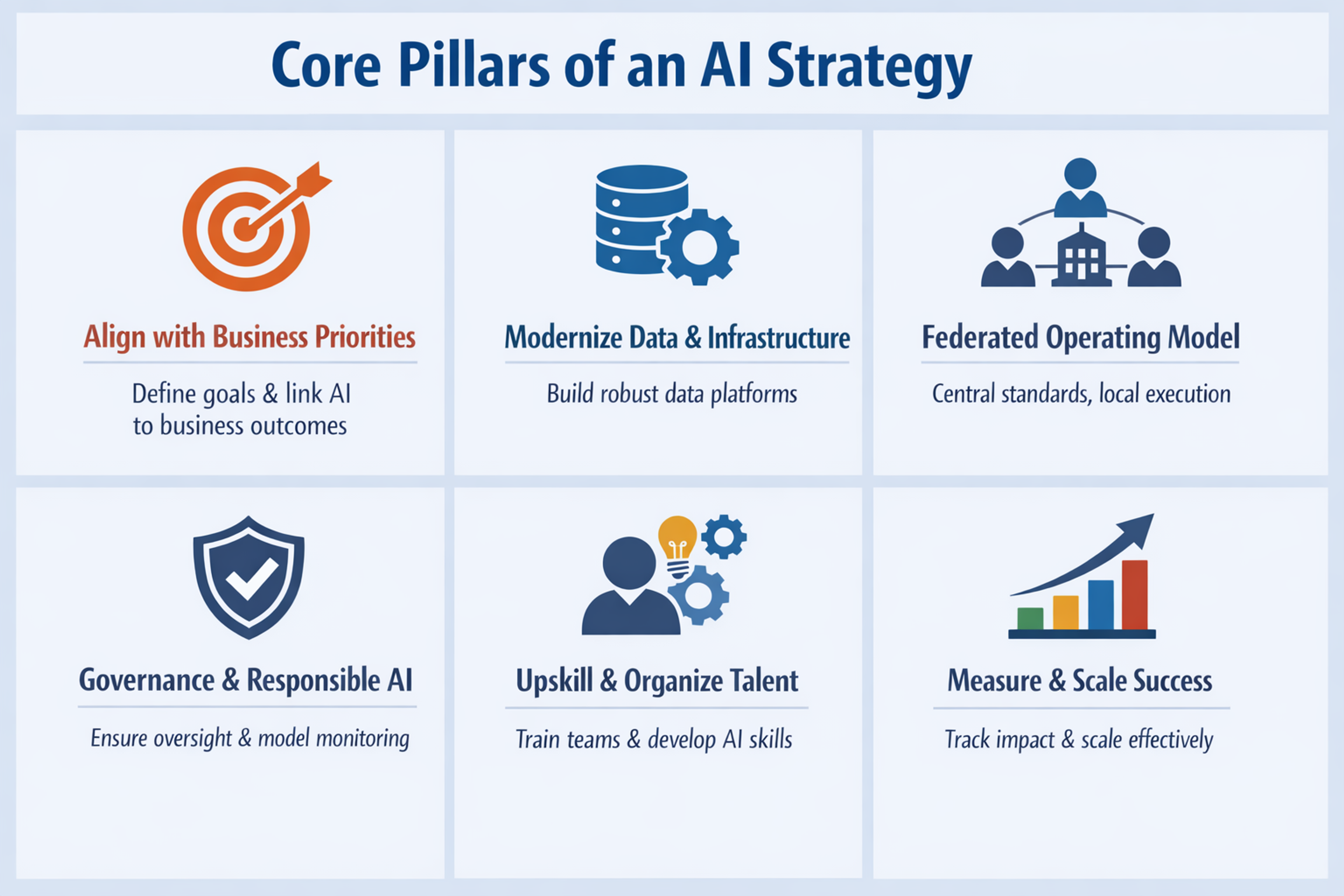
These pillars form an integrated framework. To make them actionable, companies often follow a step-by-step process.
A Simple Enterprise Process
- Assess readiness: Inventory use cases, data maturity, platforms, skills, and risk gaps.
- Define priorities: Select a small set of high-value use cases tied to business KPIs.
- Build capabilities: Data foundation, MLOps, security, and a delivery model (federated or hybrid).
- Pilot with guardrails: Run pilots with evaluation, monitoring plans, and compliance involvement early.
- Scale and integrate: Move winners into core systems and standard operating processes.
- Measure and update: Review KPIs and risks regularly; adjust based on results and new regulations.
Deploying Advanced AI: LLMs and Edge Computing
By 2026, two trends dominate the technology landscape: large language models (LLMs) and on-device AI. A forward-looking AI strategy must plan for how to leverage and integrate both.
Organizations also have the option to deploy their own models for greater control over performance, cost, and compliance - especially when building custom solutions or integrating with platforms like Azure.
Large Language Models and Generative AI
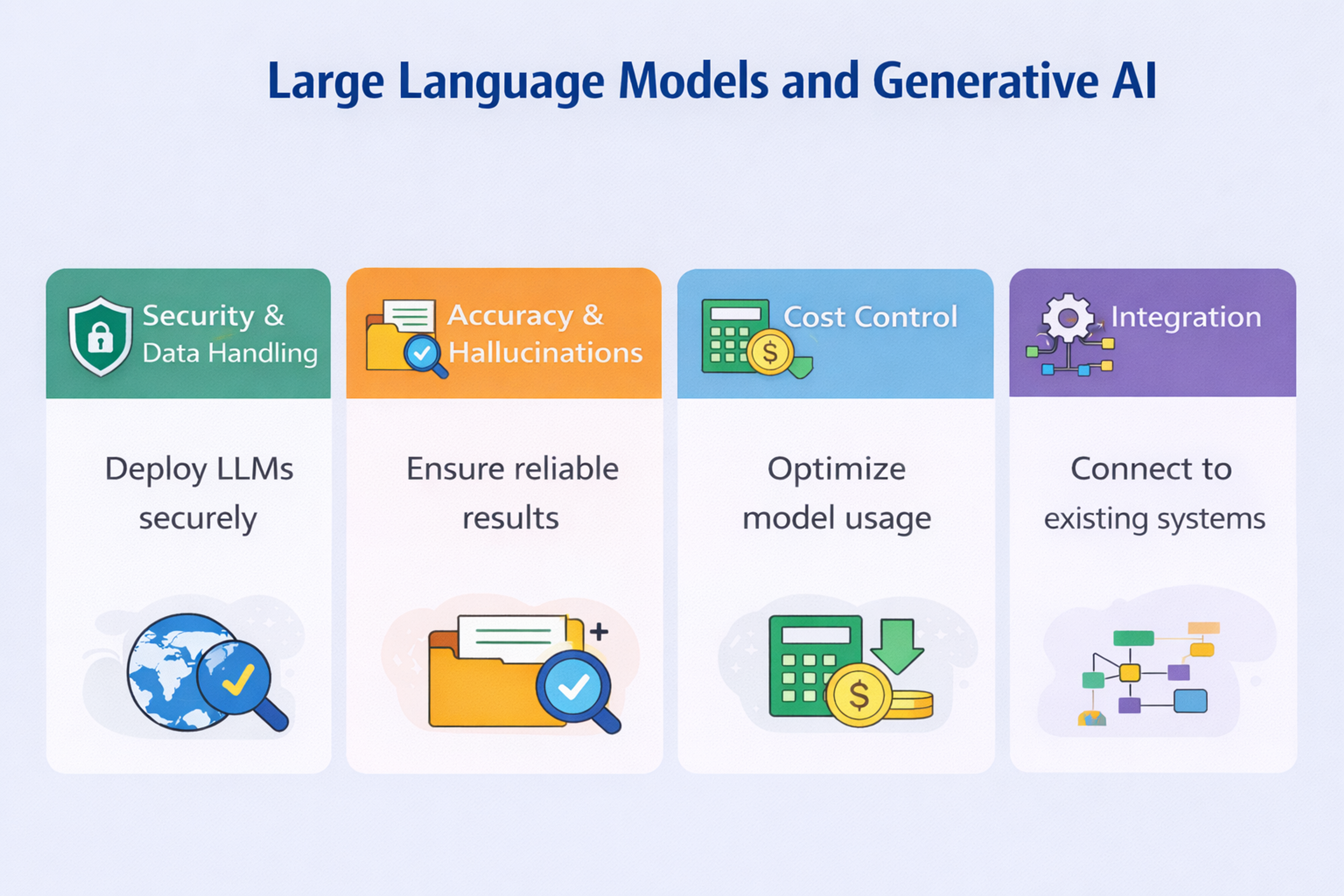
LLMs and GenAI can transform knowledge work (support, search, reporting, document workflows) and deliver measurable business value when implemented strategically, but they need practical controls:
- Security and data handling: Choose deployment patterns that match sensitivity (private cloud, on-prem, vetted APIs).
- Accuracy and hallucinations: Use RAG and strong evaluation so outputs are grounded in trusted sources.
- Cost control: Route tasks to the smallest model that meets quality, cache common queries, and monitor usage.
- Integration: Connect LLMs to systems of record via middleware (APIs, permissions, retrieval layers) so they stay current and auditable.
Large Language Models and Generative AI
Edge AI and IoT Integration
Edge AI matters when latency, offline operation, or privacy is critical (factories, vehicles, medical devices, stores). Strategy usually focuses on:
- Real-time decision-making: Run inference close to where data is created.
- Model/hardware optimization: Plan for constrained devices and diverse chips; standardize toolchains where possible.
- Hybrid edge-cloud design: Decide what stays local vs. what’s aggregated centrally, with clear security controls.
- Use-case inventory: Quality control, predictive maintenance, logistics sensing, and in-store analytics are common starting points.
LLMs and edge AI often complement each other: one improves workflows and knowledge work, the other enables real-time intelligence in the physical world.
Responsible AI: Governance, Fairness, and Compliance
A critical pillar of any AI strategy is responsible AI. AI can be a major opportunity, but only if it’s used responsibly. Enterprises must ensure systems are fair, reliable, transparent, and legally compliant - otherwise they risk reputational damage, regulatory penalties, and stalled deployments.
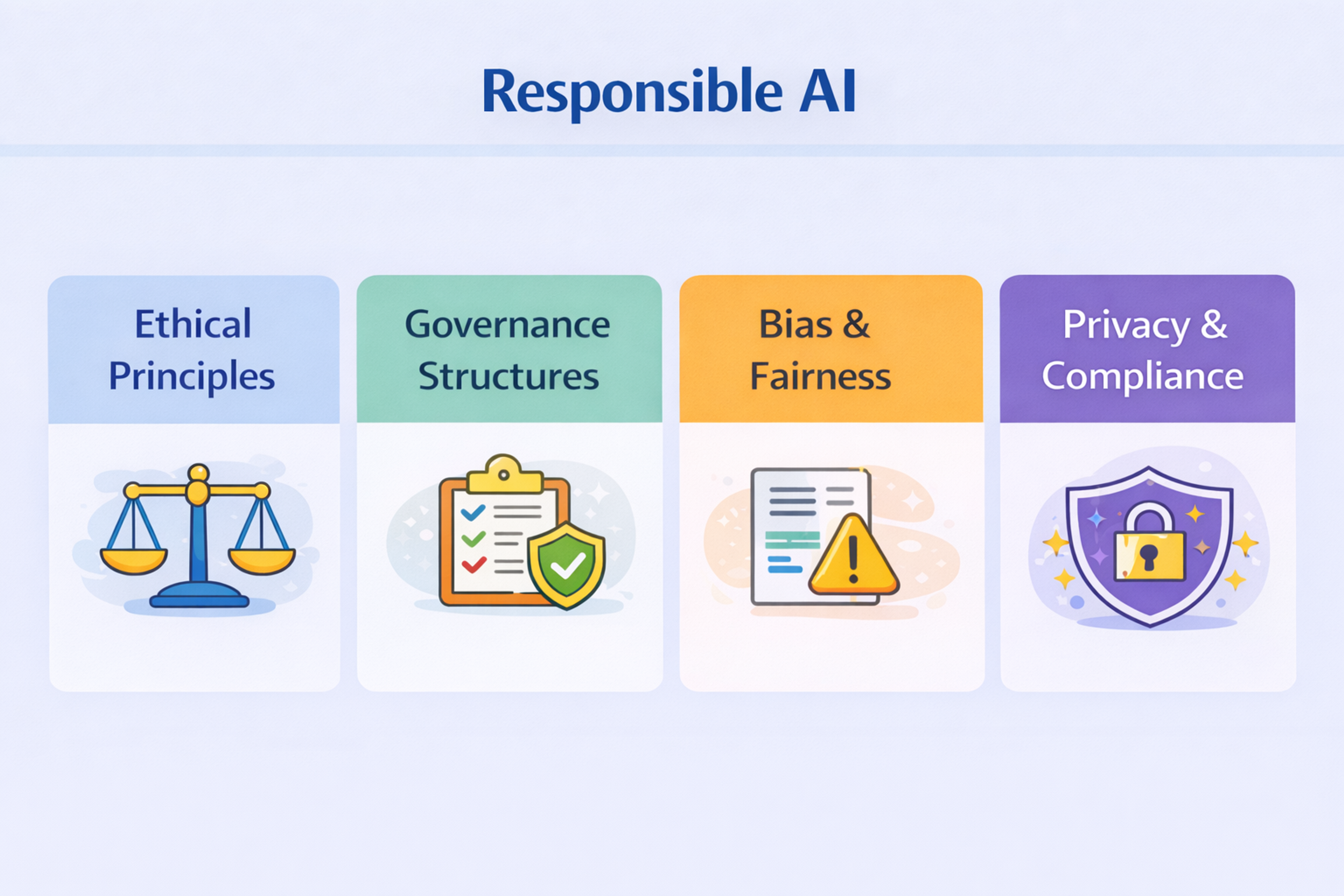
Key components of a responsible AI framework:
- Ethical principles and values: Define core principles and codify them in an ethics charter or company policy. The goal is to address benefits and unintended consequences together, not treat ethics as an add-on.
- Governance structures: Assign clear ownership. A cross-functional committee (legal, compliance, security/IT, business) reviews high-risk use cases, approves standards, and manages incidents. High-risk models should have documented data sources, tests (including bias), and defined human-oversight points.
- Bias mitigation and fairness: Audit models for disparate impact, use diverse training data, and apply mitigation techniques when needed. Build regular fairness checks into development and monitoring, and ensure teams have diverse perspectives to catch blind spots.
- Transparency and explainability: Make model decisions understandable to users and regulators - especially in finance and healthcare. Use explainability tools when appropriate, and maintain clear documentation (e.g., model cards) plus user training on interpreting outputs.
- Privacy and data protection: Enforce data minimization and strong encryption, and apply anonymization or privacy-preserving methods where possible. Vet third-party AI services for data handling, especially with LLM APIs.
- Regulatory compliance: Map AI use cases to relevant laws and risk categories early. Maintain evidence: documentation, impact assessments, audits, and monitoring logs.
In practice, responsible AI should be embedded into delivery: impact assessments for new projects, model lineage tracking, rollback capability, and human-in-the-loop controls for high-stakes decisions. Treat it as a competitive advantage - clear, public commitments to trustworthy AI can increase adoption and build customer and regulator trust.
Responsible AI: Governance, Fairness, and Compliance
AI Investments and ROI: Maximizing Value from AI Initiatives
Maximizing the return on AI investments is a top priority for organizations seeking to turn AI adoption into measurable business value. A successful AI strategy begins with a clear understanding of business objectives and a commitment to aligning every AI initiative with these goals.
Rather than deploying AI technologies for their own sake, business leaders should focus on identifying where AI can automate manual processes, optimize existing workflows, and unlock new opportunities for growth.
Effective AI implementation starts with a thorough assessment of current processes and the identification of high-impact areas where machine learning or GenAI can deliver the greatest value.
By leveraging AI systems to enhance decision-making and streamline operations, organizations can drive efficiency and innovation across the enterprise.
Ultimately, the most effective AI strategies are those that treat AI as a core business capability, not a side project. By integrating AI into the heart of business operations and focusing on continuous improvement, organizations can maximize the ROI of their AI initiatives and position themselves for long-term success.
Industry Case Studies
Below are examples of how leading enterprises are enacting AI strategies in 2026. They illustrate the principles above in action and highlight measurable outcomes.
Finance & Payments
Payments firms use AI heavily for fraud detection and risk scoring, with real-time models embedded directly in transaction flows. Successful programs follow the same formula: focus on high-impact use cases, invest in scalable infrastructure, and enforce strict governance because mistakes have immediate financial and reputational consequences.
Healthcare
Hospitals increasingly use predictive tools inside EHR workflows (risk flags, triage support, operational planning). Successful strategies focus on workflow integration, privacy, and validation across patient populations, with human oversight in clinical decisions.
Manufacturing
Predictive maintenance and vision-based quality control are common wins. Mature programs standardize sensor data, deploy edge inference for speed, and scale from a single line to multiple plants once ROI is clear.
Retail
Retailers push AI in personalization, conversational shopping support, inventory forecasting, and store operations. The best programs pair customer-facing innovation with guardrails on data use and surveillance-sensitive applications.
Industry Case Studies
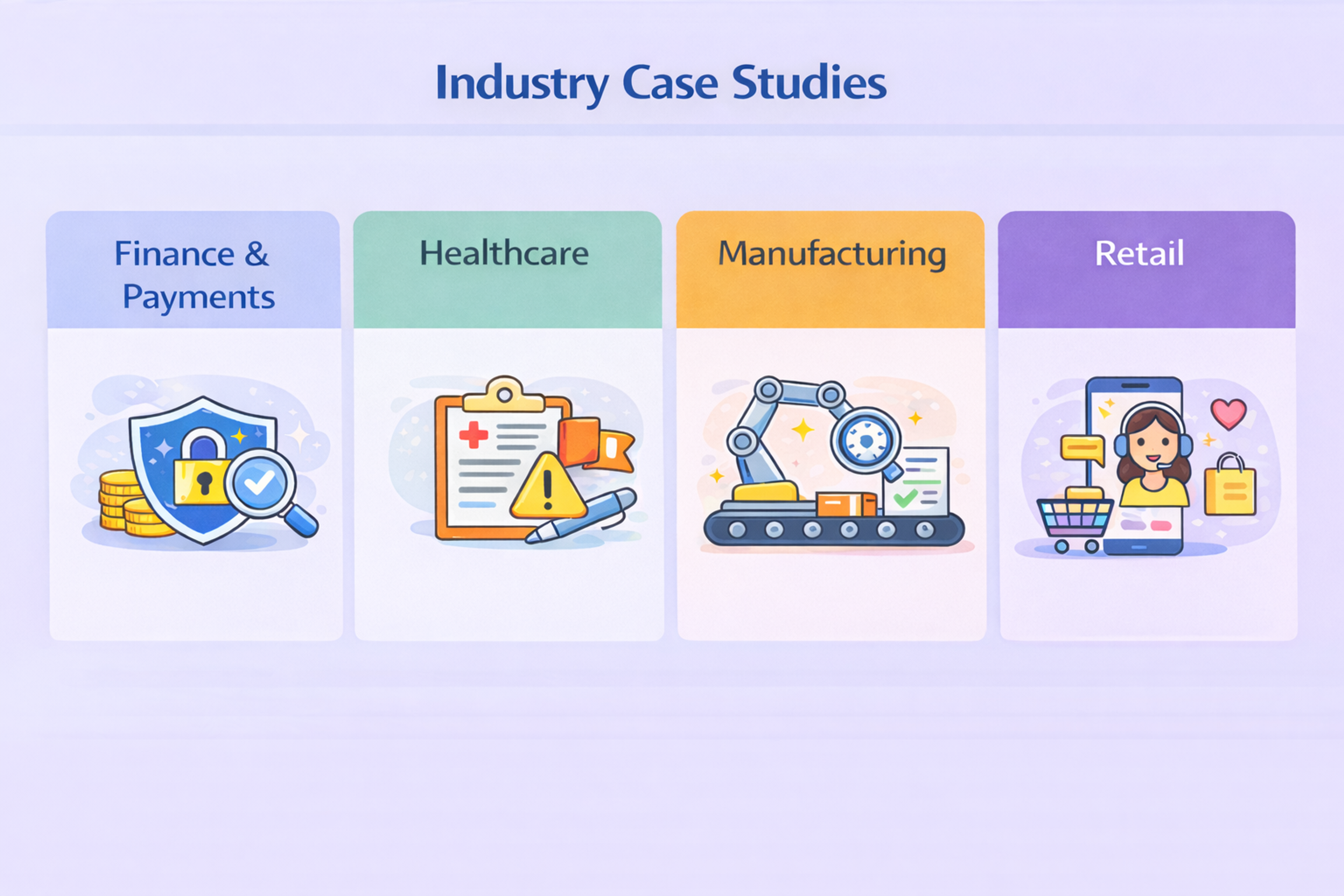
These case studies illustrate that an effective AI strategy is industry-agnostic but use-case-specific. They share a common theme: identify high-impact applications, invest in scalable infrastructure, enforce governance, and measure outcomes. Companies with such strategies are gaining ground over their peers.
Building Your AI Roadmap
To put all the above into practice, here is a concise roadmap for executives crafting an enterprise AI strategy in 2026:
- Executive alignment: Secure C-suite buy-in for the AI vision. Communicate how AI aligns with the company’s core goals (growth, efficiency, innovation) and establish a strategy council or steering committee.
- Use-case prioritization: Conduct an AI opportunity assessment. List potential projects across functions and evaluate them by business value and feasibility. Focus first on “low-hanging fruit” that delivers quick wins and builds momentum.
- Data and platform investment: Audit your data architecture. Invest in cloud/edge platforms that support AI workloads. Consolidate data silos and implement or upgrade MLOps and data governance tools. Ensure security and privacy are baked into infrastructure choices (e.g., consider on-prem deployments for sensitive data).
- Pilot and learn: Launch pilot projects with clear metrics. For each pilot, define success criteria. Use agile development - iterate quickly based on real user feedback and data. Include a process to audit model outcomes (bias checks, accuracy tests) before expanding.
- Scale and operationalize: As pilots prove successful, integrate them into business-as-usual. Develop standard APIs and integration layers so new AI components plug into existing systems. Automate retraining pipelines so models improve over time with fresh data.
- Culture and training: Parallel to tech rollout, drive organizational change. Offer training programs in AI literacy for all levels of staff. Celebrate AI successes internally to build momentum. Create roles like “AI Advocate” in each business unit. Encourage a “test and learn” mindset.
- Governance and ethics implementation: From day one, apply your responsible AI framework. Classify every AI project’s risk level and ensure appropriate oversight. Keep documentation and audit trails. Stay informed on regulatory changes globally and adjust policies accordingly.
- Monitor, measure, iterate: Establish a dashboard of AI KPIs. Review these regularly with leadership. Be prepared to pivot: if a technology trend changes (e.g., a new GPT model leaps ahead) or new regulations arrive, update your roadmap.
By following these steps, enterprises can move from experimentation to robust AI deployment. As Mastercard executives advise, leaders should “identify high-impact use cases, invest in scalable infrastructure, and foster internal expertise to keep pace with the technology’s rapid evolution.”
FAQ
Why Do Companies Need An AI Strategy In 2026, Not Just Pilots?
Because AI is now a core business capability. Without a plan, companies get scattered experiments, low ROI, duplicated tools, and higher security and compliance risk.
What Are The Key Pillars Of An Effective Enterprise AI Strategy?
Business alignment, data and platform readiness, a clear operating model, responsible governance, talent and upskilling, and a repeatable way to measure and scale wins.
How Do You Choose The “Right” AI Use Cases?
Start from outcomes, not tech. Assign an owner and KPI, then prioritize a small portfolio by value, feasibility, and risk so successful use cases can scale across teams.
How Should Enterprises Deploy LLMs Safely And Cost-Effectively?
Match model choice to data sensitivity, reduce errors with RAG plus evaluation, control spend with routing and caching, and connect to systems of record through secure integration layers.
Read more:
Conclusion
In 2026, AI is no longer optional - it is integral to a competitive strategy. An effective AI strategy combines ambition with discipline. It embeds AI into the core of the business (not just IT or analytics silos); it builds the necessary data and technology foundation.


About Clay
Clay is a UI/UX design & branding agency in San Francisco. We team up with startups and leading brands to create transformative digital experience. Clients: Facebook, Slack, Google, Amazon, Credit Karma, Zenefits, etc.
Learn moreAbout Clay
Clay is a UI/UX design & branding agency in San Francisco. We team up with startups and leading brands to create transformative digital experience. Clients: Facebook, Slack, Google, Amazon, Credit Karma, Zenefits, etc.
Learn more