

Modern AI tools already draft text, generate code, and answer questions faster than many teams. Artificial intelligence and AI technology are rapidly driving change in the job market, transforming the way tasks are performed across various industries.
In this AI era, the rise of an AI-driven workforce is reshaping the employment landscape, especially as our tech-driven world demands new skills and adaptability.
Automation is spreading beyond tech into healthcare, finance, and manufacturing, increasing pressure on knowledge work. The story is about task reorganization, not simple replacement.
AI produces drafts, recommendations, and options, while humans deliver outcomes that require judgment, exception handling, accountability, and trust. In many roles in 2026, AI will be used daily.
What Makes a Job Resilient in 2026
A job is resilient when it has at least one key feature.
When the stakes are high in health, safety, money, or law, someone has to own the decision. AI can advise, but an accountable person makes the final call.
Jobs that require emotional intelligence, creativity, leadership, and complex problem-solving are more difficult to replace because these skills are hard to formalize.
Human relationships also shape outcomes. Rapport, empathy, persuasion, and timing matter. People don’t just need correct information. They need to feel understood and safe enough to act.
What Makes a Job Resilient in 2026
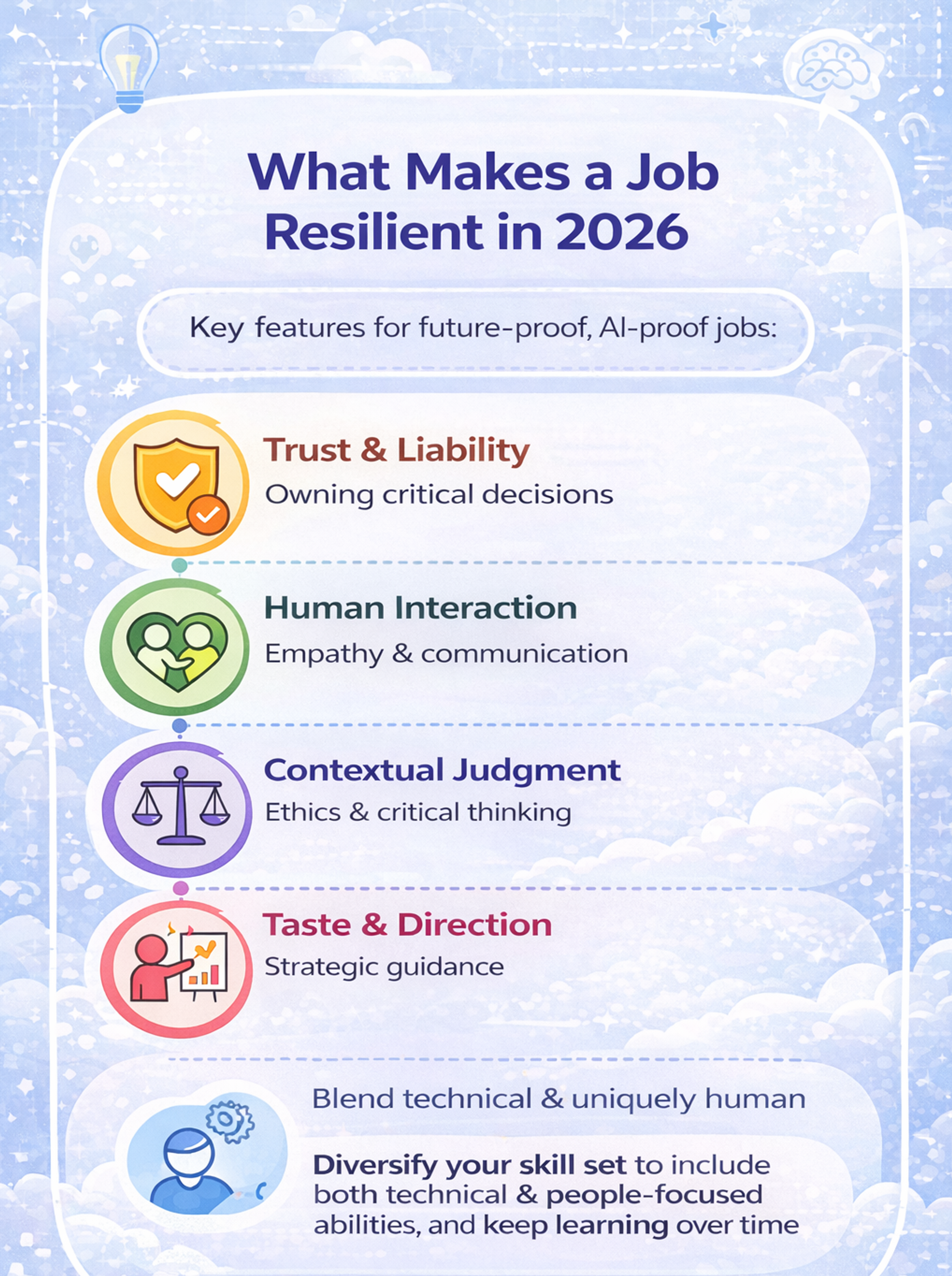
Many real decisions hinge on context and ethics. Two options can both be “correct,” but values determine what’s right. Nuanced judgment is harsh to automate in roles full of trade-offs and ambiguity. Taste and direction remain human advantages, too: generating options is easy. Choosing what fits the strategy, audience, and moment is not.
You can tilt your own role toward resilience if you:
- Develop a mix of technical and human-centered skills and keep learning
- Move closer to work that touches trust, judgment, and relationships, not just raw output
Repetitive data and administrative tasks are most vulnerable to AI. Work built on emotional intelligence, creativity, and complex problem-solving is more future-proof. When you think about your career, leaning into those capabilities helps you stay valuable in an AI-rich job market.
Care, Emotional Support, And Mental Health
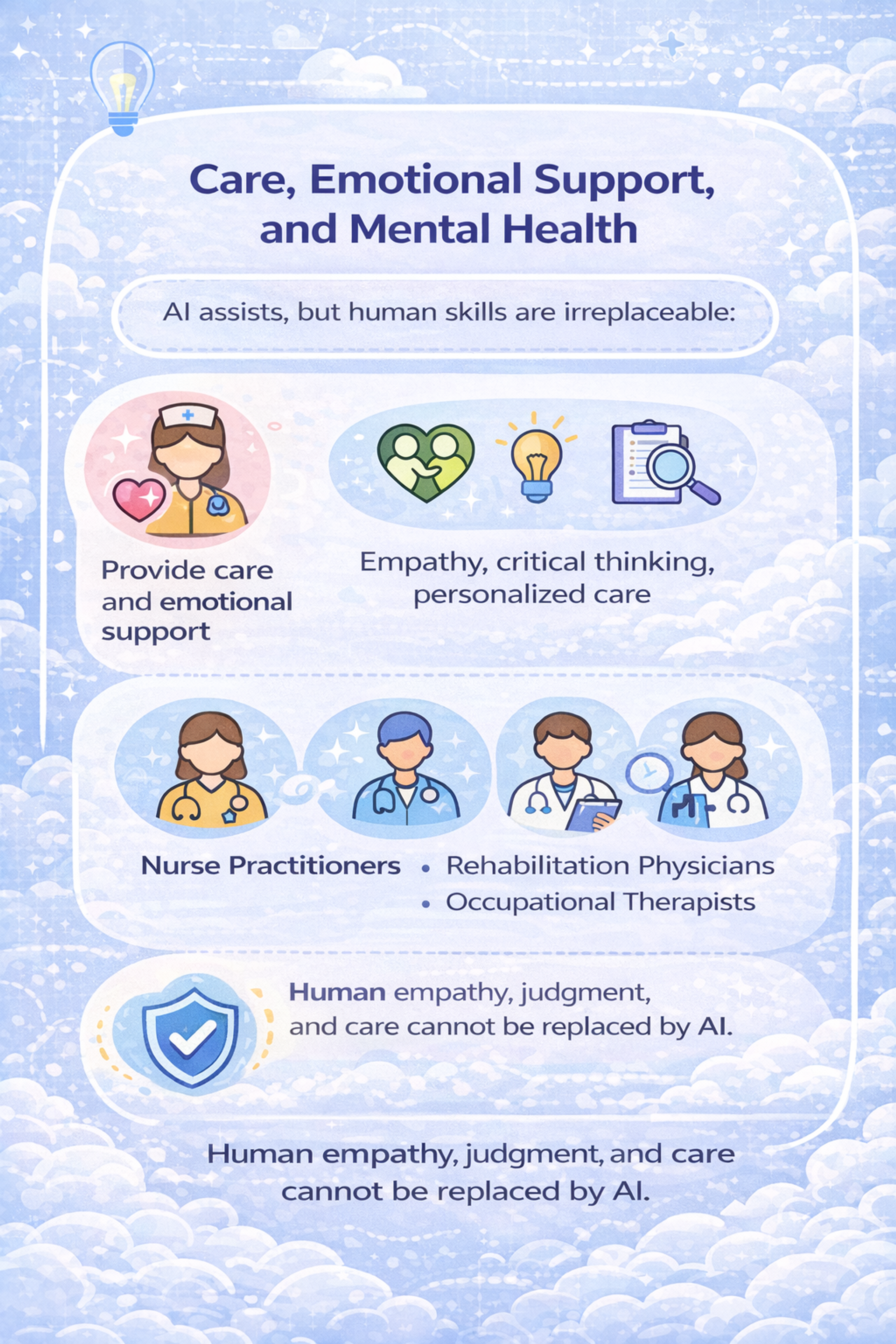
Healthcare shows AI as an amplifier, not a replacement. Systems can flag risks, suggest diagnoses, and handle documentation, but real care still depends on human observation, prioritization, clinical judgment, and trust with someone who may be scared or in pain.
Roles like nurses, therapists, rehabilitation specialists, occupational therapists, medical assistants, and social workers are resilient because they rely on empathy, reading nonverbal cues, and adapting to changing situations in real time. Automation can speed up routine tasks, but a human still must decide what to do now for this specific person.
AI can help by:
- Suggesting supportive language or exercises
- Structuring notes, plans, and educational materials
- Surfacing patterns in large datasets or symptom histories
Ethical judgment, nuanced care, and emotional support remain human responsibilities. The foundation is alliance, presence, and long-term change, not a single “good answer.” That combination of emotional awareness, quick judgment, and hands-on skill makes many healthcare and mental-health roles hard to automate.
Education And Human Development
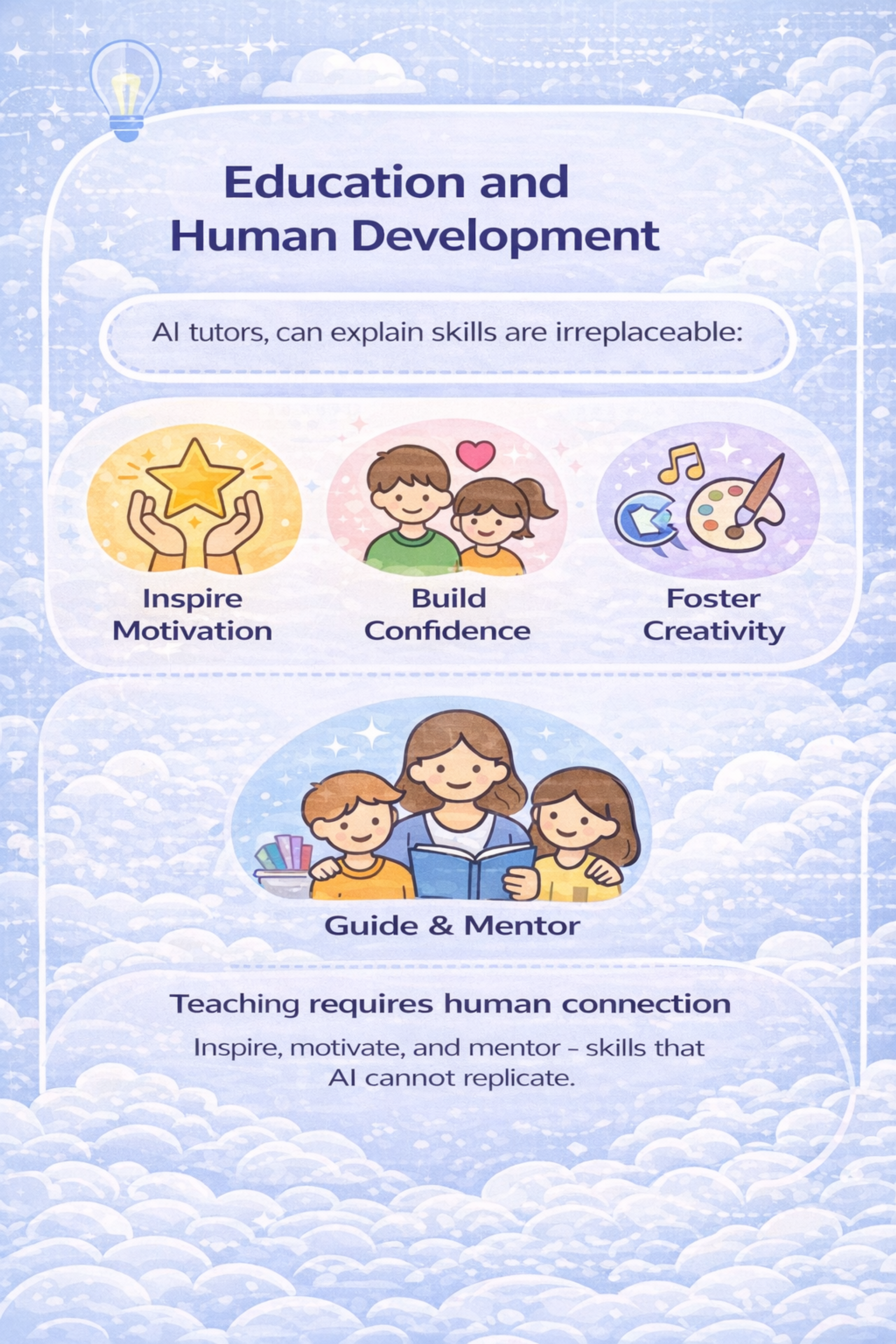
AI tutors can explain concepts and generate practice, but that’s still just output. Teaching is broader: motivation, classroom dynamics, social development, and building confidence, especially for students who doubt themselves. Creative and arts education is especially human because it relies on warmth, relationships, and shared culture.
Teachers constantly read the room: who is disengaged, who is hiding confusion, who needs more structure or a bigger challenge. They manage attention, group norms, and conflict, and they link learning to identity and goals.
AI can raise the baseline by giving explanations, examples, and drills on demand. The value shifts to humans who:
- Turn that support into real growth
- Help students interpret feedback and setbacks
- Build relationships that foster creativity, empathy, and resilience
AI tutors extend what’s possible. Teachers turn that possibility into actual change for real people.
Education And Human Development
Skilled Trades And Field Service
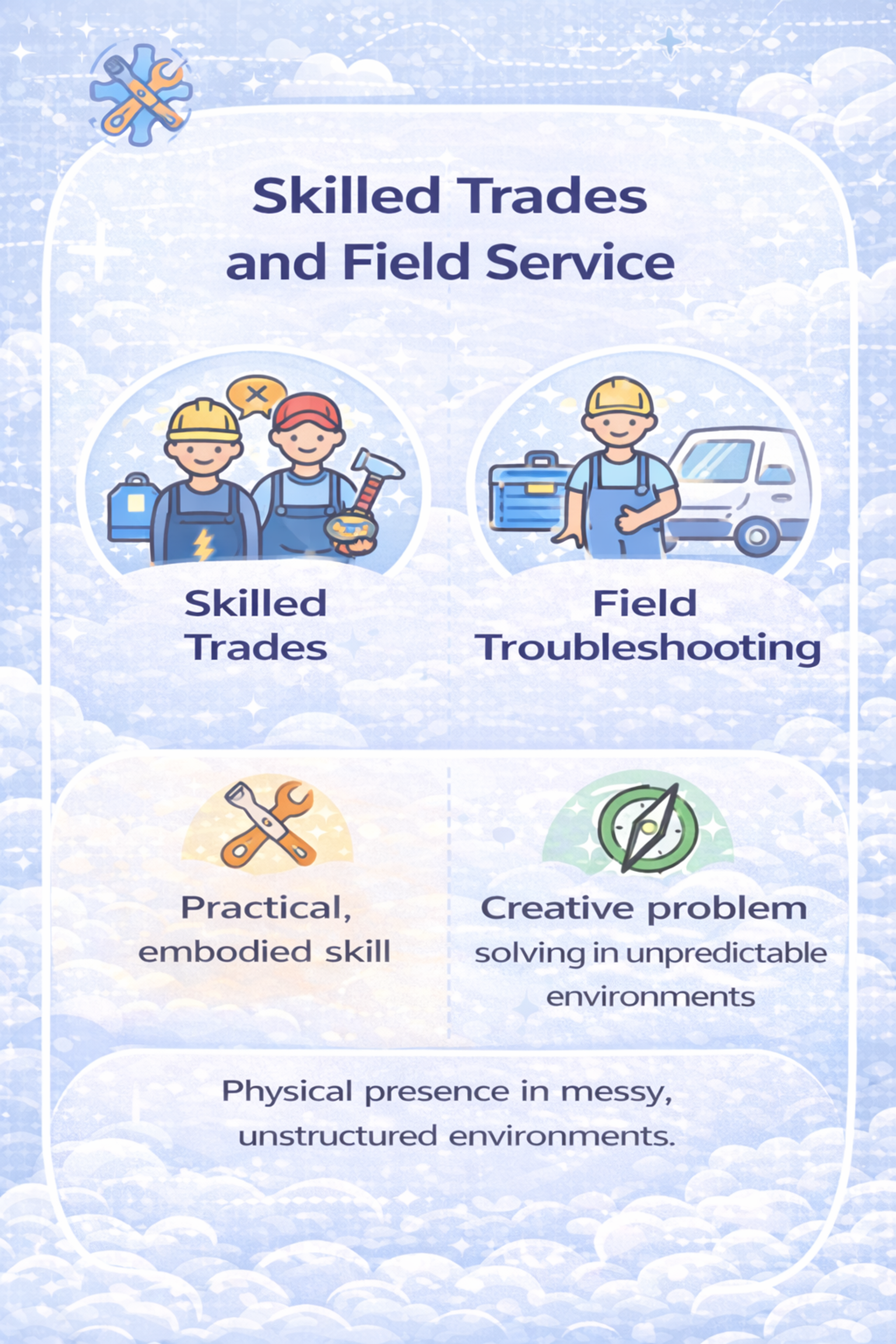
Skilled trades work in messy, unpredictable environments: old wiring, odd layouts, previous repairs, tight spaces. Electricians, plumbers, HVAC (Heating, Ventilation, and Air Conditioning) technicians, mechanics, construction workers, and similar roles rely on physical presence, fine motor skills, and on-the-spot judgment within safety codes. That makes them hard to automate.
AI can support, but not replace, by helping with:
- Diagnostics, manuals, parts identification, wiring diagrams
- Remote guidance for rare or complex issues
- Sensors and predictive maintenance that flag problems early
When safety and physical work are involved, a human still has to decide and act. As the world continues to build and repair infrastructure, skilled trades not only survive but alsobecome more valuable.
Leadership And People Management
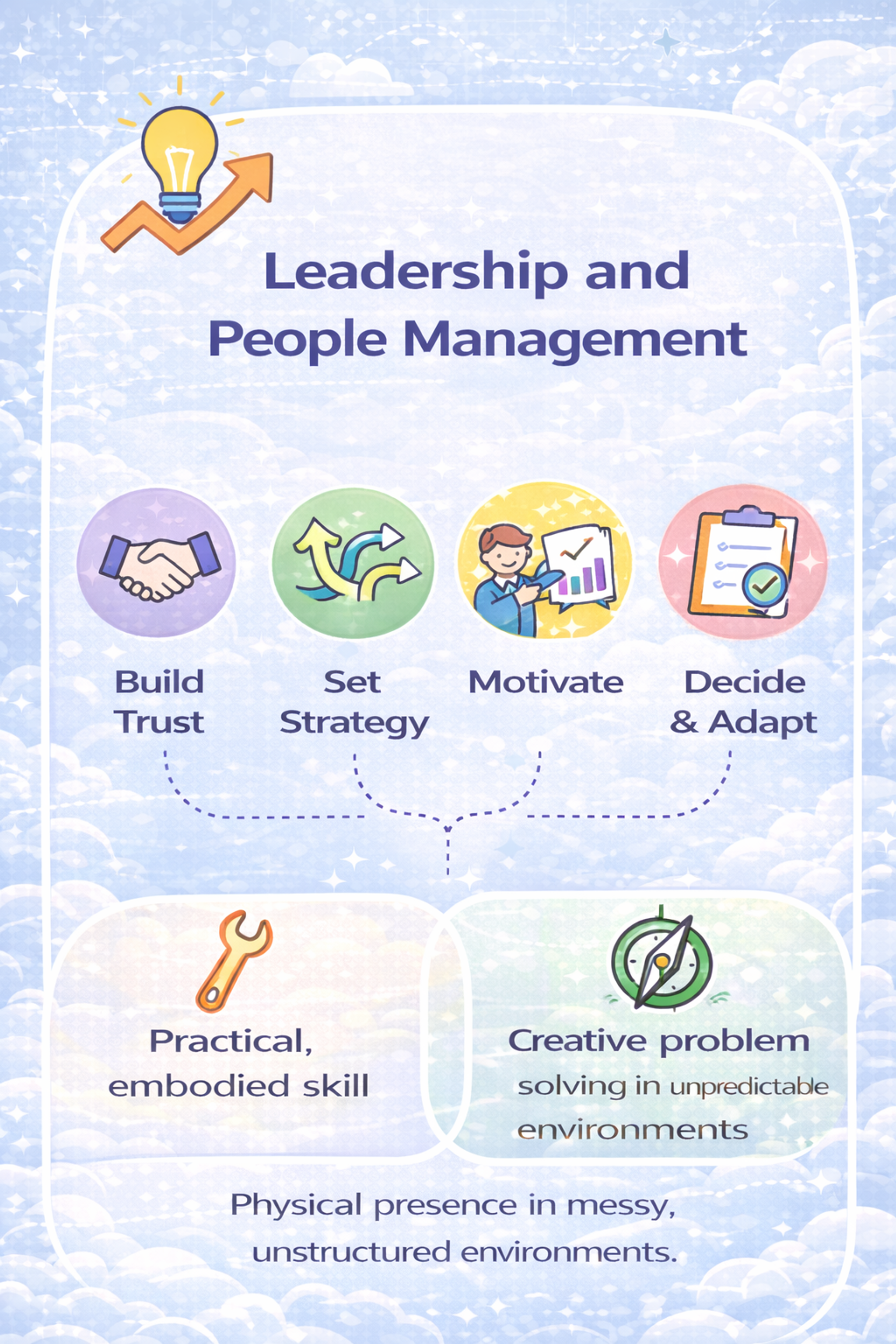
AI can draft plans, OKRs (Objectives and Key Results), reports, and coaching scripts, but that is not leadership. Leading people means making decisions that affect others, resolving conflicts, setting direction in uncertainty, and owning outcomes. More tools and output often create more coordination work, so leadership becomes more important, not less.
Leaders are still the ones who:
- Set vision and priorities and decide what not to do
- Give feedback that actually lands and protect people from chaos
- Spot burnout, negotiate resources, unblock the team, and hold the quality bar
Leadership is deeply contextual: the right move depends on culture, timing, and trust history. Executive and people-lead roles rely on emotional intelligence and nuanced judgment that do not fit neatly into data or generic playbooks, which keeps them hard to automate.
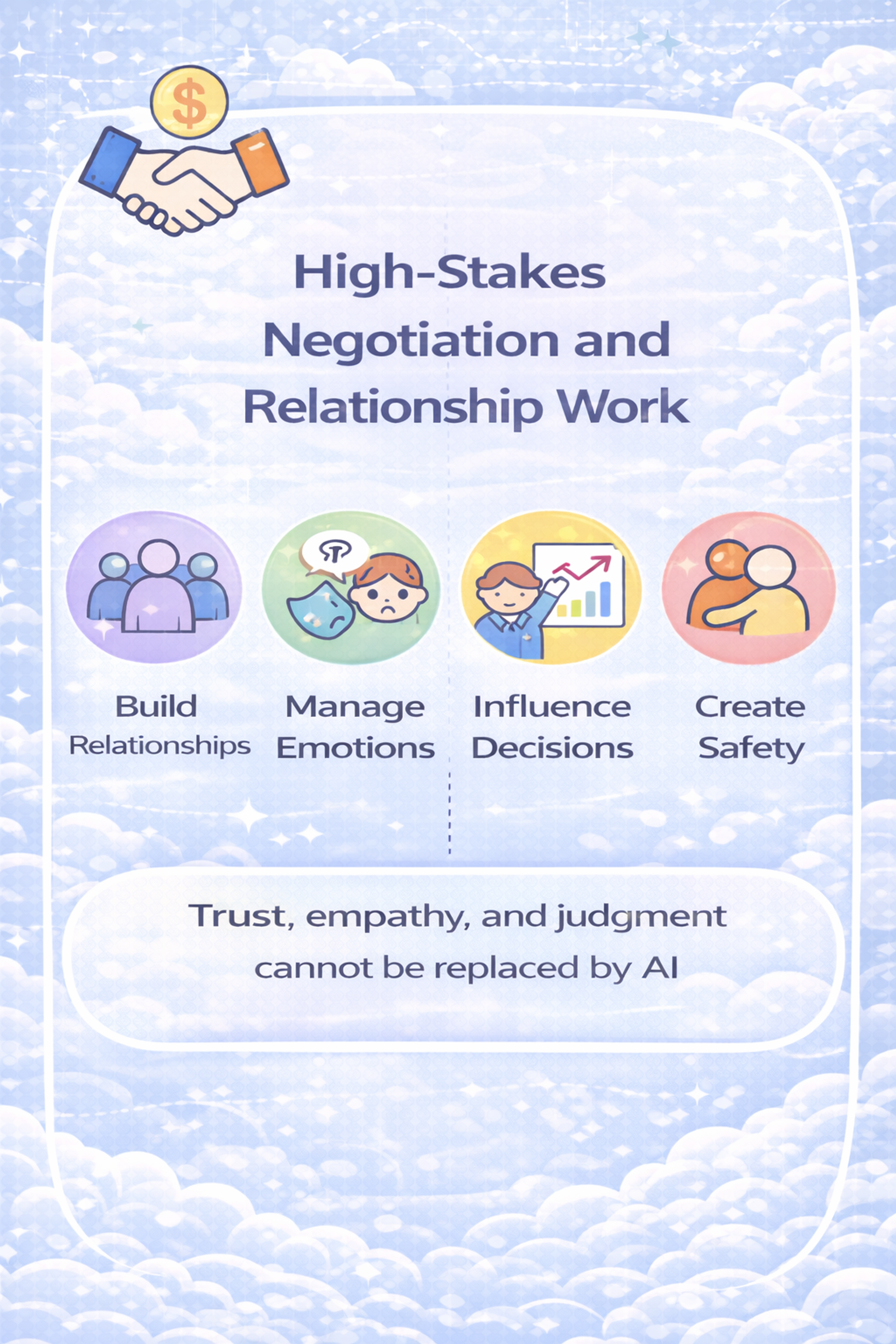
High-Stakes Negotiation and Relationship Work
AI tools like Salesforce Einstein can draft proposals and analyze accounts. They can suggest negotiation tactics and generate playbooks. That is powerful support, but it is not the same as winning the deal. Sales jobs, especially those involving negotiation and empathy, rely on human qualities that AI cannot fully replicate.
In complex B2B sales, partnerships, and conflict resolution, the real leverage sits in relationships, not information. Deals and agreements involve multiple stakeholders, hidden objections, politics, and perceived risk. People say no, maybe, or yes based on whether they trust you and believe you will still show up after the signature.
Mediators, diplomats, and conflict-resolution roles work the same way: the job is to manage emotions, reframe positions, and create safety so people can reach a compromise they can live with.
What humans bring here is hard to automate:
- Reading the room in real time
- Calibrating tone, pace, and level of pressure
- Knowing when to push, pause, or change direction
- Building and repairing trust over repeated interactions
AI can help you prepare with insights and talking points. It cannot replace being in the room, sensing the dynamics, and carrying the relationship over time.
High-Stakes Negotiation and Relationship Work
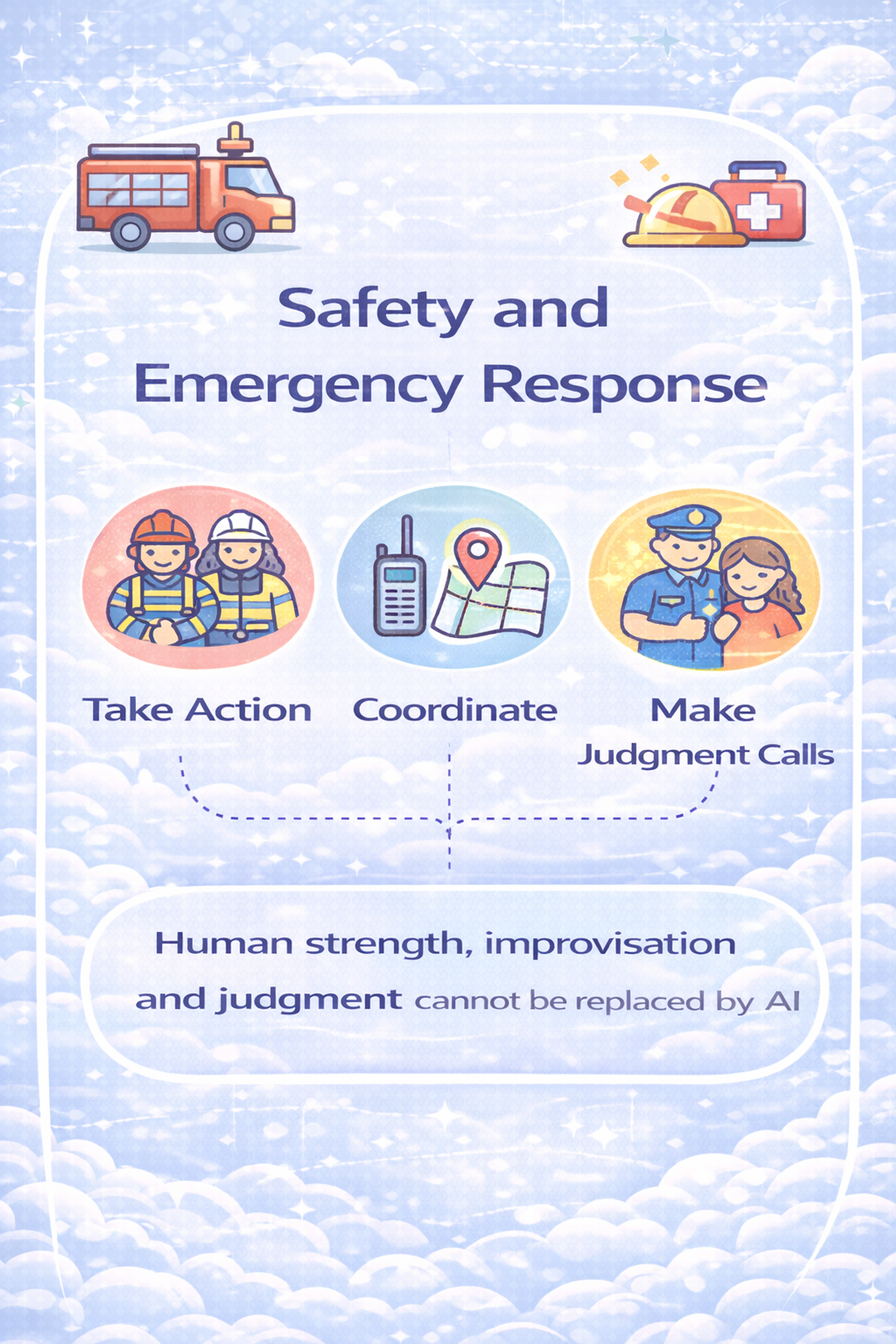
Safety And Emergency Response
When things go wrong, environments become chaotic and time-critical. AI can surface information, routes, and triage options, but emergency response still depends on human presence, physical action, and real-time judgment under pressure. Firefighters, paramedics, and other public safety roles must read the scene, improvise, and make life-or-death decisions in unpredictable conditions.
AI works best as a support layer, for example to:
- Surface protocols, checklists, and triage suggestions
- Assist dispatch with routing and resource coordination
- Provide situational data to teams in the field
On the ground, humans still calm people, earn trust, and lead others through uncertainty. That mix of judgment, empathy, and physical action keeps many safety and emergency roles highly resistant to automation.
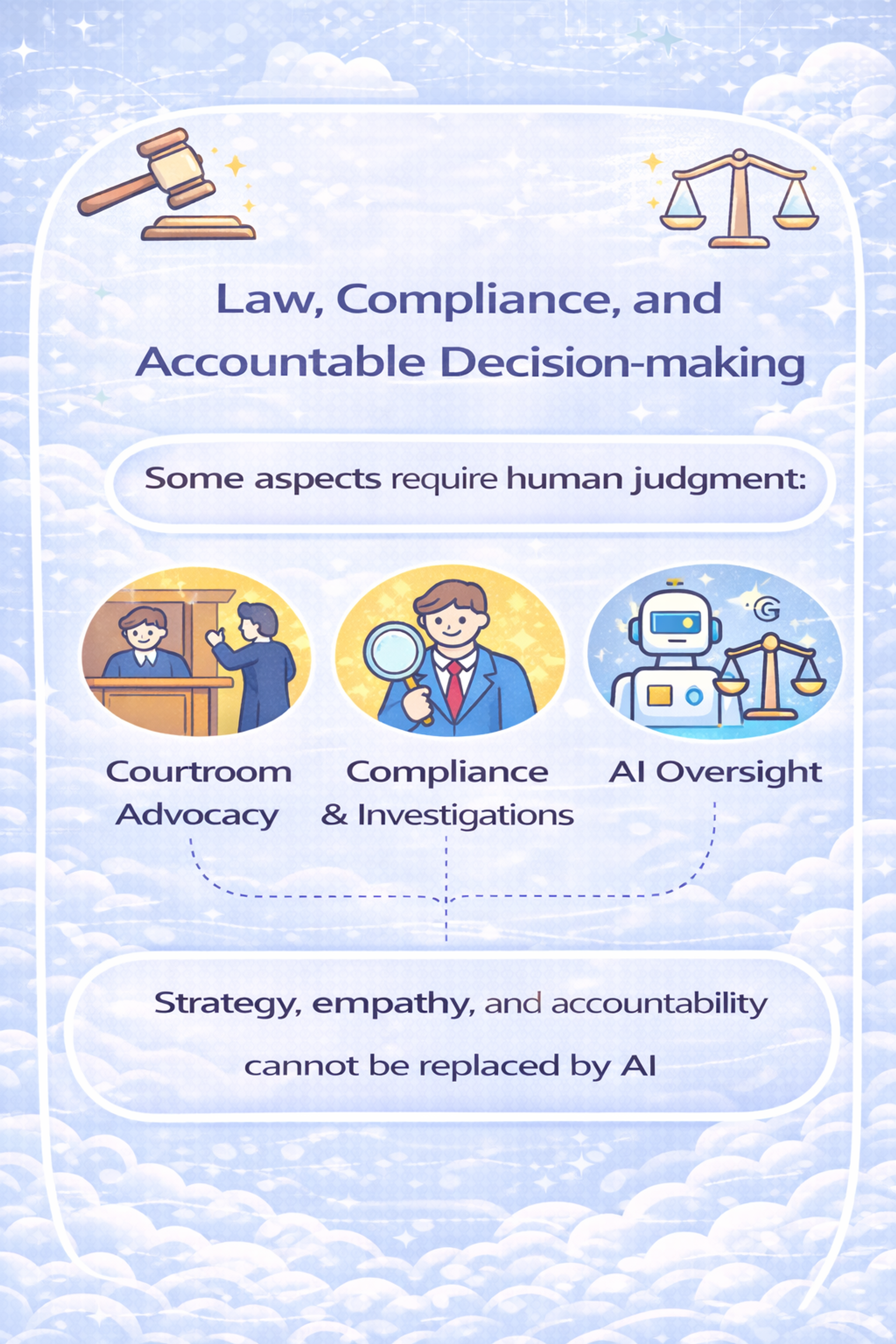
Law, Compliance, And Accountable Decision-Making
AI speeds up case research, drafting, and document review, but it does not replace the core of legal work. Legal practice is still about strategy, persuasion, and accountability in adversarial contexts: understanding people, reading situations, and making arguments that actually land. It relies on empathy, creativity, and moral judgment, not just text generation.
Some parts remain firmly human:
- Courtroom advocacy: preparation can be automated, but a person still presents arguments, shapes the narrative, reacts to new information, and handles live testimony under pressure.
- Compliance and investigations: require judgment about intent, risk, and ethics, plus designing policies, training, monitoring, and incident response when things go wrong.
- Oversight of AI itself: as capabilities grow, so does the need for accountable, legally informed oversight that balances speed, safety, fairness, and regulation.
These roles ensure technology is used responsibly and that efficiency never overrides rights, due process, or trust. Legal, compliance, and many HR functions stay resilient because they depend on ethical reasoning and deep understanding of people, not just processing large volumes of information.
The Jobs That Quietly “Disappeared” in 2025 Because of AI
In 2025, no jobs vanished everywhere, but the human-only version of several roles shrank quickly as AI became the default. Reports noted substantial layoffs attributed to AI, signaling a shift from pilots to headcount planning.
The most transparent case was tier-1 support: repetitive chat and email work - answering common questions, pasting knowledge-base snippets, and routing tickets - was moved to AI agents, while humans handled escalations and tricky cases.
Clerical copy-and-process work, also contracted as OCR, AI extraction, and automated approvals, took over data entry and routine admin tasks.
Entry-level “first-draft” white-collar roles were squeezed too: junior marketing support, basic comms, and other volume-of-text jobs declined once AI took on the initial drafts that used to train new grads.
FAQ
What Does AI Proof Mean For Jobs In 2026?
It means AI can help with tasks, but it cannot reliably replace the role because a human must own the outcome.
Which Jobs Are Most Resilient To AI In 2026?
Roles that require trust, accountability, and real-world judgment, like healthcare, education, skilled trades, leadership, and emergency response.
Why Will Healthcare And Therapy Roles Not Be Replaced?
They rely on human trust, observation, ethics, and responsibility in high-stakes situations.
Why Are Skilled Trades Considered AI-Proof?
They require hands-on work in unpredictable environments where safety and improvisation matter.
Will AI Tutors replace Teachers and Coaches?
No. AI can explain, but humans handle motivation, social dynamics, and long-term development.
Read more:
Conclusion
Technology will keep improving. Some tasks will vanish. Many will transform. But work that depends on human trust, real-world action, contextual judgment, and accountable ownership remains stubbornly difficult to automate.
The safest bet isn't finding a job that never changes. It's choosing or shaping a role where you're responsible for outcomes, not just outputs. In 2026, that's what AI-proof really means.

About Clay
Clay is a UI/UX design & branding agency in San Francisco. We team up with startups and leading brands to create transformative digital experience. Clients: Facebook, Slack, Google, Amazon, Credit Karma, Zenefits, etc.
Learn moreAbout Clay
Clay is a UI/UX design & branding agency in San Francisco. We team up with startups and leading brands to create transformative digital experience. Clients: Facebook, Slack, Google, Amazon, Credit Karma, Zenefits, etc.
Learn more