

Your website is bleeding conversions, and everyone on your team already knows it.
It loads slowly, looks broken on half the phones that hit it, and the last redesign was scoped two product pivots ago. Building a full-time design team to fix it would take months and cost more than the problem is worth. Outsourcing can close that gap in weeks, but only if you outsource the right work to the right partner for the right reason.
That last part is where most companies get stuck. Outsourcing web design isn't a single decision. It's a set of smaller ones: whether to go outside at all, what model fits your project, who to trust with it, and how to protect the work once it's live. Get the first call wrong and no vendor, however good, will save the outcome.
Key Takeaways
- Outsourcing makes sense when you're missing a specific skill, racing a deadline, or facing a project too large for your current team. It makes less sense for a site that needs constant, small, daily changes.
- A freelancer, an agency, and a subscription design service solve different problems. Picking the wrong one wastes more money than picking the wrong price point.
- Regional hourly rates vary by roughly 4 to 6 times between South Asia and the US, but the gap in project risk and revision cost often erases part of those savings.
- Building the same role in-house costs more than the sticker price of a salary once you add benefits, equipment, and management time.
- File ownership, source code, and post-launch maintenance need to be settled in the contract, not assumed after the site goes live.
Should You Outsource Web Design?
Most founders ask "should we outsource" as if it has one answer. It doesn't.
The better question is what’s missing: time, a skill, or capacity.
Time is missing when your internal team could technically do the work but is already stretched across other priorities. A redesign that competes with product launches and marketing campaigns for the same three people will lose. Outsourcing here isn't an admission of weakness but rather a scheduling decision.
A skill is missing when nobody on staff has done the specific thing you need done well. Plenty of internal teams can maintain a website. Fewer can design a checkout flow that doesn't leak revenue, or build a site architecture that still performs at ten times the current traffic. If the skill gap is specific and temporary, outsourcing solves it faster than hiring someone new.
Capacity is missing when the project itself is bigger than a redesign, closer to a full rebuild with strategy, UX, development, and copy all moving together. That's rarely something two overloaded generalists can absorb on top of their day jobs, no matter how talented they are.
The List of Benefits of Outsourcing Web Design
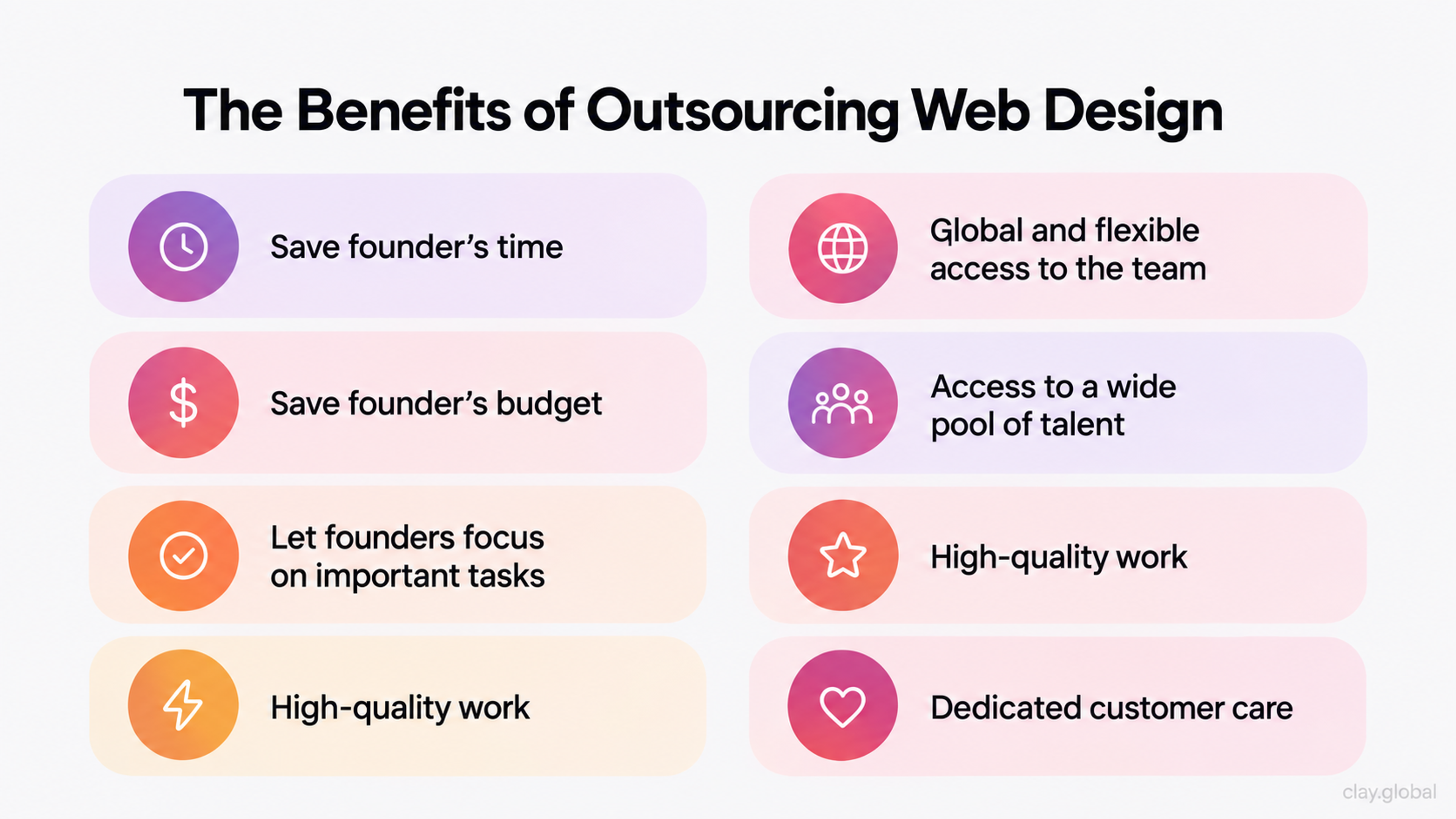
None of this requires an all-or-nothing choice. A hybrid model, where you keep strategy and brand voice in-house and bring in outside help for UX and build, works well when you know your audience but lack the specialist hands to execute on that knowledge. Plenty of companies run this way permanently.
When Outsourcing Doesn't Make Sense
Outsourcing has a failure mode, and it's not usually the vendor's fault. Research from the Project Management Institute has found that poor communication is the primary driver of failure in roughly one in three projects.
Remote, cross-organization work raises that risk further because context has to travel further to reach the people doing the work. If nobody on your side has time to join calls, review drafts promptly, or make a decision without escalating it, you won't get full value from an outside team no matter how strong they are.
Outsourcing also fits poorly with sites that change constantly. If you run a large ecommerce platform or several properties that need daily tweaks and experiments, paying an outside team for every small change adds up faster than staffing a lean internal team would. In that case, save outsourcing for the major redesign and keep day-to-day changes in-house.
And if your team genuinely needs people in the room, for workshops, stakeholder alignment, or frequent in-person sessions, a local or in-house hire will likely outperform even a great remote partner.
How to Outsource Web Design: A Step-by-Step Process
Once you've confirmed outsourcing is the right call, the process itself is straightforward if you follow it in order.
Start by defining goals, scope, and budget before you talk to anyone. Know what the new site needs to do, which pages it needs, and which integrations are non-negotiable, whether that's your CRM, a booking system, or a payment processor. Vague briefs produce vague proposals, and vague proposals produce scope creep once work starts.
From there, shortlist partners against that brief rather than against a "best agencies" list. Look at portfolios on platforms like Dribbble and Behance for range and consistency, not just polish, and check that the work you like solved a problem similar to yours. Contact past clients directly where you can, reviews tell you whether the work shipped, and references tell you whether the process was bearable.
How to Outsource Web Design
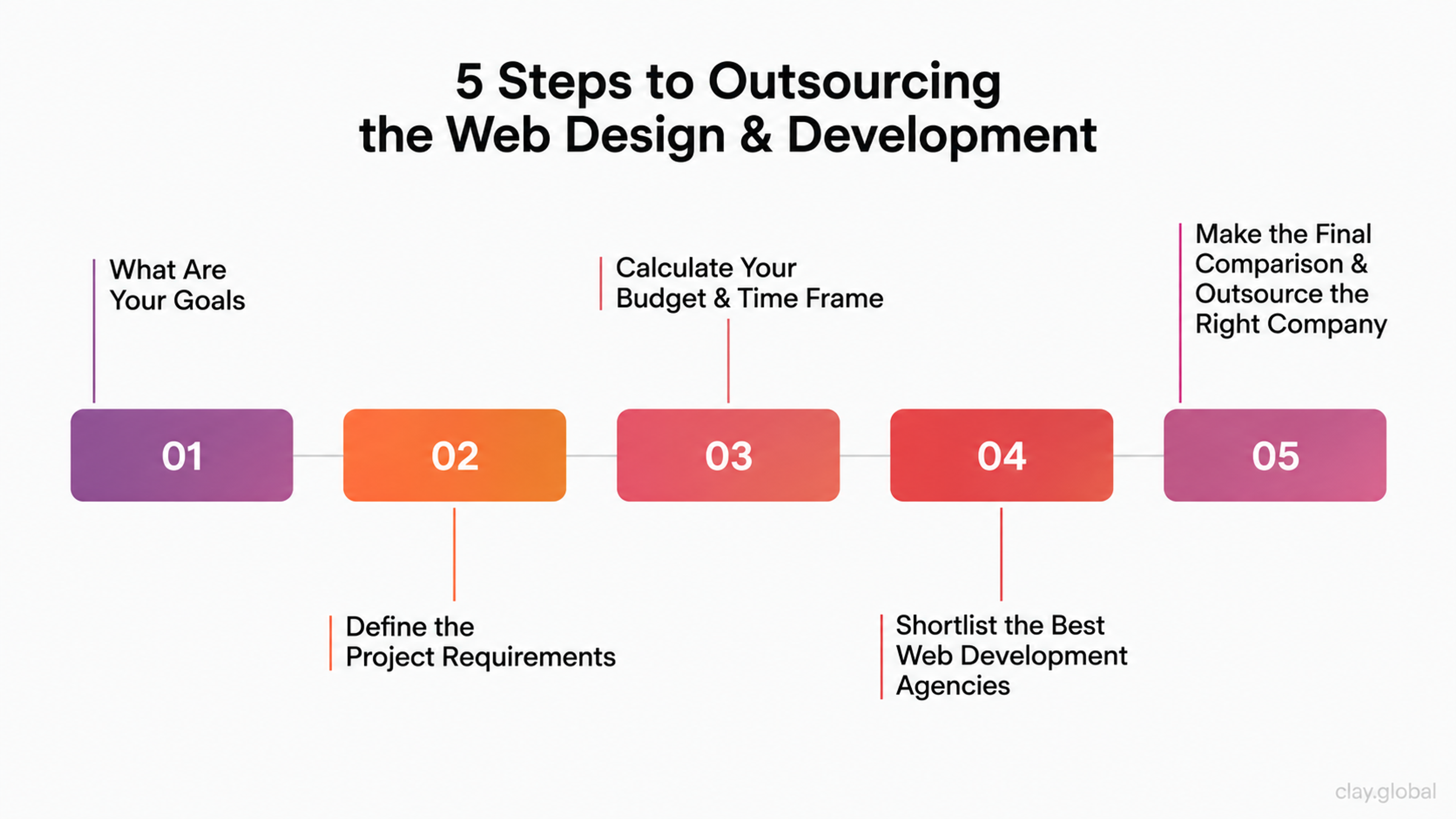
Cultural and process fit matter as much as the portfolio. A quick intro call with two or three candidates will tell you more than another week of scrolling case studies: how they communicate, how they handle a change of scope, and whether their working style matches how your team actually operates.
Ask about their project management tools too. Teams running structured workflows in Figma, Slack, and a shared project tracker tend to keep you informed without requiring you to chase them for updates.
Once you choose a partner, put milestones, tools, and responsibilities in writing before work begins, and share brand guidelines, existing content, and examples you like up front rather than mid-project.
Give specific feedback at each milestone instead of saving notes for the end. A team that gets clear, prompt feedback at every stage behaves like an extension of your own, not a vendor you're managing from a distance.
Choosing the Right Outsourcing Model
You don't have to commit to one model for every project. Most companies move between them depending on what's in front of them.
For a single landing page or a small, well-defined project, freelance platforms give you the most flexibility. You bring in a specialist only when you need one and can match their rate to your budget. The cost is your own time: more searching, more vetting, and hourly costs that climb if revisions pile up without a clear scope.
For a full redesign or a product launch, an agency gives you a complete team from day one, with strategy, UX, UI, development, and copy planned together instead of stitched from separate freelancers.
That coordination shortens the path from brief to launch and keeps quality consistent across every page, which is part of why agency engagements typically cost more than freelance ones. When your site directly drives revenue or lead generation, that premium is usually easy to justify.
Subscription design services sit between the two. You pay a flat monthly rate for ongoing design work across your site, ads, and content without tracking hourly costs. Most only cover design, so you'll still need someone to build what they hand you.
Why Companies Outsource Web Design
The generic version of this list applies to almost any outsourced function. What actually justifies outsourcing web design specifically comes down to four things, and they show up differently depending on the project.
Speed to Launch
A dedicated team working only on your site moves faster than a shared internal team squeezing it in between other work. Clay Global's multi-year partnership with Grayscale, a global leader in crypto asset management, included redesigning the main site and building a dedicated subdomain for new ETF products, work that required a full design system built to expand as the product line grew.
Grayscale Project by Clay
That kind of scope needs a team with no competing priorities that week, something few internal teams can offer while also shipping everything else on their roadmap.
Specialized Skills You Don't Have In-House
Some projects need expertise that doesn't exist on most internal teams, and fintech is a clear example. Lulo Bank, Colombia's first fully digital, carbon-neutral bank, needed a mobile banking experience that felt trustworthy and intuitive to people who had never used a fully digital bank before.
Lulo Bank Project by Clay
That's not a generic UI problem. It requires design experience specific to financial products, something most internal marketing or product teams haven't built before, and something a specialized outside team has already solved multiple times.
We've built comprehensive web experiences for Slack, Stripe, Grayscale, and Marqeta - companies that needed more than a pretty site. If yours does too, let's talk.
Real Cost Comparison
The "outsourcing saves money" argument usually skips the actual math. According to the Bureau of Labor Statistics, the median annual wage for a web and digital interface designer in the US was $104,000 as of May 2025.
Add benefits, payroll tax, equipment, and software licenses, and the fully loaded cost of that single hire lands closer to $130,000 to $145,000 a year, before they've shipped a single page. For a project that needs three to six months of focused work rather than a permanent headcount, that math rarely favors hiring.
This is also why the reasons companies outsource have shifted. Deloitte's 2024 Global Outsourcing Survey found that cost reduction, once cited by 70% of executives as the top driver of outsourcing in 2020, had dropped to 34% by 2024, overtaken by access to specialized talent at 42%. Cost still matters, but for most companies it's no longer the whole argument. Access to skills your team doesn't have, and can't build fast enough, usually is.
Genuinely Outside Perspective
Internal teams optimize for what already exists. They know the current site, the current constraints, and the current assumptions about what users want, which makes it hard to see what's actually holding the site back. An outside team walks in without any of that baggage.
When Cornerstone, a cloud-based HR software provider, needed to reorganize a sprawling catalog of employee development products into something a prospective buyer could navigate, an outside team rebuilt the information architecture across more than fifty pages, a scale of reorganization that's hard to see clearly from inside the product you already know too well.
Cornerstone Project by Clay
What Outsourcing Web Design Costs by Region
Regional rates vary more than most budgeting conversations account for, and the gap has narrowed in some regions and widened in others. Figures below reflect current agency and freelance rate data from Clutch, which compiles pricing from verified client reviews, alongside aggregated freelance-marketplace benchmarks.
United States and Western Europe. Clutch's 2026 data puts typical US web design agency rates at $100 to $149 per hour, with most reviewed projects landing under $10,000 and larger redesigns running well past that. Experienced freelancers in these markets typically charge $75 to $150 an hour. UK agencies sit in a similar range.
Eastern Europe. Freelancers typically run $25 to $50 an hour, with senior specialists and boutique agencies reaching $40 to $80.
Quality is generally strong, and the time zone overlap with both US and Western European teams is workable, which is why the region has become a default nearshore option for both.
Latin America. Nearshore outsourcing to Latin America has grown specifically because of time zone alignment with US teams, not just cost. Rates land close to Eastern European levels, but the overlap in working hours removes a lot of the back-and-forth delay that makes offshore projects slower than they need to be.
South Asia. This is the lowest-cost tier, with freelance rates commonly in the $15 to $45 an hour range. The savings are real, but so is the added coordination cost: limited daytime overlap with US hours means feedback cycles that would take a day elsewhere can stretch to two or three.
The cheapest option on paper isn't automatically the cheapest option in practice. A lower hourly rate paired with three extra rounds of revisions because of a communication gap can cost more, in both money and time, than a higher rate that gets it right in one pass.
Ownership, Contracts, and What Happens After Launch
This is the part most outsourcing guides skip, and it's the part that causes the most expensive problems later.
Before work starts, settle who owns the source files, design assets, and code once the project ends. Reputable agencies and freelancers transfer full ownership on final payment as standard practice, but that needs to be written into the contract, not assumed.
Ask specifically about design file formats, whether you'll receive raw Figma files rather than exported images, and whether any code uses licensed components or frameworks with their own terms.
Also settle what happens after launch. A design partner's job doesn't necessarily end at go-live, but plenty of contracts are written as if it does. Decide upfront whether your outsourced team handles a post-launch support window, whether maintenance moves to a separate retainer, or whether it comes back in-house.
Companies that skip this conversation often find themselves without anyone accountable for a broken page six weeks after launch, stuck between a vendor whose contract has technically ended and an internal team that never learned the site's structure.
If the project touches sensitive data, financial information, or proprietary business logic, put an NDA in place before sharing anything, and confirm how design and development files are stored and secured during the project.
Making Remote Collaboration Work
Once the contract is signed, the day-to-day work of the partnership determines whether any of this pays off.
Set objectives and deliverables in writing at the start of the engagement. A written scope isn't bureaucracy. It's the reference point both sides return to when priorities shift mid-project, which they usually do.
Give feedback that says what to change and why, not just what feels off. "This doesn't work" tells a designer nothing actionable. "The CTA doesn't stand out against the hero image, try a higher-contrast color" tells them exactly what to fix. Vague feedback is the single most common cause of wasted revision rounds.
Effective Communication Cycle
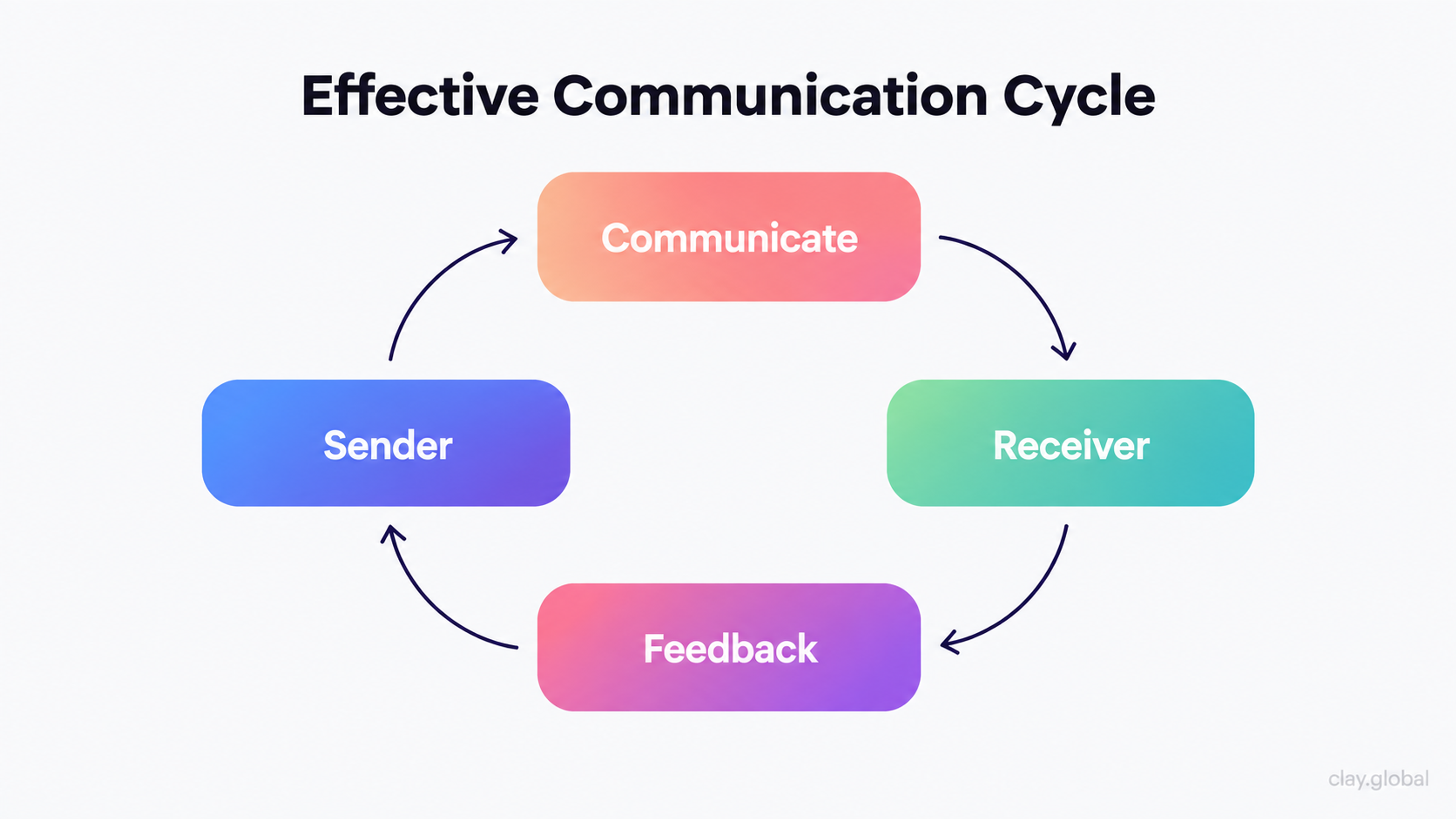
Build in async-first habits from the start, especially across time zones. Document decisions in a shared tool rather than only in a call that one team member missed, and treat that documentation as the source of truth over anyone's memory of what was said. This single habit prevents more delays than any tool upgrade.
Finally, treat the relationship as a partnership rather than a vendor transaction. Acknowledge good work specifically, raise problems early rather than letting them compound, and give your outside team enough context about your business to make good judgment calls without escalating every decision back to you.
Clay Global is a web design agency trusted by Slack, Yahoo, and Meta. Learn more about us here.
Read more
- Clay Global’s Digital Design Work
FAQ
How do I outsource web design without losing control of the project?
Keep ownership of strategy, brand voice, and final approval in-house, and outsource execution. Set milestone reviews rather than waiting until the end to see the work, and require sign-off at each stage before the team moves to the next one.
What's the difference between hiring a freelancer and hiring an agency for web design?
A freelancer gives you one person's time at a lower rate but limited bandwidth and skill range. An agency gives you a coordinated team covering strategy, UX, development, and copy, at a higher rate that reflects the coordination itself, not just the extra hours.
How much does it typically cost to outsource a website redesign?
Most reviewed US web design projects on Clutch land under $10,000, though full redesigns with custom development commonly run $10,000 to $50,000 or more depending on scope. Regional partners in Eastern Europe, Latin America, or South Asia can bring that down substantially, though coordination costs offset part of the savings.
Who owns the source files and code after the project ends?
This should be explicit in your contract, not assumed. Standard practice is full ownership transfer to the client on final payment, including raw design files and code, but confirm this in writing before work begins and check whether any licensed components carry separate terms.
What happens to my website after launch, who maintains it?
Decide this before the contract is signed. Some agencies include a post-launch support window, others move maintenance to a separate retainer, and some hand everything back to your internal team. Without this decided upfront, small post-launch bugs can sit unfixed while the vendor's contract has technically closed.
How long does an outsourced web design project usually take?
Simple sites typically take six to eight weeks. Projects with custom integrations, animation, or complex content structures can run twelve weeks or more. Clear requirements and fast feedback cycles are the biggest factors in hitting the shorter end of that range.
Can I outsource just part of my website, like development or UX research?
Yes, and it's common. Many companies keep strategy and content internal and outsource only UX and development, or bring in a specialist just for a specific piece like checkout flow or accessibility audits, rather than the entire project.
What should be in a web design contract before I outsource?
At minimum: scope of work, milestones and deadlines, payment schedule, file and code ownership on completion, revision limits, confidentiality terms if sensitive data is involved, and what happens if either party wants to end the engagement early.
Is it cheaper to outsource to South Asia than Latin America?
On hourly rate, usually yes. On total project cost, not always. Latin America's overlapping work hours with US teams tend to reduce revision cycles and delays, which can close much of the hourly rate gap by the time a project ships.
Do I need technical knowledge to manage a remote design team?
No, though a basic grasp helps you evaluate proposals and ask better questions. What matters more is having a clear internal point of contact who can make timely decisions and represent the business without escalating every choice.
What tools do outsourced design teams typically use?
Figma is the standard for real-time design collaboration. Development teams commonly use GitHub for version control, and project coordination runs through tools like Slack, Asana, or Notion. Ask any potential partner about their toolkit before signing, since a mismatch here creates friction fast.
How do I know if a design agency is legitimate before signing a contract?
Check their portfolio against real, verifiable case studies rather than isolated screenshots, and contact at least one past client directly. Look for consistent presence on platforms like Behance, Dribbble, or Clutch with reviews attached, and be cautious of any partner unwilling to share references.
What's the biggest reason outsourced web design projects fail?
Poor communication, not poor design skill. Projects fail when feedback is vague, decisions aren't documented, or nobody on the client side has time to stay engaged, not because the outside team lacked the ability to do the work.
Should a growing company eventually bring web design in-house?
It depends on frequency of need, not company size alone. A company making constant, small site changes benefits from an in-house hire over time. A company that redesigns every few years is usually better served outsourcing each time, since a full-time hire would sit idle between projects.
Conclusion
Outsourcing web design works when it solves a specific problem: a missing skill, a deadline your internal team can't hit, or a project too large to absorb alongside everything else already on their plate. It works less well as a default answer to every design need, especially for sites that change daily rather than every few years.


About Clay
Clay is a UI/UX design & branding agency in San Francisco. We team up with startups and leading brands to create transformative digital experience. Clients: Facebook, Slack, Google, Amazon, Credit Karma, Zenefits, etc.
Learn moreAbout Clay
Clay is a UI/UX design & branding agency in San Francisco. We team up with startups and leading brands to create transformative digital experience. Clients: Facebook, Slack, Google, Amazon, Credit Karma, Zenefits, etc.
Learn more