
Open any ten websites in a row, and you'll notice something unsettling. Their writing styles sound the same. Strip off the logos, and you couldn't tell which brand stands for what, which is one of the key aspects of a brand language problem, not a marketing one.
Brand language refers to the distinct way your company speaks through the right words, sentence rhythms, recurring phrases, and point of view that make your writing feel unmistakably yours. It runs through everything from social media posts to error messages. If people can’t recognize your voice, they can’t remember your brand.
Key Takeaways
- Brand language refers to the written and verbal expression of your brand identity, including its distinctive tone of voice, consistent tone, vocabulary, grammar, and messaging frameworks that operate as one system across all marketing communications channels, such as social media, email, websites, ads, and customer support.
- Brand language isn't the same as brand voice. Voice is the personality, language is how that brand personality actually sounds in sentences, captions, error messages, and support replies.
- Consistent branding language drives revenue growth of up to 33%.
- Creating a brand language is strategic work before it's a writing one. Understanding the target audience, brand values, and a clear point of view come before voice adjectives and tone rules.
- Strong brand language guidelines turn that strategy into something teams can actually use in specific situations.
- AI tools can scale consistency across channels, but they need sharp inputs.
What Is a Brand Language?
Brand Language
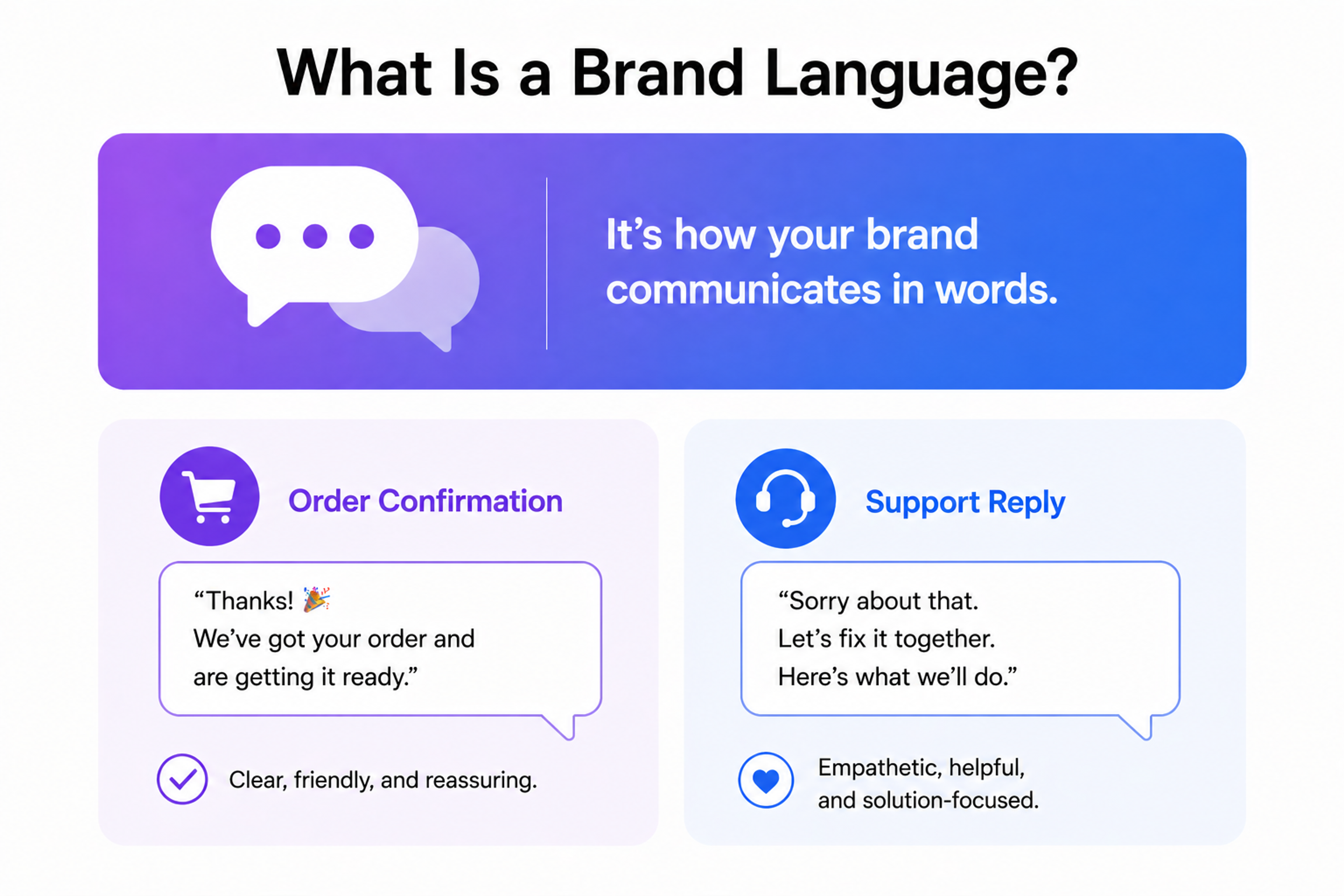
Brand language is how your brand narrative sounds in words across everything you write, from website copy to emails to support replies and marketing materials.
People often confuse it with brand voice, but brand language impacts how your team writes first and helps them communicate effectively. It gives your entire team a clear system for writing, while voice is more like a personality expressed through that writing.
If it’s warm, direct, and a little cheeky, brand language shows what that actually looks like in practice, which specific words fit, which jokes land, and how the brand tone shifts by context. A checkout confirmation and a complaint reply can share the same voice effectively while using different tones.
How Branding Language Drives Results
The reason brand language matters isn't aesthetic, but economic.
Recognition compounds. When customers encounter the same wording across channels, you start to feel familiar with it. That familiarity builds trust, and 88% of consumers say trust is critical to their purchase decisions.
Consistency also drives measurable results. Companies with a consistent brand identity see revenue growth of 23% to 33% across channels, showing how aligned communication builds trust over time. But this only works when the voice is clearly defined, documented, and maintained.
Strong brand language also reduces decision fatigue inside the company. It helps teams write faster, align more easily, and make fewer subjective calls.
New team members ramp up more quickly, and people across the entire team can publish under the same brand with more consistent messaging.
The Core Ingredients of Brand Language
Every brand language relies on the same core building blocks. Miss one, and inconsistency starts to creep in.
Strong Brand Voice
The brand personality is usually defined in three to five adjectives. The most useful versions add contrast, like “confident, but not arrogant” or “playful, but not goofy,” so the traits become practical rather than just descriptive.
Tone of Voice
Tone of voice refers to the attitude or emotion conveyed through words, which can vary from friendly and approachable to authoritative and expert, depending on the brand's personality.
It’s adjusted for the situation. The same brand narrative holds, but the emotional register shifts. A fintech app might stay steady and reassuring on a password reset page, loosen up on social media, and turn sober in a security incident email.
Guidelines should name the situations you will actually face and show how the tone of voice shifts across marketing materials and more.
Word Choice and Vocabulary
Words Shape How a Brand Feels
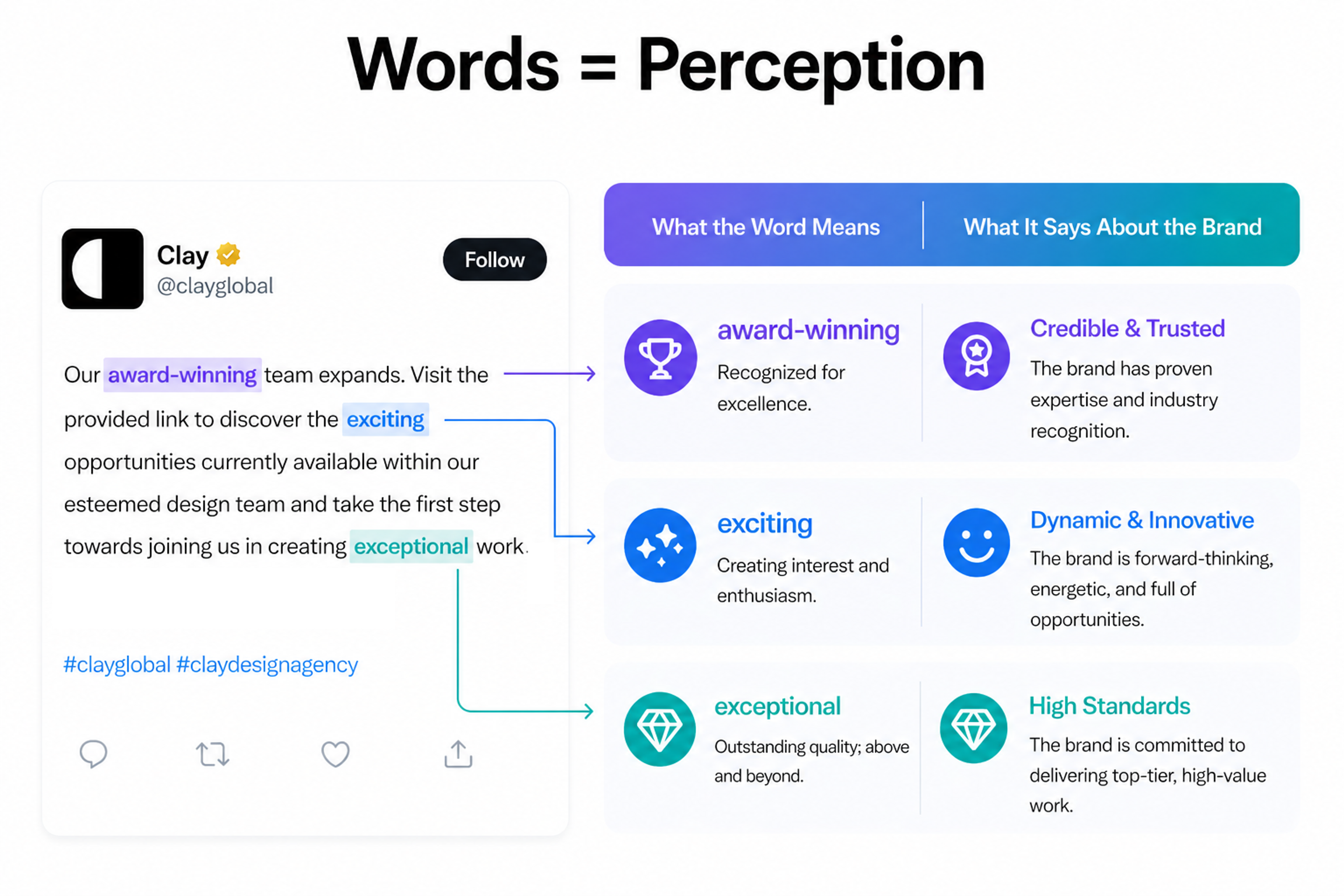
Specific words shape how a brand feels. Brand language defines preferred terms, banned ones, and signature phrases. Great brand languages maintain a living lexicon, like the right words, banned words, and a short list of in-house phrases that only you get to use.
Grammar, Syntax, and Rhythm
Brand identity often starts to break down at this point. Sentence length, contractions, fragments, punctuation, and pacing all shape how your writing sounds, even when the vocabulary stays the same.
Messaging Frameworks
A brand messaging framework is the structural layer that holds your core value proposition, elevator pitch, product descriptions at different lengths, taglines, and the standard way you tell the stories, such as your origin, mission, and customer success.
It means you are not rewriting your “About Us” page from scratch for the hundredth time, and it helps larger teams stay aligned when they are producing content at scale. Think of it as the bridge between brand identity strategy and day-to-day copy.
Note that visual brand language components are not covered here. Visual elements and visual style belong to a different part of brand identity. They are closely connected to verbal brand language, but they are not the same thing.
How to Build a Brand Language
If you are a founder, marketer, or designer starting from scratch, the temptation is to jump straight to overall brand voice adjectives and tone refers to adjustments, but don’t.
Brand language refers to all the elements of a strategic exercise before it becomes a writing style. The fundamentals come long before the first word of copy.
1. Study Your Target Audience
Who are you actually talking to? What do they already read, trust, and share? What kind of language makes them feel seen rather than sold to?
The sharpest brand identity is shaped by genuine audience insight, not internal whiteboard sessions. You want to sound like you belong in your customer's world, not like you're performing at them from outside it.
Brand perception is never fully in your control, it lives in the gap between what you say and what your audience actually walks away believing.
2. Clarify Your Values
Brand Identity Values
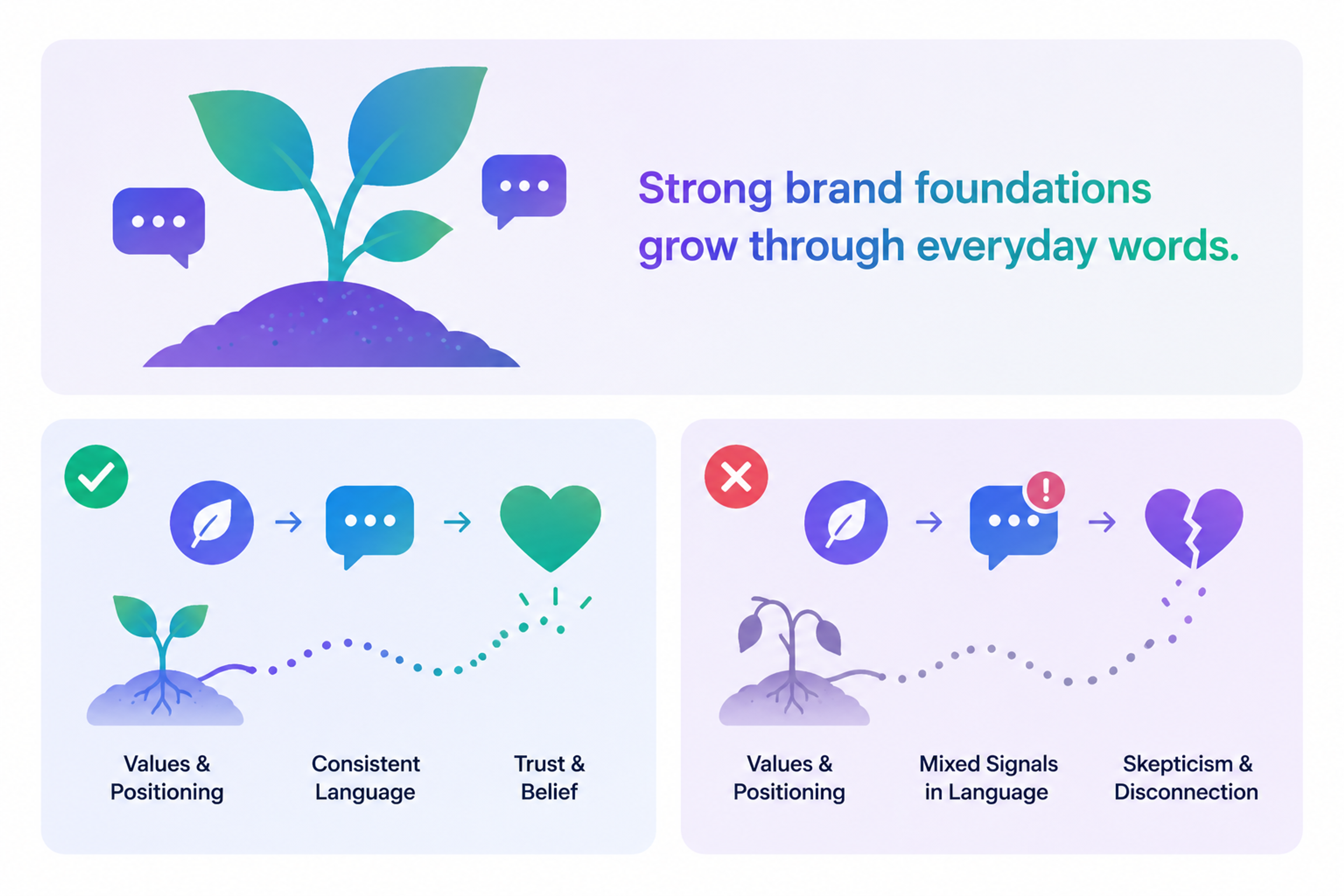
Brand identity values and positioning are the soil in which your language grows. A company that claims to care about sustainability should prove it in the words it uses every day, not just in a values statement tucked away on its website.
Mismatch between stated values and actual language is the single biggest reason branding efforts feel hollow.
3. Find Your Perspective
What does your brand believe that competitors don't? What conversation does it want to start, and which side of it does it sit on?
A brand narrative without a perspective tends to produce polite, forgettable writing. One with a perspective produces writing people argue about, which is almost always better than writing nobody remembers.
4. Shape the Voice
Only once you have audience, values, and perspective nailed should you start drafting unique voice adjectives and documenting clear guidelines. Skip that strategic foundation, and you will end up with a brand identity that technically works but does not feel like it belongs to anyone in particular.
For teams that don’t have the time or distance to work through this internally, bringing in an outside branding agency can help. Here are a few agencies that can help with this:
Whether you build it internally or bring in specialists, the order matters. Target audience first, values second, perspective third. Voice and guidelines come after, not before.
How to Build Brand Language Guidelines
Own distinctive voice, tone, vocabulary, grammar, and brand messaging frameworks all need to live somewhere the entire team can access. That place is your guidelines, a shared reference that defines how your brand should sound, which specific words belong in your lexicon, and how tone shifts across situations so teams can communicate effectively.
Steps to Create Brand Language Guidelines
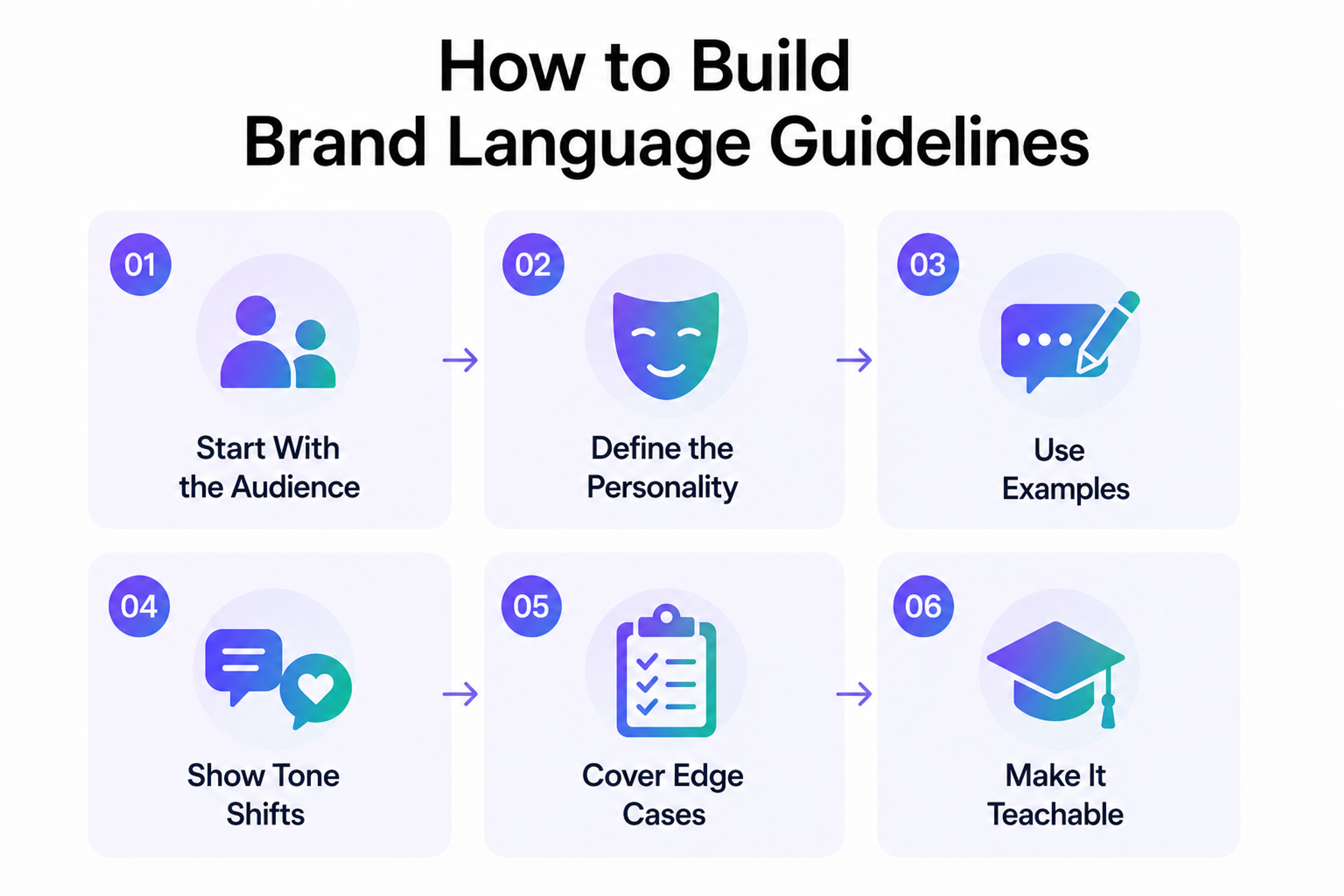
Think of it as the operating manual for your brand’s voice, the place writers, designers, and AI tools check before they publish.
Good guidelines are a working system, not a vanity document. Here’s the sequence that usually leads to guidelines people actually use.
Start With the Audience
Start with your target audience. Who are you talking to, and how do they already speak? If it ignores them, all the elements of brand language impacts will feel forced. A fintech product for freelancers should not sound like one for Fortune 500 CFOs, even if the software is similar.
Define the Personality
Distill your brand personality into 3 to 5 adjectives, each with an anti-pair. Then test them. If everyone in your category could claim the same traits, like “trustworthy,” “innovative,” or “customer loyalty-focused,” start over. Your overall brand voice should be something competitors cannot easily copy.
Use Examples
Write the practical parts around real examples, not abstract rules. Telling people to use contractions is easy to forget. Showing them that we write don’t instead of do not, unless we’re stressing a refusal, is something they can actually apply. A clear do and don’t table with real sentences will usually help more than pages of principles.
Show Tone Shifts
Document how brand tone applies to real situations. Include examples for launches, errors, apologies, support replies, long-form content, and social media posts. If you sell B2B, add sales emails and pitch deck patterns. The goal is to prepare people for the moments when they actually have to write under your brand name.
Cover Edge Cases
Include vocabulary lists, grammar choices, punctuation rules, how to talk about competitors, how to handle sensitive topics, and regional differences if you work across markets. A one-page summary helps most people, but the longer version is what saves you in edge cases.
Make It Teachable
Make the guidelines easy to learn and apply. Run a workshop when you launch them, not just a link drop. Tie them to reviews for people who write. Add a quick reference inside your content tools. 95% of companies have brand guidelines, but only about a quarter actively enforce them. The gap is mostly about operationalizing them.
Brand Language Examples
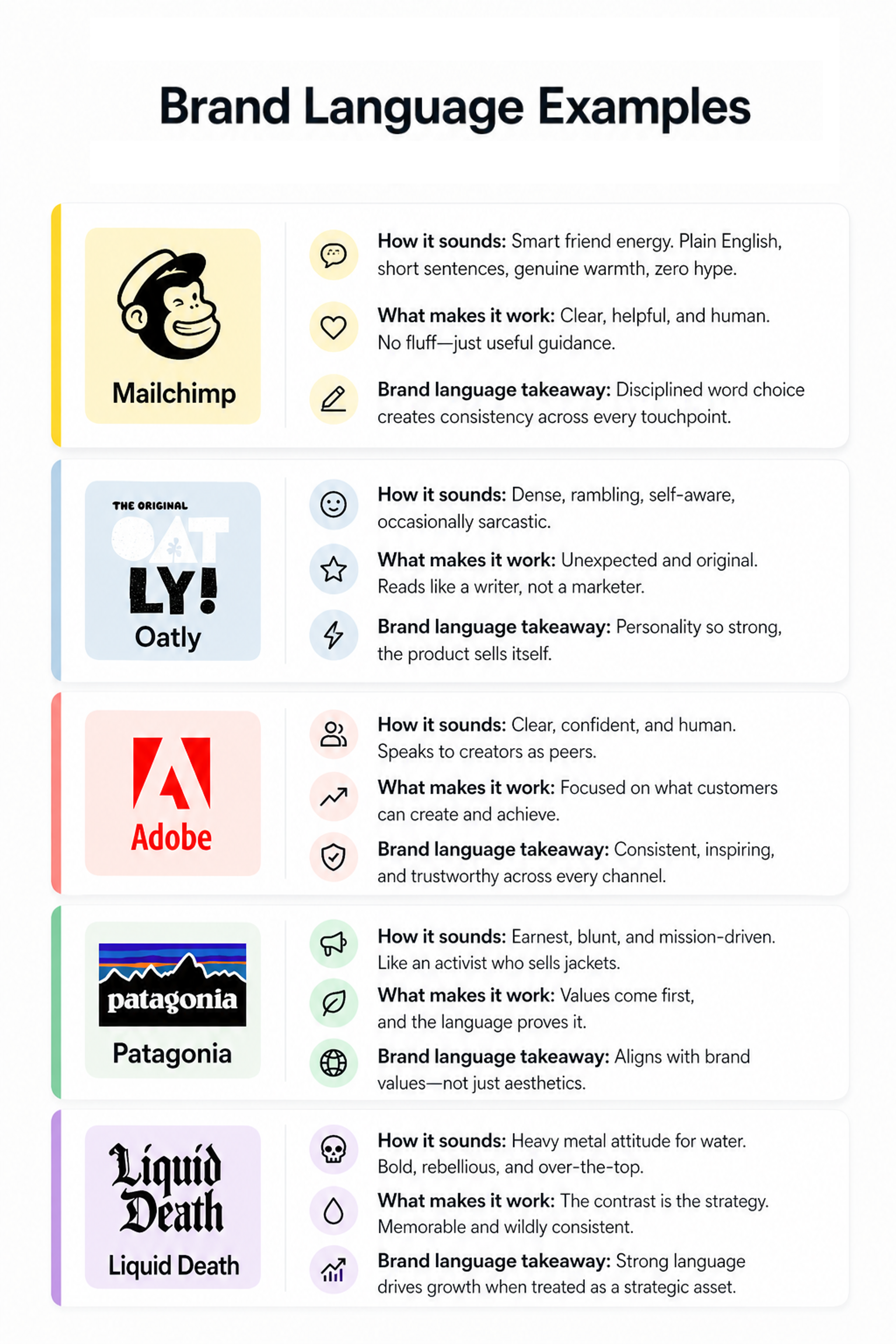
The quickest way to understand branding language is to watch it in action. These brand language examples work because each is so specific that you could identify it even without famous logos.
Examples of Brand Language
Mailchimp
Mailchimp, the email marketing platform, writes like a smart friend who happens to know email marketing, using plain English, short sentences, genuine warmth, and zero hype. Their voice-and-tone guide is publicly available and reads like a masterclass.
It bans phrases like "just" because they diminish the action, and "easy" because they assume too much about the reader's experience. That level of word-choice discipline is what creates consistent brand messaging across every Mailchimp touchpoint, from a billing email to a help doc.
Oatly
Oatly, the oat milk brand, sits at the opposite end of the spectrum. Dense, rambling, self-aware, occasionally sarcastic packaging copy that reads like someone pulled a writer off a novel and put them in charge of a carton. "It's like milk but made for humans."
That doesn't sound like marketing, which is exactly why it works. Their language gives them so much brand personality that the product nearly sells itself on the grocery shelf.
Adobe
Adobe’s brand language is clear, confident, and human. It speaks to creative professionals as peers, avoiding both over-explaining and empty hype.
Its voice is forward-thinking but grounded in real customer value. Technology is presented through what it helps people create, express, or achieve. Across channels, Adobe keeps one consistent personality. It is simple, intelligent, inspiring, and trustworthy.
Patagonia
Patagonia, the outdoor apparel company, writes like an activist who also sells jackets. Earnest, blunt, frequently political. When they tell you to repair your gear instead of buying new, they mean it, and their brand language makes that mission credible in a way a slogan never could. Make sure your language aligns with your brand values, not just its aesthetics.
Liquid Death
Liquid Death, the canned water firm, uses the language of heavy metal to sell water. "Murder your thirst." "Death to plastic." The disconnect between product and brand tone is the whole point, and they stay consistent with that world so well that it's become a multi-hundred-million-dollar company. It shows how brand language drives growth when treated as a strategic asset rather than a tactical decoration.
Using AI to Build and Scale Your Brand Language
AI is changing how brand language gets created, scaled, and maintained. Since language is text, and text is what LLMs handle best, a clear brand language can now guide all types of content across languages.
An AI brand language tool is software that ingests clear guidelines, learns your unique voice, and either generates on-brand content directly or flags when human-written drafts drift out of character.
Jasper, Grammarly Business, and Copy.ai all fall into this category, each with its own strengths. Most enterprise platforms now offer brand voice training on sample content, so outputs match not just your core values but your rhythm.
Used well, AI brand tools solve the scale problem that killed brand consistency in the first place. A company producing a hundred pieces of content a week can keep its voice effectively aligned without doubling the content team.
How AI Brand Language Tools Work
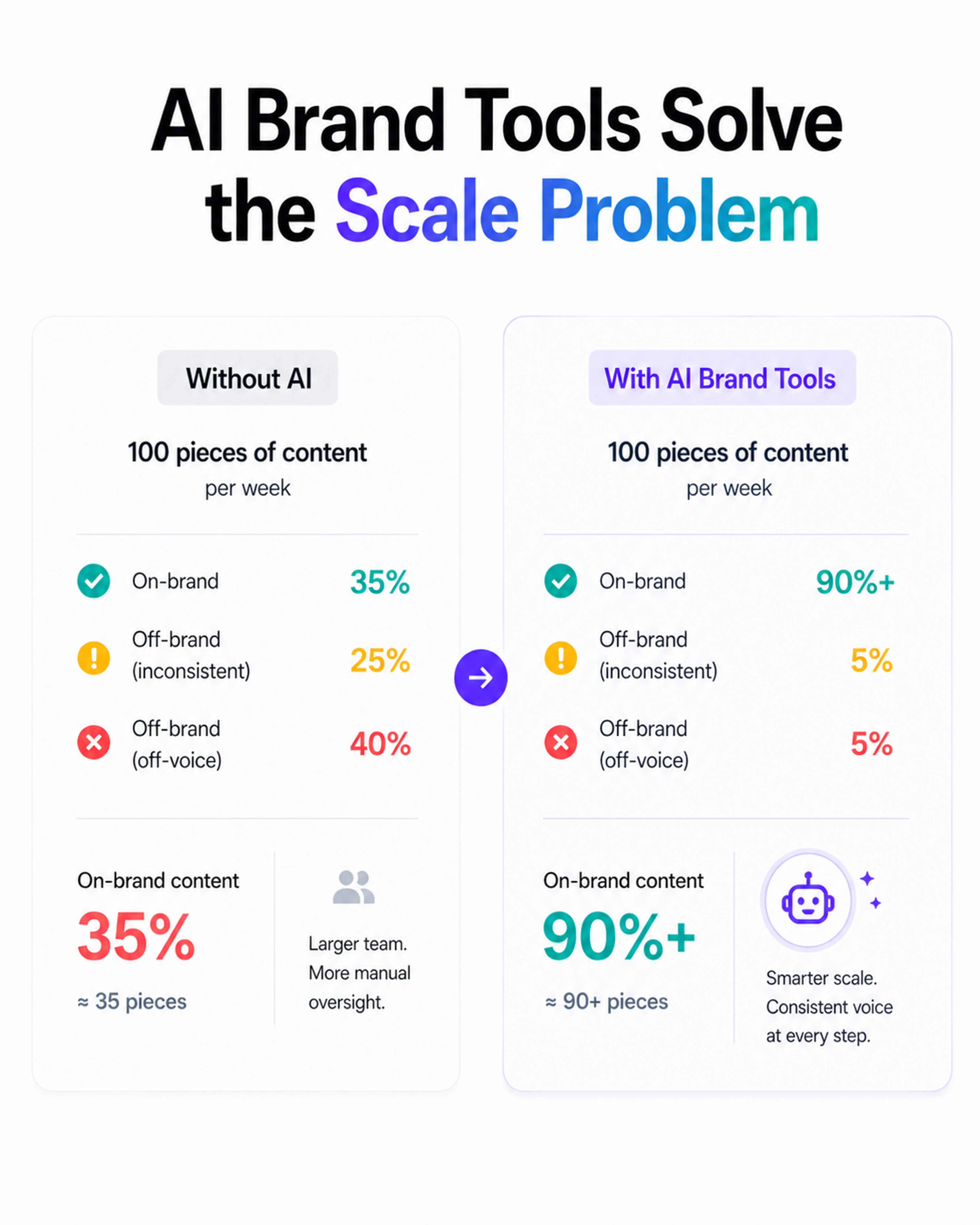
The Oxford College of Marketing recommends distilling your voice into 3-5 adjectives with written examples before you even open a prompt, because AI models can't reverse-engineer nuance from a single word.
Used poorly, these tools launder your brand identity into whatever the model thinks a brand should sound like. A few warnings based on what actually goes wrong:
- Don't skip the strategy. If you feed an AI brand language tool vague guidelines, it will produce vague content. The documentation has to be sharp first.
- Train on real-world examples, not aspirational ones. 5 pages of your best-performing copy teach the model more than any amount of adjective lists.
- Human review isn't optional at the top of the funnel. AI handles scale, and humans protect brand identity. For high-stakes content like launches, press statements, and founder posts, keep the final word with a writer who owns the voice.
- Expect drift. Retrain quarterly. Your brand language evolves as your target audience does, and a static AI voice model becomes stale faster than you think.
The brands winning with AI use it to keep every draft on-voice, no matter who writes it or where it appears.
Ready to take your brand to the next level? We’ve done it for Google, Snapchat, and Slack, and you can be the next. Let’s talk.
Read More
- Brand identity for a risk management platform by Clay Global
FAQ
What's the difference between brand language and brand voice?
Brand voice is the personality. It is the adjectives you would use to describe how your brand sounds, such as warm, direct, or witty. Brand language is the full system built on top of that personality. It includes the actual words, sentence patterns, grammar choices, and tone shifts that translate voice into writing across every channel.
Do small businesses actually need brand language guidelines?
Yes, and arguably more than large ones. A small team that writes without guidelines accidentally creates five distinct brand voices. One page of do/don't examples prevents that.
Can an AI brand language tool replace my copywriter?
No, but it will change what they do. AI handles scale, first drafts, variations, and consistency checks. Humans still own the strategic decisions about what the brand sounds like, which words matter, and when to break the rules. Think of it as a conductor rather than an orchestra.
How do you train an AI brand language tool on your voice?
Feed it 10-20 pages of your best existing content, clear voice adjectives with examples, a vocabulary of preferred and banned words, and do/don't sentence pairs. The quality of what you put in determines the quality of what you get out. Retrain every quarter or when your positioning shifts.
What are the most common mistakes in brand language?
First, the adjectives are too generic to be useful. Words like trustworthy, innovative, and customer-focused describe almost every company. Second, there are no examples so nobody can apply the guidelines in practice. Third, there is no enforcement, so the guidelines sit unused in a drawer. All of this comes from treating guidelines as a document rather than a tool.
Should we define our brand language before or after our visual identity?
In parallel, ideally. Treating them as separate workstreams almost guarantees a mismatch between brand language and visual identity. You might end up with a playful logo paired with corporate copy, or a minimalist look paired with overly chatty and friendly writing. If you have to choose an order, start with a strategy. Audience, values, and positioning should inform both the visual and verbal systems. They can then develop alongside each other and continue to inform one another.
Should brand language be the same across every channel?
Voice should stay consistent, tone should shift. A LinkedIn post, a Twitter reply, and a privacy policy should all sound like the same company, but the register adjusts. Guidelines should name these shifts explicitly. Otherwise, every writer improvises, and the brand starts to fracture.
How often should you update your brand language guidelines?
A light refresh annually, a structural review every 2 to 3 years, or whenever your positioning changes. If your target audience shifts or your product expands meaningfully, don't wait on a schedule, because rules that fit last year's brand start working against a new one fast.
Can 2 brands in the same industry sound different enough to matter?
Yes, and they must. Liquid Death and Evian both sell water, but nothing else about them sounds alike. When two brands in the same category start to sound the same, one of them is usually working harder than the other, and it is almost never the market leader.
How do you get buy-in for brand language guidelines across a company?
Tie it to outcomes, not aesthetics. Show the revenue impact of consistency, the cost of inconsistent messaging, and the time writers waste without shared rules. Bring the CEO, sales, and support into the process, not just marketing. Guidelines imposed by one team get ignored by every other team.
Is hiring a branding agency to develop a brand language really worth the investment?
That depends on the stage and the stakes. A well-defined brand language shapes years of marketing, product copy, and hiring pages, and the cost of getting it wrong internally almost always exceeds what an agency would charge. But agencies are not right for every situation. If your voice is already working and you need it documented, a freelance strategist or an internal workshop often gets you most of the way there. The honest test is how expensive it is to get this decision wrong.
How long does a brand language project actually take?
Six to twelve weeks is standard. Faster usually means cutting corners during research. Slower tends to mean scope creep or client-side indecision. Teams that already have clear positioning can move toward the shorter end. Teams starting from zero should expect the longer end, plus handoff time for training and enforcement once the work is delivered.
We already have an in-house marketing team. Why bring in an outside agency?
In-house teams are close to the brand, which is both their strength and their blind spot. They catch nuances outsiders miss, but they can't see the assumptions they've internalized over years of working inside the company. Agencies bring pattern recognition from dozens of brands, something nearly impossible to build without that exposure. The best outcomes usually combine both, with outside strategy and in-house execution and ownership.
Final Thoughts
Brand language is high-leverage infrastructure, not a finishing touch. The companies that get it right treat it as something built on strategy, clearly documented, and consistently applied over time. Get it right, and people recognize you from the first line. Skip it, and you end up sounding like everyone else.


About Clay
Clay is a UI/UX design & branding agency in San Francisco. We team up with startups and leading brands to create transformative digital experience. Clients: Facebook, Slack, Google, Amazon, Credit Karma, Zenefits, etc.
Learn moreAbout Clay
Clay is a UI/UX design & branding agency in San Francisco. We team up with startups and leading brands to create transformative digital experience. Clients: Facebook, Slack, Google, Amazon, Credit Karma, Zenefits, etc.
Learn more