
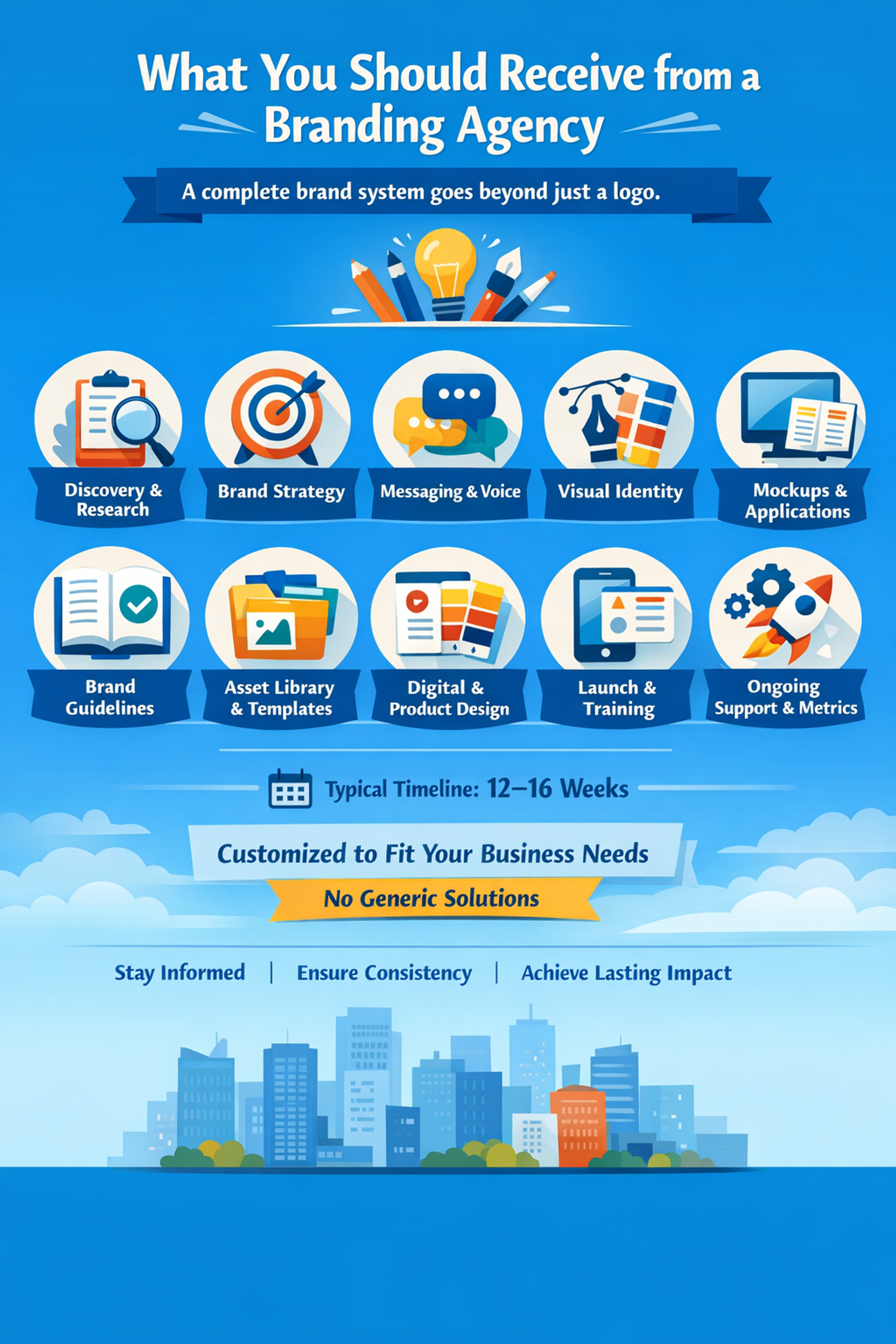
A professional agency delivers a complete system that works. This system encompasses strategic decisions, clear guidelines, and ready-to-use assets that ensure your brand remains consistent and cohesive.
Understanding what you should receive helps you evaluate proposals and compare agencies. Knowing the common branding deliverables and having a complete list of what to expect from agencies ensures you are fully informed and prepared for your branding journey.
It also helps you avoid beautiful presentations that fall apart when your team produces real materials. A comprehensive branding engagement typically takes 12 to 16 weeks, although timelines vary based on scope and complexity. Branding packages and branding services should be tailored to the specific needs of your business, rather than relying on generic solutions.
What Should You Receive from a Branding Agency
Discovery and Research
Strong branding starts with understanding. The process often begins with a discovery session to align on goals and gather insights. A discovery summary should be provided. It captures insights from stakeholder interviews, workshops, and reviews of existing materials. Strategy requires an understanding of the audience before design begins.
The document highlights business goals and customer pain points, surfaces internal misalignment, and notes practical constraints such as product limitations, legal requirements, and channel realities.
Most projects benefit from a competitive and category audit, often referred to as a brand audit. The best brand audits don't just show competitors. They explain category conventions, identify overused approaches, and reveal differentiation opportunities that won't confuse your audience.
A comprehensive brand audit also assesses your market share and position within the industry, providing a clear picture of your brand equity and overall market presence.
Brand Strategy Outputs
Strategy is the backbone of everything that follows. Without a clear strategy, teams end up debating every execution detail instead of moving forward. When the strategy is vague, everything downstream fails to work well.
A branding project typically involves both strategic and creative phases, including branding design and development. The strategic phase focuses on defining the foundational elements that will guide all creative work.
Brand Strategy by Clay
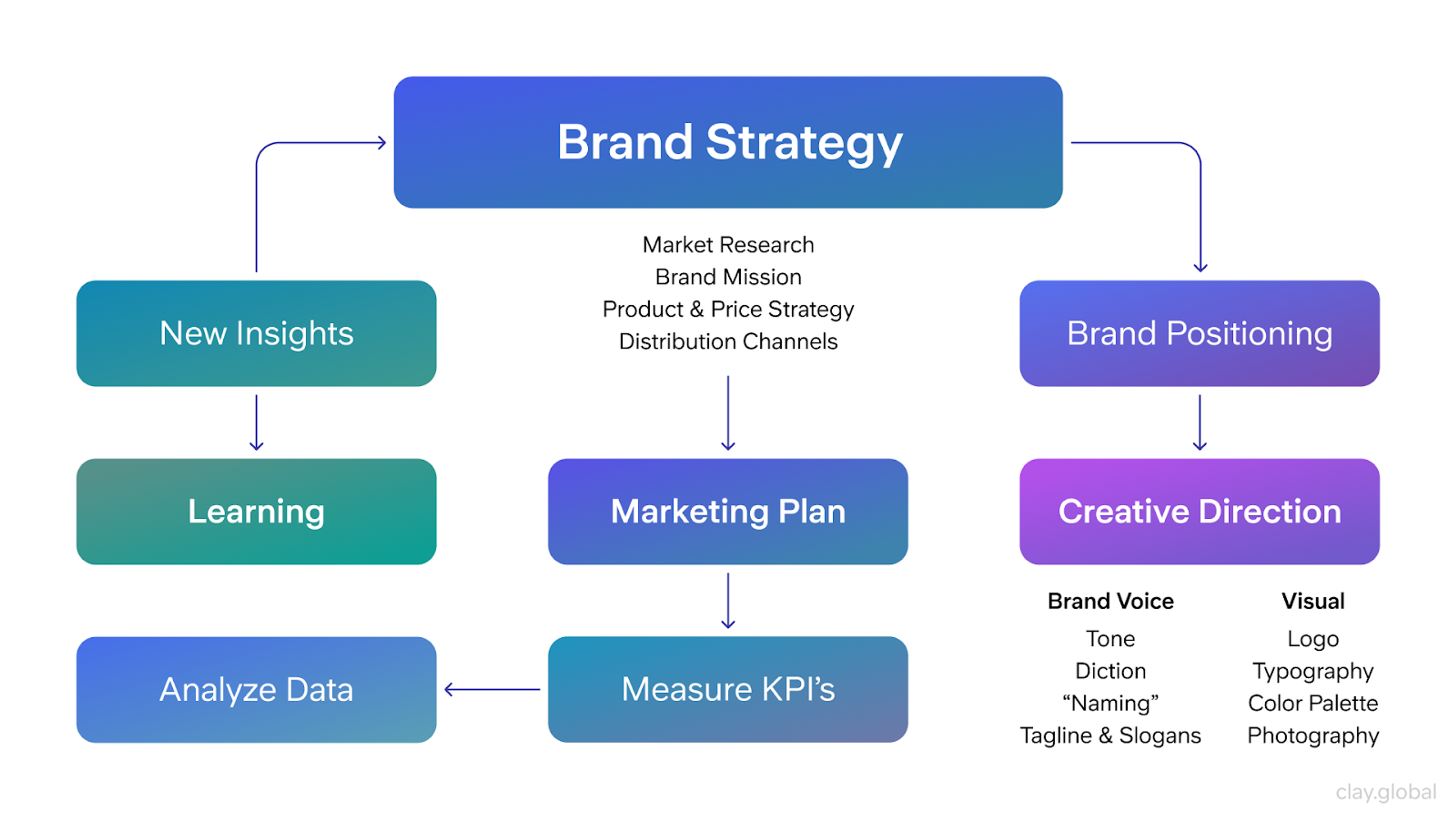
You should expect a positioning statement that defines:
- Who is your audience?
- What do you offer?
- What makes you meaningfully different?
Brand positioning is a key deliverable that articulates your overall strategic identity, including your values, personality, and how you differentiate in the market.
This is an internal tool, not a tagline. It answers who you are in the market and why customers should care about you. A strong positioning statement gives teams a filter for evaluating ideas and opportunities.
A value proposition framework separates features from outcomes and sets a hierarchy of benefits. It usually includes:
- the core promise you make
- The proof that supports this promise
- clear reasons for customers to believe you
A messaging framework is also essential to ensure consistency in how your value proposition and other brand messages are communicated across all deliverables and channels. Your value proposition connects what you do to what customers actually want and feel.
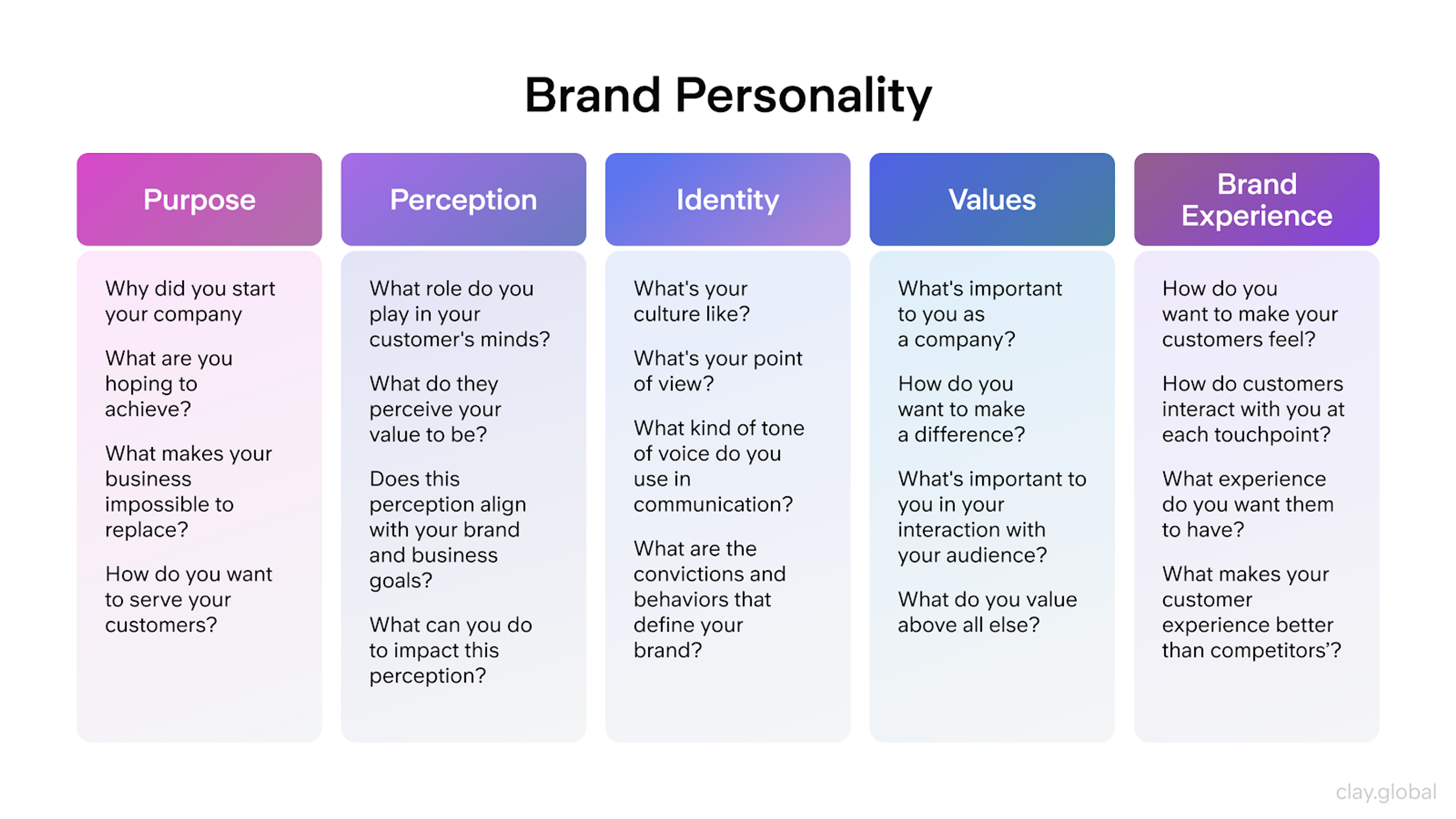
Many agencies also deliver brand fundamentals, such as mission statements, vision statements, and purpose statements, along with brand attributes or personality traits. Mission statement and brand values are core brand pillars that help establish a strong brand foundation.
These brand pillars ensure consistency and alignment across all brand messaging and deliverables, ensuring a unified and cohesive brand presence. They should be specific enough to influence real choices, rather than vague phrases that apply to any company. The best attributes guide tone of voice, visual direction, and even which partnerships make sense.
If you manage multiple products, service tiers, or distinct audiences, brand architecture becomes essential. This framework clarifies how your master brand relates to sub-brands, product lines, features, or acquired companies.
Good architecture prevents naming and design fragmentation as you grow. It sets rules that keep everything connected while still allowing the right level of differentiation. These frameworks help achieve clarity and alignment throughout your organization.
Messaging and Verbal Identity
Visual identity gets attention, but words handle daily brand work. Messaging and verbal identity are essential brand identity deliverables that help create one brand voice, ensuring consistent messaging and recognition across all touchpoints.
Strong engagement involves a messaging architecture centered around a core message. It contains several supporting pillars, proof points, and key narratives. These elements adapt for marketing campaigns, sales conversations, product descriptions, and hiring communications.
A tone of voice guide translates brand personality into practical writing rules and plays a crucial role in supporting a cohesive brand identity across all communications. Look for guidance on sentence structure, vocabulary choices, and formality level. It should clarify what your brand actively avoids saying.
Brand Personality by Clay
Tools like Frontify or Brandpad make these guidelines accessible to distributed teams. The most useful tone guides include concrete examples. These show sample headlines, before-and-after rewrites, and patterns for calls-to-action or error messages. These examples demonstrate how principles apply in real-life situations.
If naming sits within scope, expect a documented process. This includes research, development of the shortlist with a clear rationale, and coordination with trademark attorneys. Legal coordination covers clearance and domain availability.
Even when final naming decisions rest with you, agencies should provide recommendations. They should also deliver usage rules and a scalability plan for future products or market expansion.
Visual Identity System
Your visual identity should arrive as a system you can actually use, not just a pretty logo on a slide.
At minimum, expect a complete set of logo variations designed for real-world use:
- Primary logo
- Secondary logo (for alternative layouts or contexts)
- Simplified versions for small placements or complex backgrounds
- A white (or light) version for use on colored backgrounds
Usage rules should clearly explain:
- Required clear space around the logo
- Minimum sizes for print and digital
- Acceptable and unacceptable backgrounds
- Common misuses to avoid, with visual examples
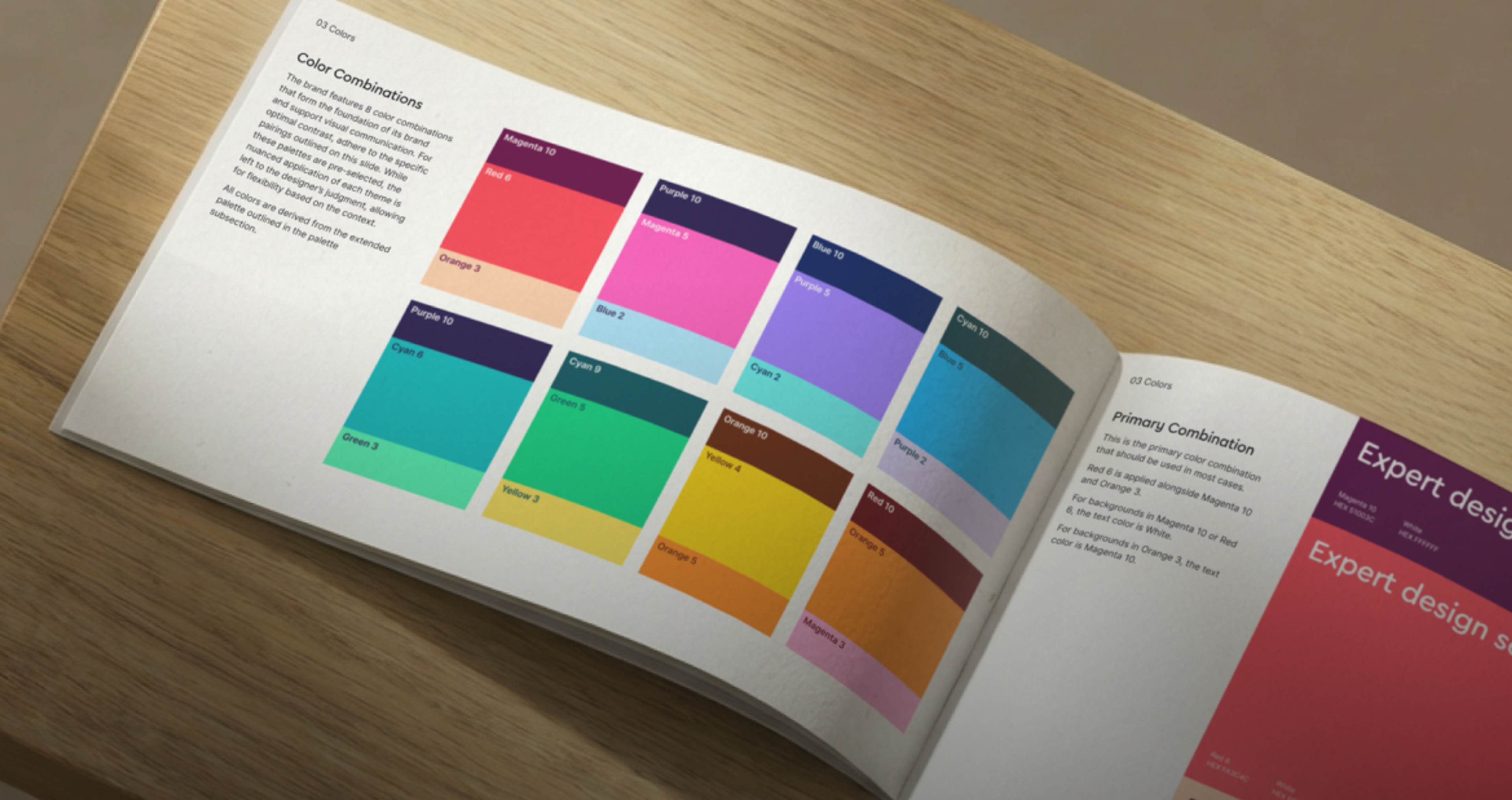
Color and typography need to come as practical toolkits, not vague vibes. A mood board with curated images can define overall style and positioning, but it should be backed by:
- Primary and secondary color palettes
- Accessibility guidance (contrast, combinations to avoid)
- Typography choices with defined scales and hierarchy rules
These typography rules should cover headings, body text, and interface elements. If you run a digital product, request design tokens and system architecture so that everything translates smoothly into tools like Figma. This keeps your marketing and product experiences visually aligned, rather than drifting into separate identities.
Supporting visual elements create recognition even when the logo is off-screen. They might include:
- Iconography direction
- Illustration or photography styles
- Geometric patterns or shapes, including a core brand pattern derived from your logo or key symbols
Visual Design Elements by Clay
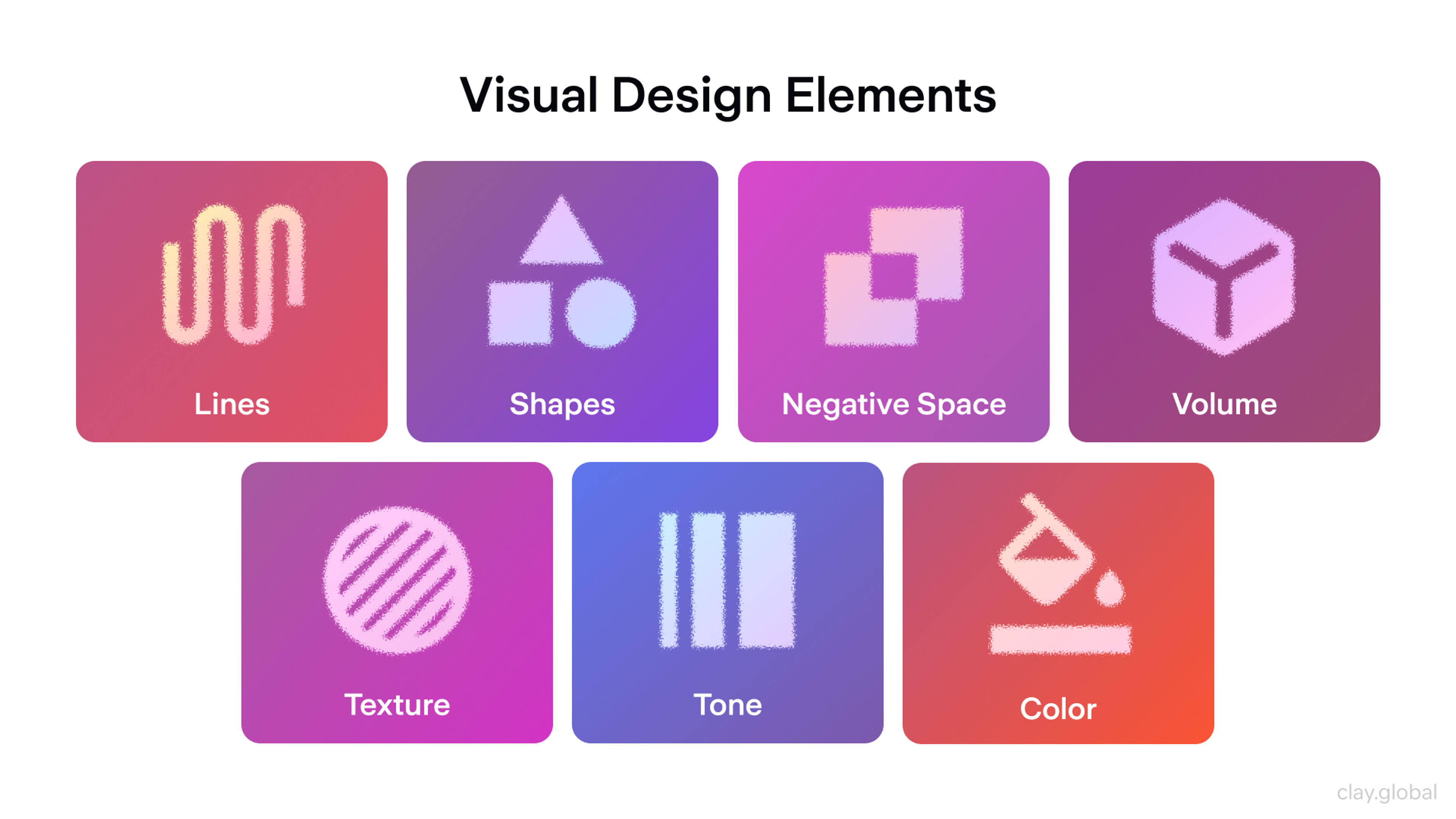
These elements can be used across digital platforms for consistent branding and can also inform motion principles for video, micro-animations, and product transitions. The goal is recognizability across all touchpoints, whether or not the logo is visible.
When the visual identity system is handed over, you should receive a comprehensive collection of design assets, including all logo versions, color palettes, typography assets, patterns, and supporting imagery, packaged in a way that allows your team to start using them immediately.
Applied Concepts and Key Mockups
Beyond delivering system components, agencies should demonstrate their brand's application to high-impact touchpoints. This is where the identity gets pressure-tested against real constraints.
These include small spaces, crowded social feeds, busy layouts, and different content types. These applications prove the system works in practice, not just in theory.
Typical applications include website hero sections and key interior pages. They also provide examples of social media posts across various platforms, business card mockups, signage, and social media profile visuals, including profile images and icons. Sales one-pagers or leave-behinds, pitch deck covers, inner slide templates, and product interface screens are also common.
You do not need fully designed versions of every touchpoint. You need to provide sufficient examples, such as a business card, signage, or a social media profile, to demonstrate that the system can handle diverse situations. Seeing one instance of each key touchpoint confirms the brand works in practice. It should remain recognizable and flexible.
Brand Guidelines
Guidelines turn branding decisions into practical tools teams can actually use. Effective guidelines should include all the necessary information for teams to apply the brand correctly.
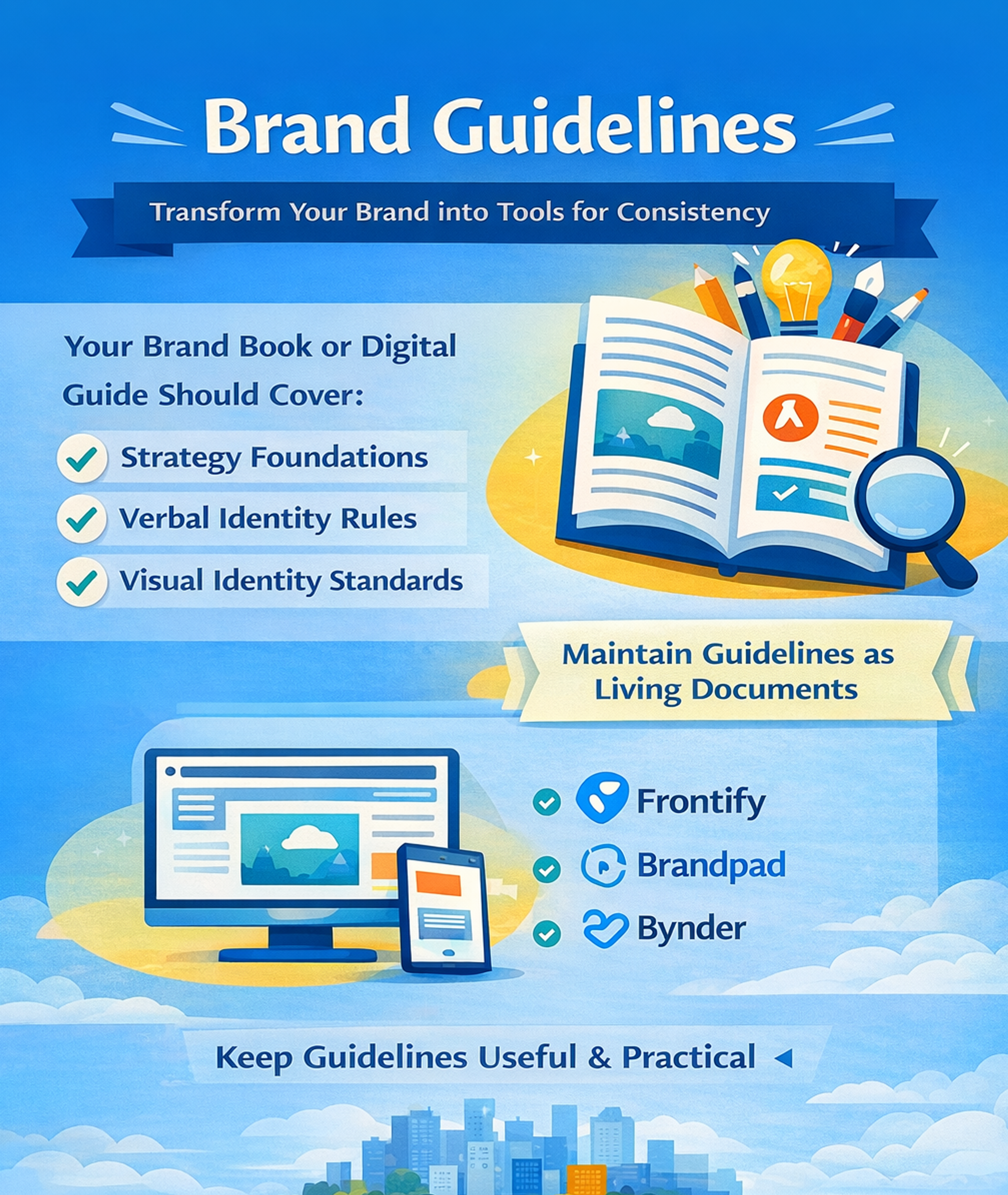
You should expect a brand book or digital guide that covers:
- Strategy foundations
- Verbal identity rules
- Visual identity standards
These guidelines should include examples across your key channels. Many teams utilize platforms like Frontify, Brandpad, or Bynder to maintain guidelines as living documents, keeping them accessible and up-to-date, rather than relying on static PDFs that quickly become outdated.
A helpful guideline answers the fundamental questions people face in daily work, such as:
- What happens when the logo sits on a busy photograph?
- How should product error messages sound compared to marketing headlines?
- How can we maintain a consistent brand voice in customer support emails?
If guidelines only show inspirational examples and ignore production challenges, teams will stop using them and invent their own rules under deadline pressure.
Many agencies deliver guidelines in multiple formats. A web-based version on a brand management platform becomes the daily reference. A downloadable PDF works as a backup and is easier to share with external partners. The formats should match how your team actually works.
Brand Guidelines
Asset Library and Templates
A complete handoff includes organized source files in formats your team can use immediately. You should receive vector logo files for print and digital applications. Include standard raster formats for quick deployment.
Color specifications, typography details, and font licensing responsibilities must be explicitly documented. This prevents confusion. Agencies should clearly specify which fonts you've licensed, the applicable restrictions, and where to access them.
File organization matters as much as the files themselves. Clean folder structures, consistent naming conventions, and version control notes prevent future confusion.
This matters especially when multiple vendors or team members access brand assets. Many branding problems stem from teams working with outdated or incorrect files. They couldn't find the correct version.
Templates often determine whether brands stay consistent or drift immediately. Common deliverables include presentation deck templates with flexible slide layouts, email signature templates as a key brand touchpoint, and social post structures for major platforms, along with story format guidelines.
Email header and footer assets, as well as simple one-pager or advertisement frameworks, are standard. The exact template list should match your actual production volume and channel priorities.
Templates should clearly indicate what teams can change without breaking the visual system. This includes aspects such as image choices and headline length.
Digital and Product Touchpoints
Brands live in real digital environments, not pristine mockups. If your brand operates primarily online, expect focused applied designs. These should demonstrate the system in context.
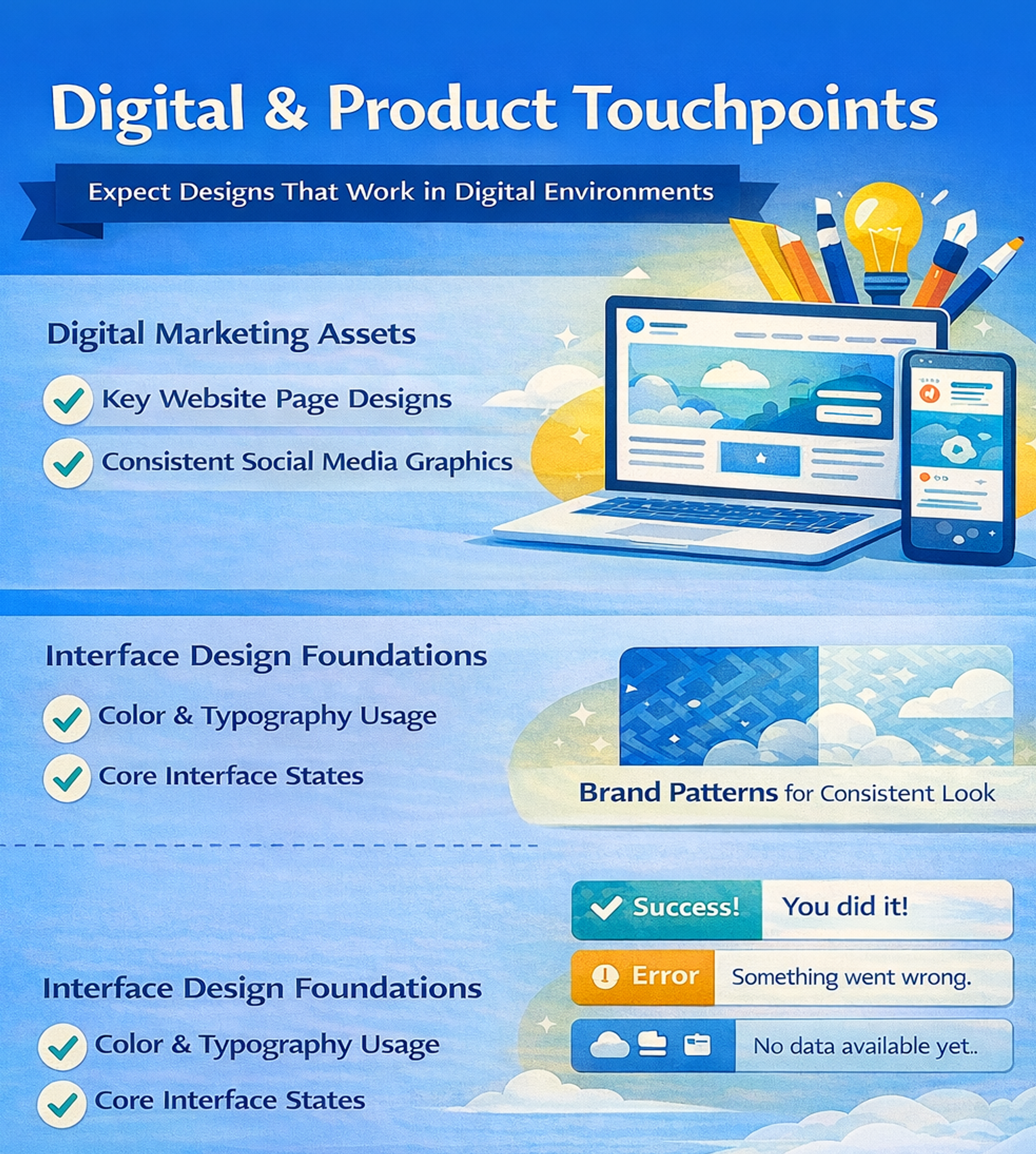
This might include key website page designs, landing page modules, or homepage concepts showing how components combine.
Visual elements, such as brand patterns, are essential for digital marketing assets, including website backgrounds and social media posts, where consistent branding enhances recognition and engagement.
For software companies, request interface design foundations. These should cover color usage in user interfaces and typography hierarchy. They should address consistency in icon style and core interface states. These states include errors, success messages, and empty screens.
Even lightweight guidance prevents the typical split between a polished marketing brand and a neglected product brand. When your product interface looks disconnected from your marketing, customers notice, and trust erodes.
Digital and Product Touchpoints
Launch Support, Governance, and Measurement
Practical agencies help you implement, not just hand over files. They often support launch with a clear checklist that prioritizes what to update first so your team does not feel overwhelmed.
These branding services can include everything from brand identity creation to marketing materials and online assets, ensuring all deliverables are aligned for a successful brand launch.
A solid launch checklist usually focuses on core touchpoints first:
- Website
- Social profiles
- Product interfaces
- Sales collateral
Then it extends to second-wave items:
- Email signatures
- Partner and reseller materials
You do not need to update everything at once. Innovative sequencing reduces stress and provides you with the opportunity to test and refine before a full rollout.
Internal enablement speeds up adoption. Many agencies run training sessions or provide onboarding materials that explain how to use the new brand system. This reduces misuse and helps teams implement the brand consistently.
When stakeholders understand the reasoning behind key decisions, they can make more informed day-to-day choices without requiring constant approvals.
Governance should be clarified before launch, so people know how to operate inside the new system.
At a minimum, you want clear answers to questions like:
- Who approves new branded materials?
- How do teams request exceptions or additions?
- Where are questions about the brand asked and answered?
Some agencies include a basic governance framework. Others offer ongoing support for audits, template expansion, and guideline updates. These ongoing services help build brand equity over time by maintaining brand consistency and adapting to new needs. Without this kind of structure, brand consistency often collapses within a few months as teams invent workarounds to meet new needs.
If branding is tied to growth goals, simple measurement signals should be defined early. You might track changes in brand awareness, direct traffic to your website, conversion rates on redesigned pages, or sales feedback about more precise positioning.
Qualitative signals from customer interviews can also show whether the brand feels more relevant and differentiated. Tracking brand equity is also essential, as it reflects the overall value and strength of a successful brand in the market.
Agencies usually do not own these metrics in the long term. Their role is to help you decide what to monitor after launch. Measurement creates accountability and makes it easier to defend the investment when stakeholders question the value of branding work.
How to Compare Agency Proposals
Look for specificity when you review branding proposals. Deliverables should be described as concrete outputs, not vague promises. Each item should spell out what you actually get, including file formats and what "final" means in practice.
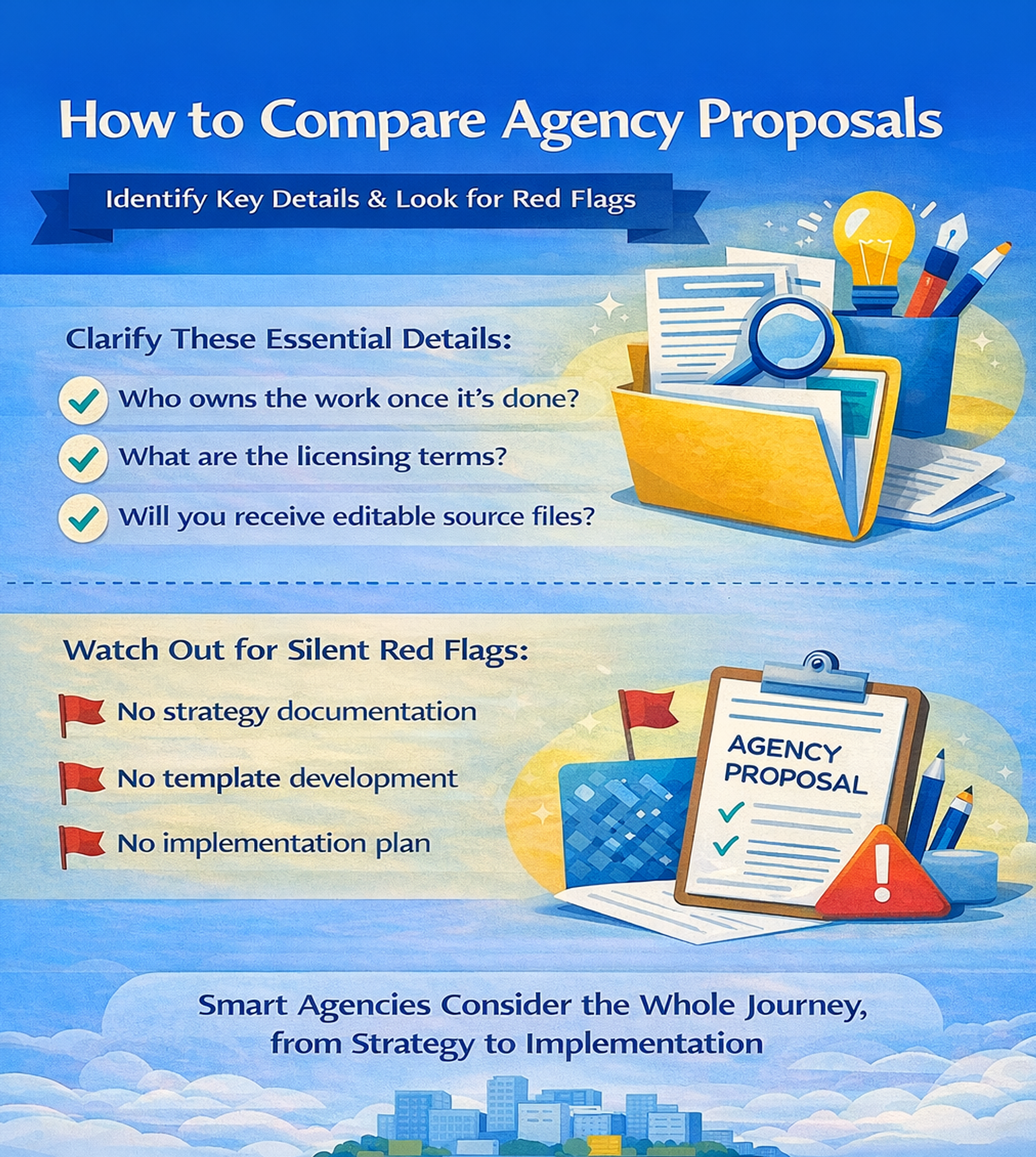
There are a few non-negotiable details to clarify up front:
- Who owns the work once the project is done?
- What are the licensing terms?
- Whether you receive editable source files or only exported assets?
Spelling this out early helps you avoid disputes and surprise limitations later.
Also, pay attention to what's missing. Some silent red flags:
- No strategy documentation: direction will be argued throughout the project, with no clear way to resolve disagreements
- No template development: your team will rebuild the brand themselves under deadline pressure, often inconsistently
- No implementation plan for guidelines: the brand book may look beautiful, but it ends up unused and forgotten
Smart agencies consider the entire journey, from strategy to implementation, not just the glamorous middle where design assets are created.
It's also worth noting how the agency talks about alternatives. Strong partners can admit when in-house teams, specialist freelancers, or a phased approach might suit you better. That kind of honesty usually signals that they understand your real constraints and goals, rather than simply pushing a standard package.
Most people are unaware of the numerous deliverables typically included in a comprehensive branding proposal. If you want to delve deeper into what to look for, you can explore a detailed blog post or guide that focuses specifically on branding deliverables and proposal checklists.
How to Compare Agency Proposals
FAQ
What Are the Core Branding Deliverables You Should Expect from an Agency?
Positioning, value prop and messaging framework, visual identity system, brand guidelines, and an organized asset library with templates.
What Should a Positioning Statement Include?
Who your audience is, what you offer, and what makes you meaningfully different. It should be an internal decision tool, not a tagline.
What Should a Visual Identity System Include at Minimum?
Real-world logo variations, clear usage rules, practical color and typography toolkits with accessibility guidance, plus supporting elements like icons or patterns.
What Should Brand Guidelines Include to Be Actually Usable?
Strategy foundations, verbal and visual rules, and channel examples that answer day-to-day production questions, not just inspiration.
Read more:
Conclusion
A strong branding engagement leaves you with a system your team can actually run. You get a clear strategy that guides decisions and a distinctive identity that builds recognition. You receive coherent messaging that expresses your values and guidelines, answering real questions.
You get templates, making consistent execution fast and reliable. When a new team member can produce on-brand work without extensive guidance, the agency has done its job correctly. Professional branding typically requires an investment of twelve to sixteen weeks and a corresponding budget.


About Clay
Clay is a UI/UX design & branding agency in San Francisco. We team up with startups and leading brands to create transformative digital experience. Clients: Facebook, Slack, Google, Amazon, Credit Karma, Zenefits, etc.
Learn moreAbout Clay
Clay is a UI/UX design & branding agency in San Francisco. We team up with startups and leading brands to create transformative digital experience. Clients: Facebook, Slack, Google, Amazon, Credit Karma, Zenefits, etc.
Learn more