

Most digital products fail the moment someone opens the app, can't figure out what to do next, and quietly closes the tab. That gap between what a product can do and what users actually understand how to do is the gap a UX design agency exists to close.
A UX design agency is an external team you hire to research how users behave, design how a product works, and validate whether the result is genuinely usable before you ship it.
The work runs from interviews and wireframes to prototypes, usability tests, visual design, and the handoff that turns design into shipped code.
UX Disciplines by Clay
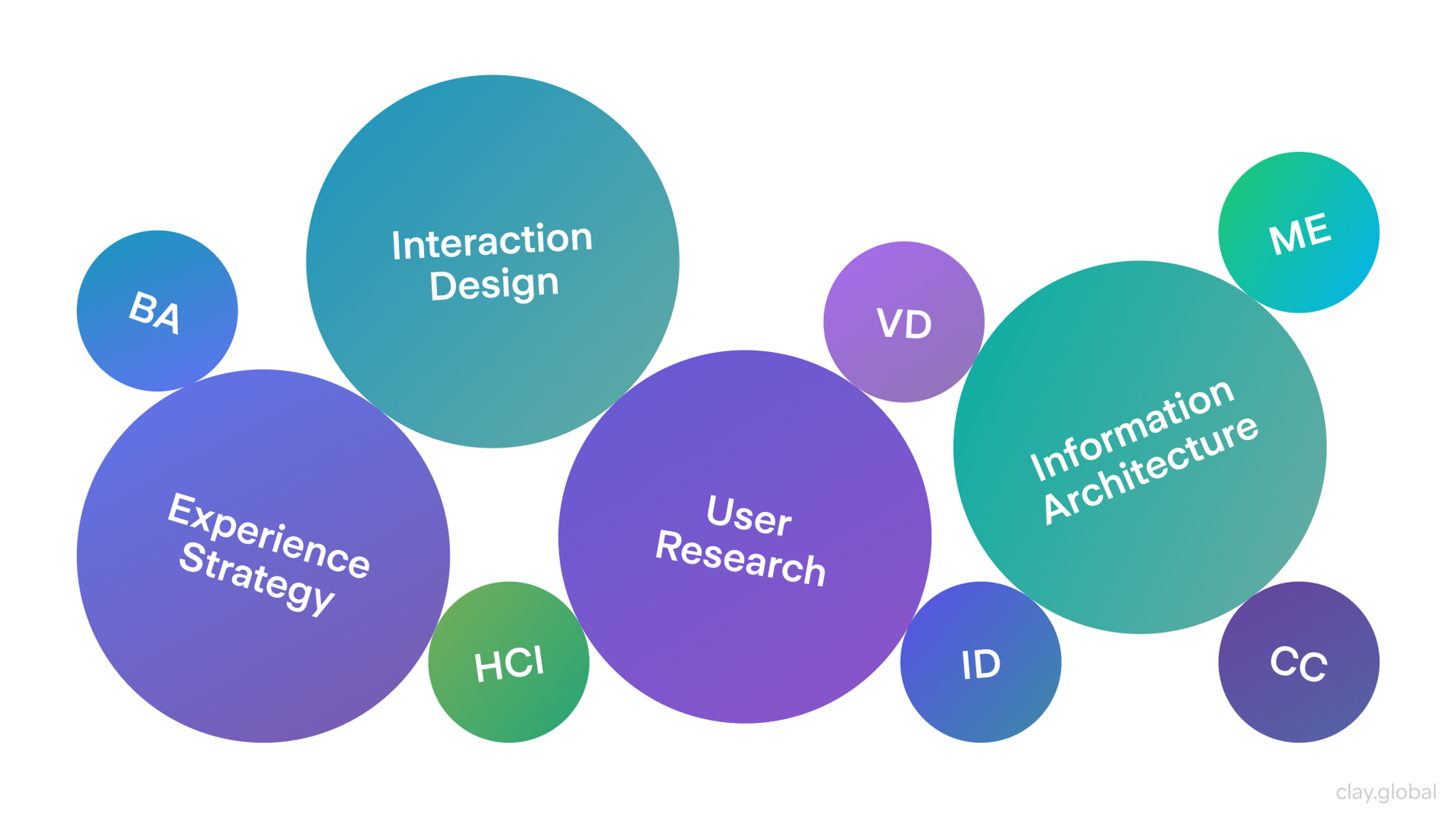
Done well, it pays for itself many times over. Done poorly or not at all, and it shows up as churn, support tickets, and abandoned carts.
Key takeaways
- A UX design agency is a specialist team that handles user research, prototyping, usability testing, wireframing, visual design, and interface development for digital products.
- The four common agency types are product design, UX research, software development, and branding. Each solves a different problem.
- A typical UX agency project averages around $85,000 over a 10-month engagement, with hourly rates ranging from $100 to $250 for senior agency talent.
- Forrester's research shows every $1 invested in UX returns up to $100, while design-driven companies grow revenue significantly faster than peers.
- Hire an agency when you need cross-functional expertise, fast turnaround, or fresh thinking on a product that's stuck. Skip it for small visual refreshes or work that an internal team can handle in a sprint.
What a UX Design Agency Actually Does
A UX design agency designs how a product feels to use. That sounds soft, but the work is concrete: figure out who the users are, observe how they currently solve the problem, design an interface that lets them solve it faster, prove the design works, and hand it to engineering in a state that can actually be built.
The deliverables are tangible:
- Research findings
- User flows
- Wireframes
- Interactive prototypes
- Usability test reports
- Component libraries
- Design specs for developers
UX Design Process by Clay
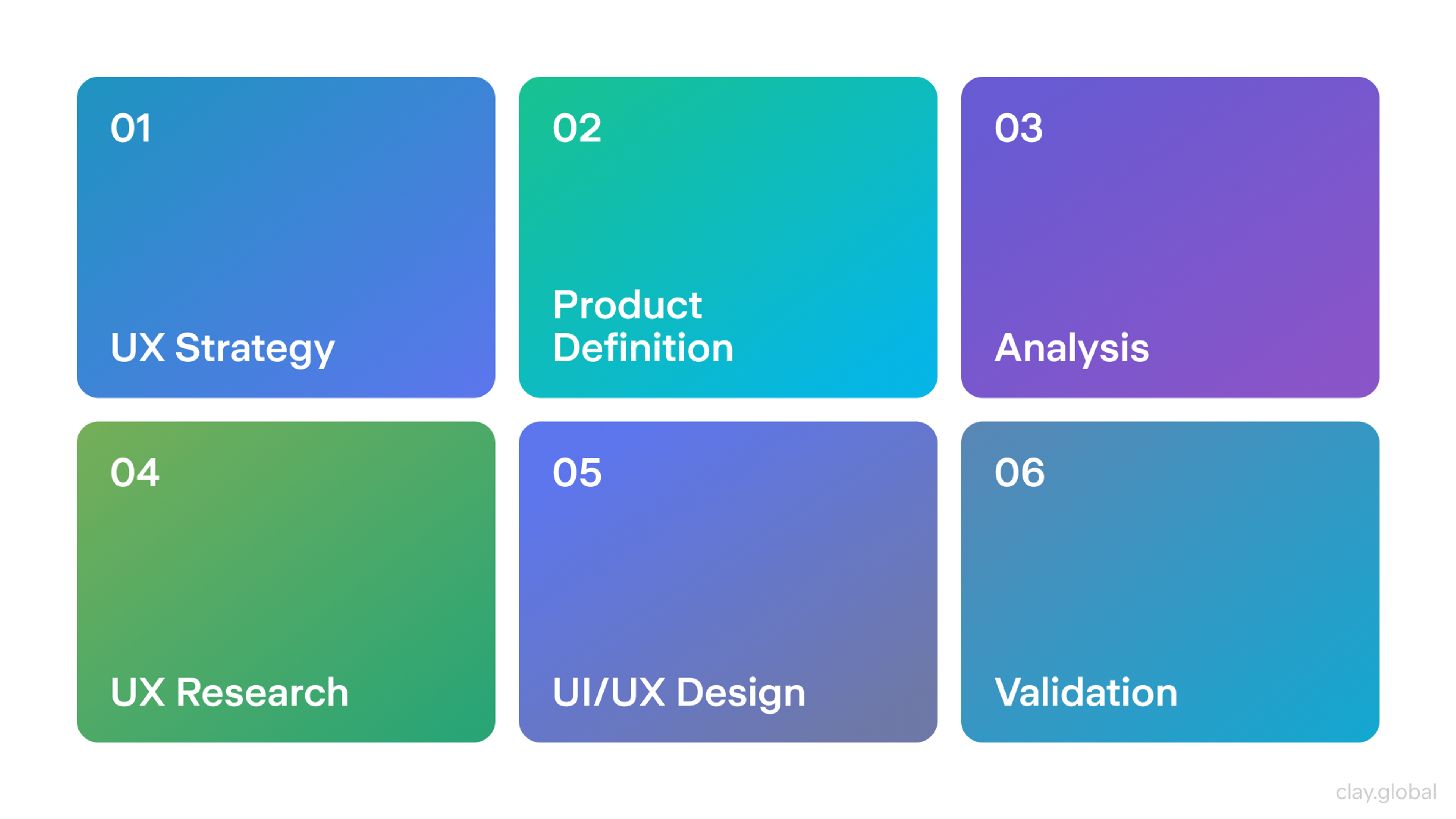
Most agencies own all of these stages, though the depth varies by team.
What separates a real UX agency from a "we also do design" shop is the research backbone. A good agency starts with questions:
Who is the user?
What are they trying to accomplish?
Where does the current experience break down?
And treats every design decision as a hypothesis to be tested. Pretty screens are an output, not a goal.
Take our work on the JOKR mobile grocery app. One-click checkout, a basket that personalizes based on past behavior, iconography that signals categories at a glance - none of that came from a designer's intuition.
JOKR Mobile App Designed by Clay
It came from observing how shoppers actually move through grocery flows on their phones, then engineering friction out of the steps where most users drop off.
That's the work. Not decoration. Diagnosis and treatment.
The Core Services a UX Agency Offers
Every reputable UX agency offers some version of the same six services. The names vary, the depth varies, but the spine is consistent.
User Research
Interviews, surveys, focus groups, contextual inquiry, eye-tracking, analytics review, and competitive analysis. The point is to replace assumptions about users with evidence about users.
Research happens before design begins and continues throughout: what you learn in week eight should change what you draw in week nine.
UX Research Process by Clay

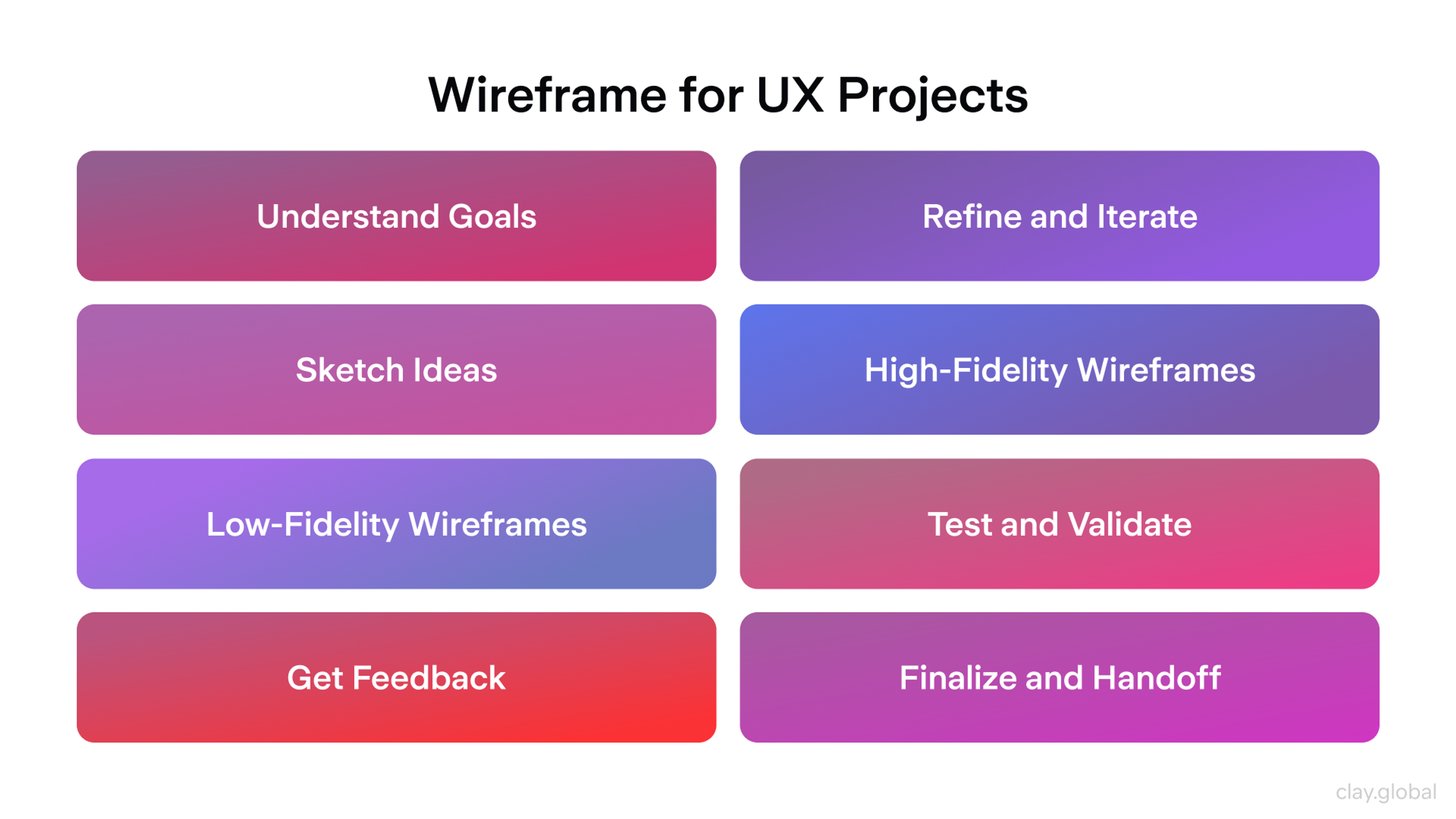
Wireframing
Low-fidelity layouts that map structure and flow without the distraction of color, typography, or polish. Wireframes are cheap to make and cheap to throw away, which is exactly the point: you want to find the bad ideas before you've invested 40 hours making them look beautiful. Most teams work in Figma, with Sketch and Adobe XD still in rotation at certain shops.
Wireframe for UX Projects by Clay
Prototyping
Interactive mockups that simulate how a feature will actually behave. Prototypes range from clickable wireframes to high-fidelity, near-production simulations. They exist for one reason: to put a real interaction in front of a real user and see what happens.
Usability Testing
Watch a user try to complete a task. Note where they hesitate, what they misread, and where they give up. Repeat with five to seven users, and patterns emerge fast.
The Nielsen Norman Group's classic finding still holds: five users will surface roughly 85% of usability problems on a given flow. You don't need a hundred-person panel to get a useful signal.
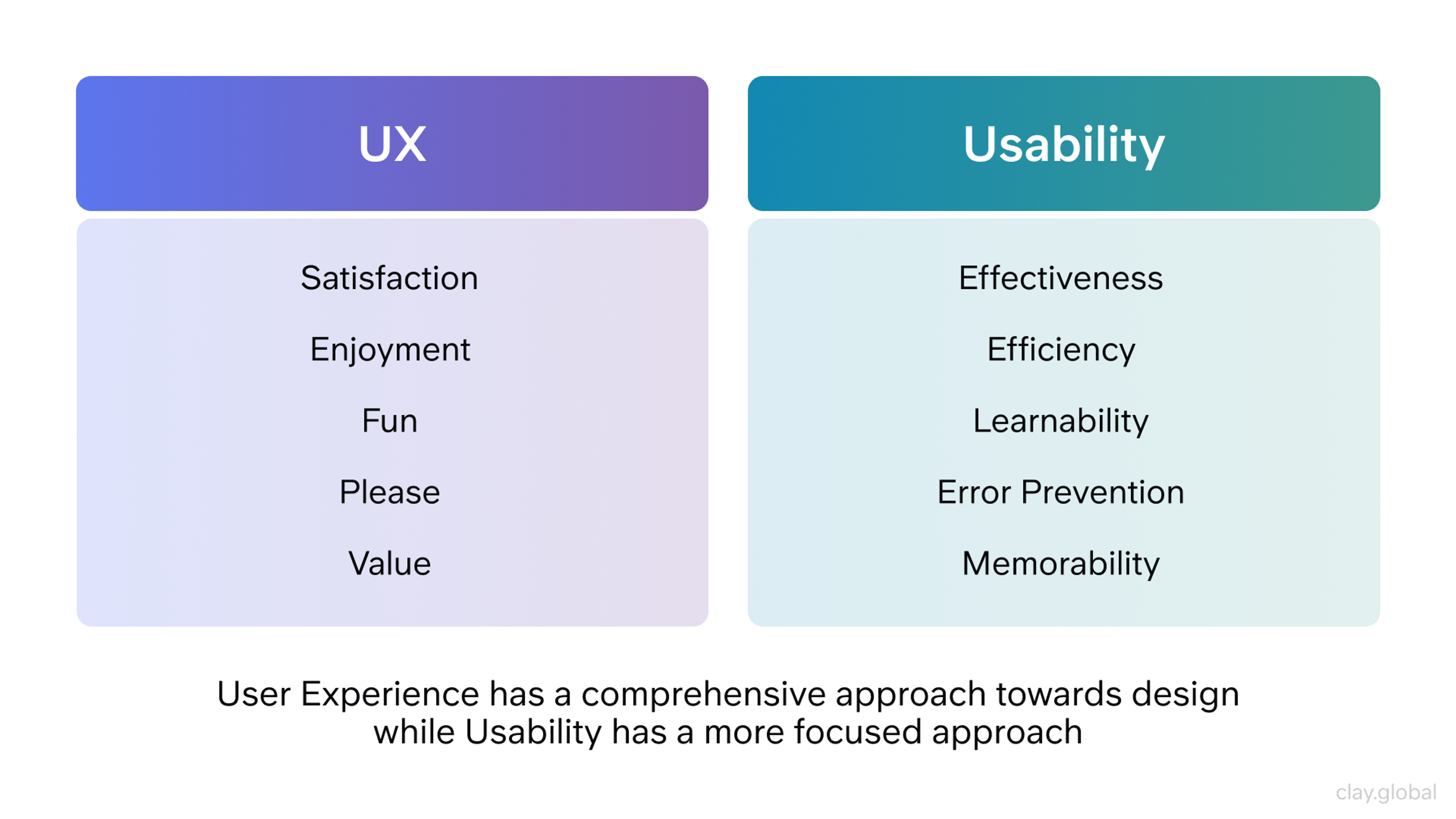
UX vs Usability by Clay
Visual and Interaction Design
The craft layer: typography, color systems, spacing, iconography, motion, microinteractions, and the small touches that make an interface feel considered instead of generic.
This is where a strong agency earns its premium: anyone can wireframe a checkout, but few can make one feel effortless.
UI Development and Design System Handoff
The final mile. Component libraries, design tokens, documented states, and developer-ready specs.
A UX project that ends at a Figma file is half-finished, sowith a Figma file is half-finished, so the value only lands when engineering can build the design without translating intent.
Four Types of UX Design Agencies You'll Encounter
Not all UX agencies do the same work. The category is broad, and the wrong fit will burn budget fast. Four archetypes cover most of what's out there.
Product Design Agencies
The most common shape. They handle the full arc from research to UI handoff and tend to work on flagship products like apps, SaaS platforms, fintech dashboards, and e-commerce flows.
Clay sits in this category, as do firms like IDEO and Frog Design. If you're building or rebuilding a digital product end-to-end, this is usually the right starting point.
UX Research Agencies
Pure research shops. They run studies, ethnographic work, accessibility audits, and large-scale usability programs without necessarily designing anything themselves.
Useful when you have an internal design team that can execute but lacks the bandwidth or rigor to do deep research. Less useful if you want one team to take you from problem to shipped product.
Software Development Agencies with UX Practices
Engineering-led firms that have grown UX teams to round out their offer. They're often strong on technical feasibility (knowing what's actually buildable in a given stack) and weaker on early-stage research or visual craft.
A reasonable choice for complex backends with a light UI surface, less so for consumer products where polish matters.
Branding Agencies that Offer UX
Brand-led firms that have moved into product. They tend to deliver beautifully on identity, logo systems, and visual language, but vary widely on UX rigor.
Best for companies whose product is essentially a brand expression - direct-to-consumer, lifestyle, hospitality. A risky bet for complex software unless they have a dedicated UX practice with real product experience.
The honest test for any agency: ask to see two case studies that match your problem, then ask what they'd do differently if they ran them again. Agencies that can answer that question well are usually worth talking to.
The Business Case for Hiring a UX Agency
UX gets dismissed as a "nice to have" until someone runs the numbers. The numbers tend to end the conversation.
Forrester's widely cited research found that every $1 invested in UX returns up to $100, roughly a 9,900% ROI. The figure gets quoted so often it almost loses meaning, but the underlying mechanism is real: better usability lifts conversion, reduces support load, cuts redesign cycles, and increases retention, and those effects compound.
McKinsey's Business Value of Design study tracked design-driven companies over five years and found they grew revenue and shareholder returns at roughly twice the rate of industry peers. Forrester's 2025 Total Economic Impact analysis on continuous user testing showed organizations achieving revenue retention improvements of up to 10.8% over three years after embedding research into their product process.
The cost side matters too. Fixing a usability problem after launch typically costs about ten times what it costs to fix in design, and roughly a hundred times what it costs to catch in research, or the so-called 1-10-100 rule. An agency that runs five usability tests and surfaces a confused checkout flow before launch has already paid for itself.
What a UX Design Agency Costs in 2026
Pricing is the question that kills most early conversations, so it's worth being concrete.
Based on Clutch's review data across hundreds of agencies, the average UX agency project costs around $85,000 and runs about ten months, working out to roughly $8,900 per month. That's the median for full-service work: research, design, testing, and handoff on a real product.
Hourly rates split sharply by tier. Boutique and offshore agencies typically run $25 to $75 per hour. Mid-sized US and European agencies charge $100-$200 per hour. Senior agencies and specialist boutiques in major markets (the firms working on Meta, Google, or Slack-scale projects) routinely charge $200 to $250+ per hour, with niche specialists like accessibility consultants going higher.
Project size scales with scope:
- A focused engagement (a checkout redesign, an onboarding flow, a mobile app section) typically lands between $15,000 and $50,000.
- Full product design, including research and design system work, runs $50,000 to $150,000.
- Multi-product platforms with embedded research operations can clear $500,000.
Three factors push pricing up faster than most clients expect: tight deadlines (rush fees of 20–50%), expanding scope (every additional platform, be it web, mobile, or tablet, adds roughly a third to the budget), and unclear requirements (revisions are where projects bleed). The clearest brief and the most decisive client always gets the cheapest project.
When to Hire a UX Agency (and When Not To)
Hiring an agency is the right call when:
- You're launching a new product and need research, design, and validation in a compressed window.
- You're rebuilding a product that's stuck: declining engagement, rising support load, conversion issues that internal iteration hasn't fixed.
- You need cross-functional expertise (research, design, and engineering handoff) that would take a year to hire in-house.
- You want fresh thinking. Internal teams develop blind spots. Outside teams don't have them yet.
It's the wrong call when:
- The work is small enough for a freelancer or your existing team. A logo refresh or a single-screen redesign is not an agency-scale problem.
- You don't have the internal capacity to support the engagement. Agencies need clients who can make decisions, give feedback, and approve work. If your team can't, the project will stall regardless of how good the agency is.
- You're hoping the agency will define your product strategy. They can pressure-test it, but if you don't know what you're building or why, hire a strategy consultant first.
- You're optimizing on price alone. The cheapest agency rarely produces the cheapest outcome: rework and redesign cycles cost more than a senior team would have charged upfront.
A useful gut-check: if a successful project would create more than ten times its cost in business value over the next two years, hire the agency.
If it wouldn't, it's probably not the right time.
Read more:
FAQ
What's the difference between UX and UI design?
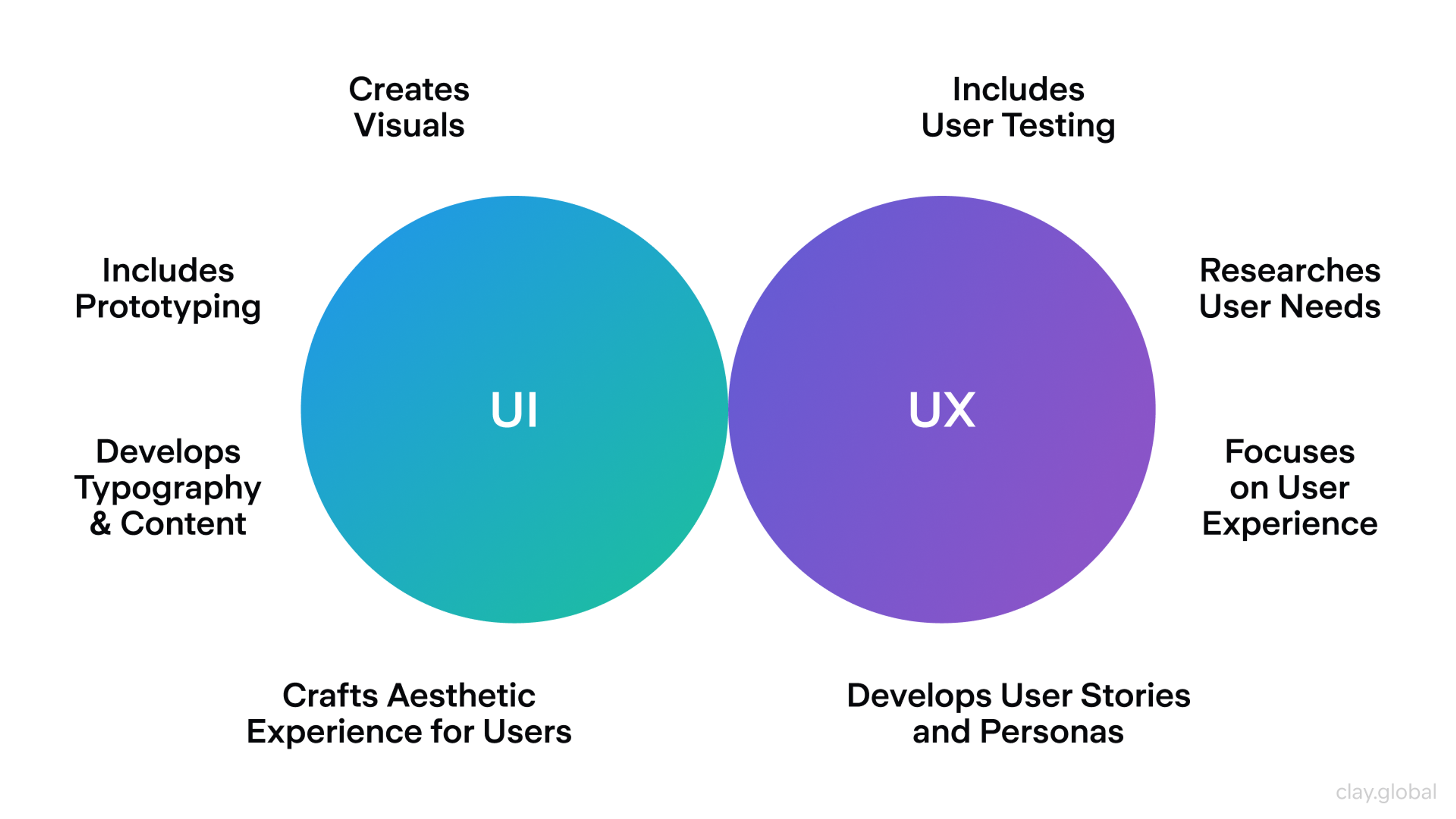
UX design is how a product works - the structure, flow, and logic of how users accomplish goals. UI design is how it looks and responds - the visual surface, typography, color, animation, and interaction details. Most modern agencies handle both, but the disciplines are distinct, and good agencies staff specialists for each.
UI vs UX by Clay
How long does a typical UX project take?
Anywhere from six weeks for a focused redesign to twelve-plus months for a full product build. The Clutch median sits around ten months for end-to-end agency engagements. Anything claiming a finished product in under four weeks is either very small in scope or skipping research entirely.
Can a UX agency work with our existing development team?
Yes, and most do. A common arrangement is for the agency to own design through high-fidelity prototypes and a documented design system, while your in-house engineers handle implementation. Strong agencies build their handoff specifically for this: annotated Figma files, component libraries, and direct collaboration with your developers during build.
What's the difference between a UX agency and a freelance UX designer?
A freelancer is one person with one perspective and limited bandwidth. An agency brings a multi-disciplinary team (researchers, designers, strategists, sometimes engineers) who can run several workstreams in parallel. Freelancers cost less and work well for narrow projects. Agencies cost more and work well for complex, multi-stage problems where one person can't cover the surface area.
Do UX agencies do A/B testing and post-launch optimization?
Some do, especially product design firms with growth practices. Others hand off at launch and leave optimization to internal teams. Worth confirming upfront, if you want ongoing experimentation support, scope it into the engagement rather than assuming it's included.
How do we choose between a US-based agency and an offshore one?
US agencies typically charge two to four times more but bring closer time zones, deeper familiarity with North American user expectations, and tighter integration with US-based engineering teams. Offshore agencies can deliver excellent work at lower rates if you're willing to manage time zone overlap and have clear documentation. The deciding factor is rarely price - it's how much real-time collaboration the project requires.
What should a UX agency proposal include?
A scoped problem statement, a research plan, defined deliverables for each phase, a clear timeline with milestones, named team members (not just "senior designers"), pricing structure, and a process for handling scope changes. Vague proposals lead to vague projects. Push for specifics before signing.
How do we measure whether the engagement was successful?
Tie it to business metrics, not design metrics. Conversion rate. Activation rate. Retention. Support ticket volume. Task completion time. NPS. The agency should propose these baselines at kickoff and report against them at the end. "The new design looks better" is not a success metric.
Will a UX agency redesign our brand at the same time?
Some product design agencies do brand work, and most branding agencies do some product design, but the strongest teams are usually specialized. Combining a major brand overhaul with a major product redesign in one engagement is doable, but expensive and slow. Often it's smarter to sequence them.
What's a "design sprint" and is it worth doing as a first engagement?
A design sprint is a one-to-two-week intensive that takes a problem from kickoff to a tested prototype. It's an excellent way to evaluate an agency before committing to a long engagement, and a fast way to validate a feature before investing months in building it. Most established agencies offer them between $15,000 and $40,000.
How do we know if an agency is overselling its capabilities?
Three signals: case studies with no measurable outcomes ("the client was thrilled"), a portfolio that all looks the same regardless of industry, and an inability to clearly explain what their research process actually involves. Good agencies talk about specific decisions, specific tradeoffs, and what they'd do differently next time.
Do small companies and startups actually need a UX agency?
Sometimes. If you're pre-product-market-fit and burning cash, a freelancer or a hands-on advisor is usually better. Once you have a signal that something works and you're investing real money in scaling it, agencies start making sense, especially for the redesign that takes a working product to a polished one.
The Bottom Line
UX design isn't a coat of paint. It's the difference between a product users tolerate and one they recommend. The agencies that do this work well treat design as evidence-based decision-making, not visual decoration, and the business outcomes follow accordingly.
The product you ship is the one users get. Make sure it's the one you actually meant to build.


About Clay
Clay is a UI/UX design & branding agency in San Francisco. We team up with startups and leading brands to create transformative digital experience. Clients: Facebook, Slack, Google, Amazon, Credit Karma, Zenefits, etc.
Learn moreAbout Clay
Clay is a UI/UX design & branding agency in San Francisco. We team up with startups and leading brands to create transformative digital experience. Clients: Facebook, Slack, Google, Amazon, Credit Karma, Zenefits, etc.
Learn more