

Most startups get branding backward. They treat it as something to sort out once the product is ready, the funding is secured, and the team is in place.
By then, they've already made dozens of decisions about naming, visual style, tone, and audience positioning without a coherent strategy holding them together. Undoing that patchwork later costs far more than getting it right early.
The good news: building a strong brand as a startup doesn't require an agency retainer or a six-figure design budget. What it requires is clarity about what you're building, who it's for, and a deliberate approach to the branding services and tools you choose at each stage.
Partnering with branding agencies for startups, though, can eliminate several risks.
Key Takeaways
- Brand identity is more than a logo. It's the combination of visual style, voice, positioning, and customer experience that makes your startup recognizable and trustworthy.
- Startups can build credible brands on limited budgets using DIY tools, freelancers, and subscription design services, as long as the underlying strategy is sound.
- The highest-ROI branding investments for early-stage companies are usually a strong logo, a clear brand voice, and consistent visual templates across key channels.
- Knowing when to hire professionals matters as much as knowing which professionals to hire. The wrong timing wastes money, while the right timing multiplies it.
- Consistency across every customer touchpoint builds trust faster than any single branding asset can.
- Common mistakes like imitating competitors, skipping market validation, and building desktop-first assets are easy to avoid once you know what to watch for.
What Startup Branding Means
Branding is often reduced to visual design. In reality, it's the full set of signals your business sends to the market: what you look like, how you sound, what you stand for, and how customers feel after every interaction with you.
For startups, the most foundational piece is brand identity: the visual and verbal system that makes your company recognizable. That includes your logo, color palette, typography, and the tone of voice you use across every piece of communication.
Get these right, and everything downstream (marketing, sales collateral, product UX) becomes easier and faster to produce.
Brand Design Elements by Clay
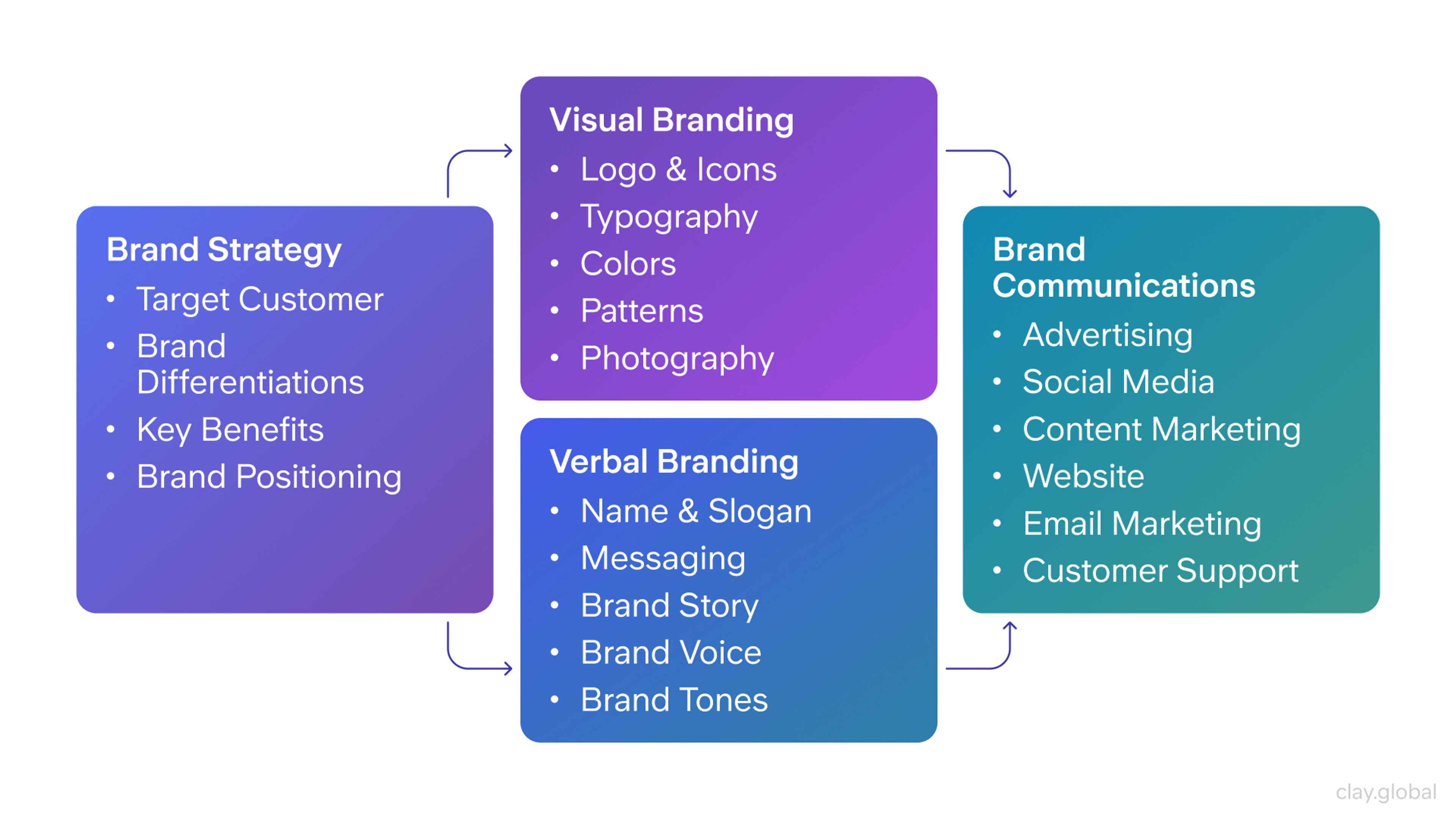
Your brand voice is just as critical as your visual identity. A startup that sounds inconsistent across its website, emails, and social media looks unfinished regardless of how sharp the logo is. Customers pick up on that dissonance, even if they can't name it.
Market research underpins all of it. Branding decisions made without audience input are guesses dressed up as strategy. Before you finalize anything (colors, tone, positioning), you want real data on how your target customers perceive competitors, what language they use to describe their problems, and what kind of brand signals build trust in your category.
Why Branding Matters More at the Early Stage Than Most Founders Realize
Here's a counterintuitive truth about startups: the less credibility you have, the harder your brand has to work. An established company can coast on its reputation. You can't.
Every touchpoint (your website, your pitch deck, your Instagram grid, the way you write a cold email) is doing active persuasion work on your behalf.
A 2023 study by Edelman found that trust is now among the top three factors consumers consider before purchasing from a new brand.
For startups, which by definition lack track records, a polished and coherent brand is one of the few proxies for trustworthiness available to you.
Visual Identity Elements by Clay
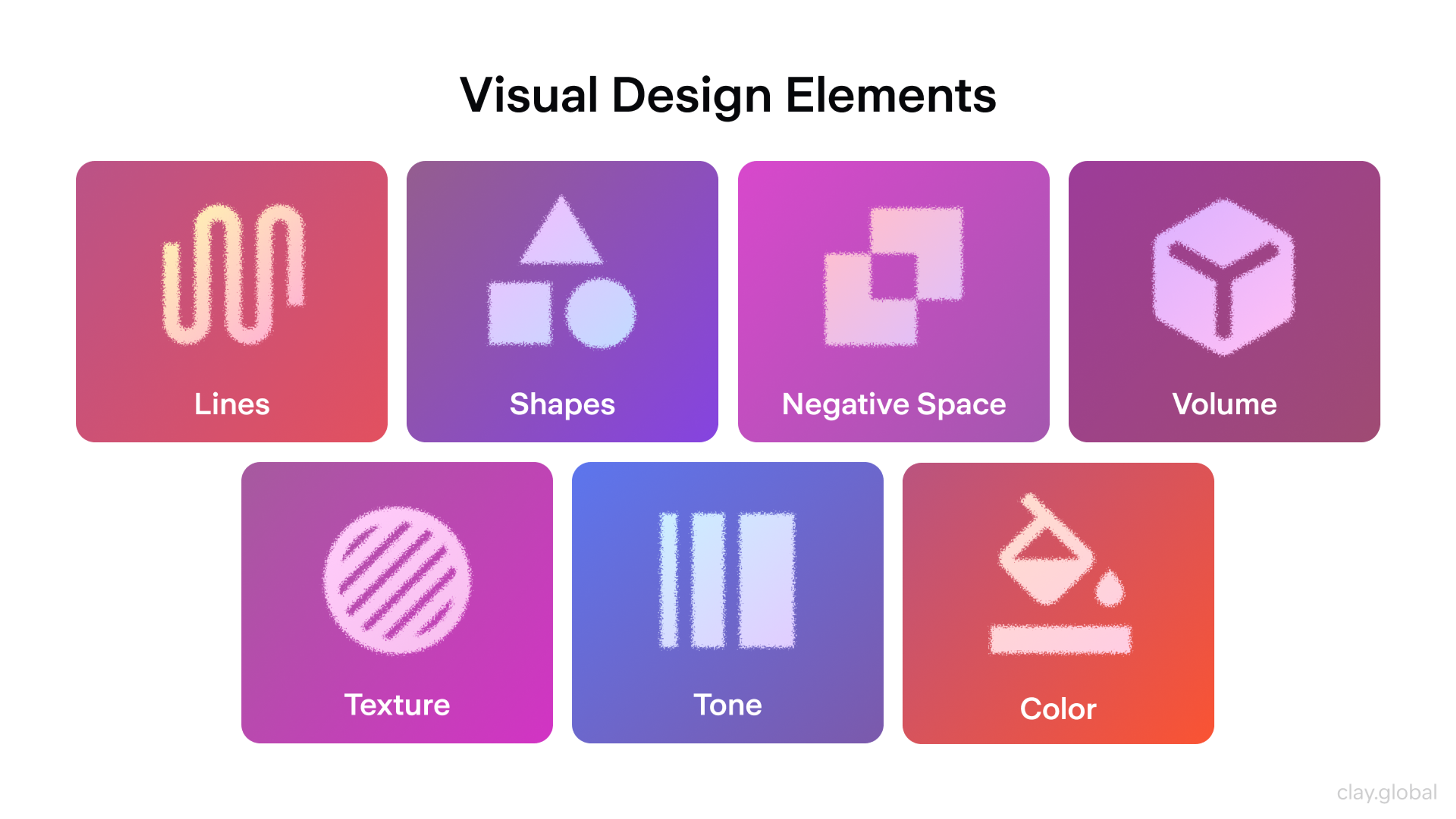
The startups that build serious brand equity early tend to share one thing: they treated brand consistency as a non-negotiable from day one.
Warby Parker didn't just disrupt eyewear pricing. They built a brand around accessibility and social impact that made their low-cost model feel premium.
Glossier didn't spend on traditional advertising. They built a brand voice so distinctive and community-driven that their customers did the marketing for them.
Neither of those outcomes required huge budgets. They required clear thinking about identity, audience, and consistency.
Cost-Effective Branding Options for Startups
DIY Branding Tools
For pre-seed or early-seed companies working with minimal runway, DIY tools have improved dramatically. The gap between "designed by a freelancer" and "designed using a good platform with real effort" has narrowed considerably.
A few worth knowing:
Logo and visual identity: Looka and Adobe Express let you build a logo and basic brand kit without design experience. The results won't be custom, but they'll be professional enough to get you moving. Use them as a starting point, not a final destination.
Color and typography: Coolors and Adobe Color help you build a palette that holds together. Pair with Google Fonts for free, high-quality typefaces. Setting a two-font system (one display, one body) and sticking to it gives you visual consistency at zero cost.
Social media templates: Canva and Visme let you create repeatable templates so your content looks coherent week to week. Building your templates once saves hours downstream.
The DIY approach works best when you have a clear brand strategy before you touch the tools. Without knowing your positioning, target audience, and tone of voice, even polished visuals will feel hollow.
Freelancers and the Gig Economy
Platforms like Fiverr and Upwork give you access to a global pool of designers at rates that fit startup budgets.
A strong freelance logo designer can deliver excellent work for $300-$800. Brand identity packages (logo, colors, typography guide, basic usage rules) run $1,000-$3,000 at the mid-tier.
The keys to getting good work from freelancers are specificity and accountability. Write a detailed brief: include competitor examples, visual references, your target audience, and the feeling you want the brand to evoke.
UI Designer Deliverables by Clay
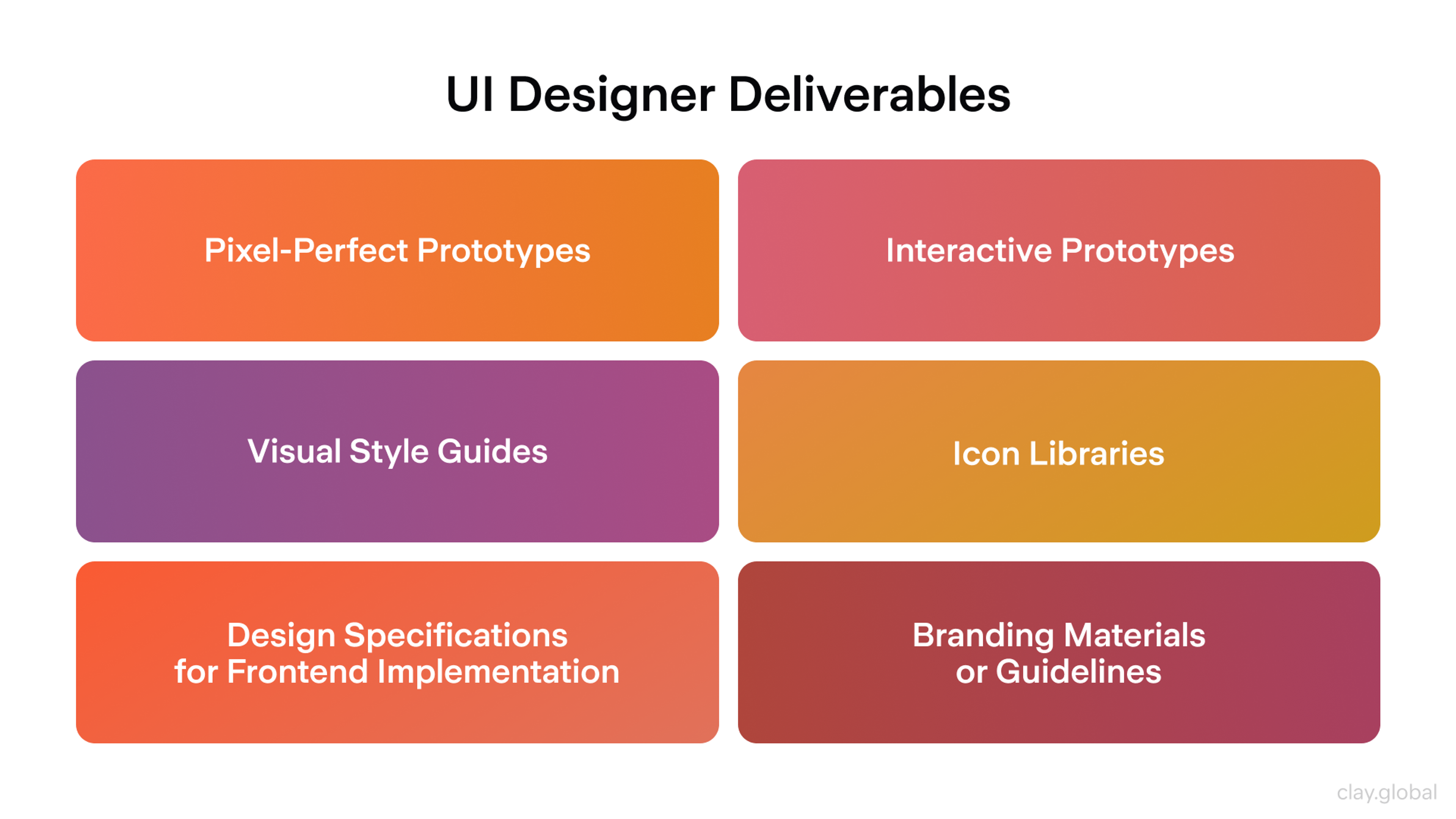
Set clear revision rounds upfront. Review portfolios carefully and look for work in your category or aesthetic territory.
Quality control matters. Ask for working files (not just PNGs), check that color codes and font names are documented, and don't sign off until you have everything you'd need to brief a new designer independently.
Subscription Design Services
Subscription services like Design Pickle operate on a monthly flat-fee model, giving you unlimited design requests and a dedicated designer.
Plans typically start around $500/month. For startups producing regular marketing assets (social posts, ad creative, email headers, pitch deck slides), the economics can beat hiring a freelancer per project once you're past the initial brand build.
Marketing platforms, including HubSpot and Buffer, complement these services with content scheduling and analytics, so you can manage brand output across channels without a full marketing team.
Design Contests
Platforms like 99designs and DesignCrowd run competitions where multiple designers submit concepts, and you pay only for the winner.
The upside is creative diversity: you see 20-40 different takes on your brief. The risk is that without a tight brief, submissions will scatter in every direction.
Design contests work well for logo development when you genuinely want to explore a wide range of directions before committing. They work less well for complex brand systems where cohesion across multiple elements matters from the start.
When to Invest in Professional Branding Services
DIY and freelance options serve you well up to a point. There are specific inflection points where bringing in a professional branding agency pays off:
Product launch or rebrand. If you're taking a product to market for the first time or repositioning after an early pivot, a professional agency can ensure that your brand enters the market, making the right first impression. First impressions in saturated categories are hard to override.
Entering a new market. Different markets have different visual languages and trust signals. What reads as premium in B2B SaaS looks very different from what reads as premium in DTC consumer goods. Agencies with category expertise navigate this fluency faster than you can build it in-house.
Marketing & Branding Strategies by Clay

Fundraising. Investors pattern-match on brand as a proxy for execution quality. A poorly branded company can lose credibility before the pitch deck lands. A well-branded one signals that founders think clearly about positioning and audience.
For startups based in San Francisco looking for end-to-end execution, agencies like Clay and Mission Control combine brand strategy, UX design, and production support under one roof, which is useful when you need a website, app, and brand system built in parallel.
Making Smart Branding Investments: ROI Thinking
Not every branding investment pays off equally. Before allocating budget, ask which elements will have the most contact with your target audience and carry the most weight in their trust-building process.
For most startups, that means prioritizing in roughly this order:
- a strong, versatile logo
- a clear and consistent brand voice
- a website that converts
- repeatable visual templates for ongoing content
Everything else builds on those foundations.
Run simple ROI logic on each option. A freelance brand identity package at $2,000 that you use across five years of marketing materials, two funding rounds, and a product launch is a very different calculation from the same spend on a one-off design project with no documentation and no style guide.
ROI

Investments in professional services pay off most when you have clarity on your market position before briefing the agency. Agencies can execute a clear strategy well. They can't define your strategy for you, or at least not without high additional cost.
Emerging Trends Shaping Startup Branding
AI-assisted brand design. Tools like Looka and the AI features in Adobe Express are making automated logo generation genuinely viable for early prototyping.
More sophisticated platforms are beginning to use machine learning to analyze audience data and suggest brand positioning. This doesn't replace strategic thinking, but it accelerates the design iteration loop.
Sustainability as brand identity. Consumers, particularly younger demographics, are increasingly factoring environmental and social values into purchase decisions. A 2024 NielsenIQ study found that 62% of consumers say sustainability is a significant factor in their buying choices.
For startups, building sustainability into the brand identity from the start, rather than treating it as an afterthought, is increasingly a competitive differentiator.
Personalization and community-led branding. Glossier's approach has become a template: build a community before you build a product, let the community shape the brand voice, and turn customers into advocates.
This model requires less spending on traditional advertising and builds defensible brand equity that's hard for larger competitors to replicate.
Common Branding Mistakes Startups Should Avoid
Imitating competitors. Drawing reference from successful brands is fine. Copying their visual identity or tone is a mistake. It makes you derivative in the eyes of customers looking for something new, and it risks legal issues if the imitation is close enough to constitute trademark infringement.
Focus your energy on what makes you different, not on how to look like someone else.
Brand Strategy by Clay

Skipping market validation. Branding decisions built purely on internal preferences often miss the target. Before you finalize your visual identity or messaging, test it with real people from your target audience.
Even five informal conversations can surface misalignments that save you from an expensive course correction later.
Building desktop-first brand assets. The majority of your audience will encounter your brand on a phone. A logo that looks elegant at 400px can become illegible at 40px.
Complex color gradients that render beautifully on a retina display can muddy on a mid-range Android. Test every brand asset at mobile scale before signing off.
Inconsistency across touchpoints. Your brand does its best work when it says the same thing everywhere. A startup whose website sounds polished but whose social media sounds like a different company entirely loses trust without customers being able to explain why.
Build a simple brand guide, even a two-page document, and share it with everyone who creates or approves content.
Scaling Your Brand as You Grow
As your startup grows, the brand needs to grow with it without losing the coherence that made it recognizable in the first place.
Brand scaling usually involves expanding your visual system (adding illustration styles, photography guidelines, motion standards) rather than rebuilding from scratch.
If your original brand work was done correctly, with documented color codes, font files, logo usage rules, and a clear positioning statement, expansion is straightforward. Without that documentation, every new asset becomes a fresh negotiation about what the brand is.
Refresh brand elements at natural inflection points: a new product line, entry into a new market, a fundraising round that changes your public profile. Avoid refreshing purely for novelty, as brand recognition is built through consistency, and unnecessary changes erode the equity you've accumulated.
The startups that scale their brands well treat their brand guide as a living document. They update it as the brand evolves, distribute it to new team members and agency partners, and enforce it consistently enough that customers recognize the brand on any platform, in any context.
Read more
FAQ
What do branding services for startups typically include?
Most branding services cover logo design, color palette development, typography selection, and brand guidelines. More comprehensive packages add brand strategy (positioning, target audience definition, messaging frameworks), website design, social media templates, and pitch deck design. The scope depends on the agency or freelancer and the budget you're working with.
How much should a startup spend on branding?
Early-stage startups can build a functional brand identity for $500-$3,000 using freelancers or DIY tools. A mid-tier branding agency engagement (covering strategy, identity, and basic collateral) typically runs $15,000-$50,000.
Full-service agencies with strategy, UX, and production capabilities charge more. The right investment depends on your stage, the complexity of your category, and how much you'll leverage the work.
Can a startup do its own branding without a designer?
Yes, with caveats. DIY tools like Looka and Adobe Express can produce professional-looking results, but only if you have a clear brand strategy before you start designing. Without defined positioning, audience, and tone of voice, even polished visuals will feel generic. If design isn't your strength, a freelance logo designer is a better investment than hours spent on a DIY tool.
What's the difference between brand identity and brand strategy?
Brand strategy defines who you are, who you're for, and why you're different. It's the thinking behind the brand. Brand identity is the visual and verbal expression of that strategy: the logo, colors, fonts, and tone of voice. Strategy without identity is invisible. Identity without strategy is arbitrary. You need both, and strategy should always come first.
How important is brand consistency for early-stage startups?
Very. Customers build trust through repeated, coherent brand experiences. A startup that looks and sounds different across its website, social media, and email marketing creates subtle friction that erodes confidence, even if customers don't consciously register it. Consistency signals that you're organized and reliable, two things early-stage companies need to prove.
When should a startup hire a branding agency instead of freelancers?
Hire an agency when you need a cohesive system built across multiple deliverables simultaneously (brand strategy, identity design, website, and collateral) and when the stakes are high enough (a product launch, a funding round, a major market entry) to justify the investment.
Use freelancers for discrete, well-defined tasks where you're providing the strategy yourself.
What should a startup look for in a branding agency?
Category experience matters, but it's not everything. Look for an agency that asks good questions about your audience and positioning before pitching visual concepts. Review case studies for work that solved real business problems, not just work that looks beautiful. Check that they deliver documented brand guidelines, not just final files.
How does brand strategy affect fundraising?
Significantly. Investors evaluate a brand as a signal of how clearly founders think about their market and audience. A startup with a polished, coherent brand signals execution capability. A poorly branded one creates doubt about the team's ability to communicate value to customers. Strong branding won't close a round, but weak branding can lose one.
What's a brand guide, and does a startup need one?
A brand guide documents your visual identity (logo files, color codes, typography, usage rules) and your verbal identity (tone of voice, messaging principles, how to write for your brand).
Every startup needs one. It doesn't have to be a 60-page PDF. Even a two-page quick reference that designers and copywriters can follow will pay dividends in consistency.
How do you know when it's time to rebrand?
Rebrand when your current brand no longer reflects what your business actually is, such as after a significant pivot, a market expansion, or a shift in target audience. Don't rebrand just because the brand feels dated or because you hired a new designer who has strong opinions.
Brand recognition is built slowly and lost quickly, while rebranding has a real cost in accumulated equity.
What branding mistakes do startups make most often?
The most common ones: starting with visuals before strategy, imitating competitors instead of differentiating from them, skipping market validation, building assets that don't work at mobile scale, and failing to document brand standards for the team. Each of these is avoidable with a bit of upfront discipline.
Is it worth investing in a professional logo for a very early-stage startup?
Yes. Your logo appears everywhere: website, pitch decks, business cards, app icons, social media. It's often the first thing a potential customer or investor sees.
A logo that looks amateurish does real damage to perceived credibility. Even a modest investment with a skilled freelancer is worth it.
How long does a startup branding project typically take?
A freelance logo project typically takes one to three weeks. A full brand identity package with a freelancer or small agency runs four to eight weeks. An end-to-end branding engagement with a full-service agency, covering strategy, identity, website, and collateral, is usually three to six months. Factor that timeline into your launch planning.
What role does brand voice play in startup branding?
Brand voice is how your company sounds across every piece of communication. It's as important as visual identity, and arguably harder to maintain because more people contribute to it.
A distinct, consistent voice builds recognition and trust, particularly on social media, where you're competing for attention against hundreds of other brands. Define your voice early, document it clearly, and apply it everywhere.
Conclusion
Branding won't make a bad product good. But it will make a good product visible, credible, and worth remembering. For startups operating in competitive markets, that's not a nice-to-have. It's a foundational business asset.
Start with strategy. Invest deliberately in the elements with the highest audience contact. Document everything. And treat consistency as a discipline, not an afterthought.


About Clay
Clay is a UI/UX design & branding agency in San Francisco. We team up with startups and leading brands to create transformative digital experience. Clients: Facebook, Slack, Google, Amazon, Credit Karma, Zenefits, etc.
Learn moreAbout Clay
Clay is a UI/UX design & branding agency in San Francisco. We team up with startups and leading brands to create transformative digital experience. Clients: Facebook, Slack, Google, Amazon, Credit Karma, Zenefits, etc.
Learn more