

Ask five agencies how long the branding process takes, and you'll get five answers between six weeks and eighteen months. All five can be honest. The range is that wide because "branding" describes at least four different products, and because most of the calendar has nothing to do with design.
A branding project is gated by how fast your team makes decisions, whether your name survives a legal check, and how many physical and digital surfaces the new brand has to land on. Design labor is the small, predictable piece. Everything around it is the variable.
So the useful question isn't "how long does branding take?" It's "which parts of this timeline do I control, which parts does the agency control, and which parts does neither of us control?" Answer those three, and you can commit to a launch date you'll actually hit.
Key Takeaways
- A brand refresh runs 6 to 12 weeks. A new brand from scratch runs 3 to 4 months. A full rebrand with naming and a website runs 5 to 9 months. Enterprise and regulated rebrands run 12 to 18 months.
- Active design time is usually half or less of the calendar span. The gap is review latency.
- Your review turnaround across five approval gates can shift the project by seven weeks or more, rivaling the entire visual identity phase.
- Name changes introduce a clock you don't own. USPTO data shows an average of 4.2 months from filing to a first examining action.
- Launch day isn't the finish line. Signage, packaging, and legal entity changes routinely trail the public launch by months.
- Compressing a timeline doesn't remove work evenly. It removes the guidelines and the application testing first, which is where the recurring cost lands.
Realistic Timelines by Project Type
Here's what to plan for, split into the two numbers that matter. Active weeks are roughly what the agency bills against. Calendar span is what goes in your board deck.
Branding Projects Timelines
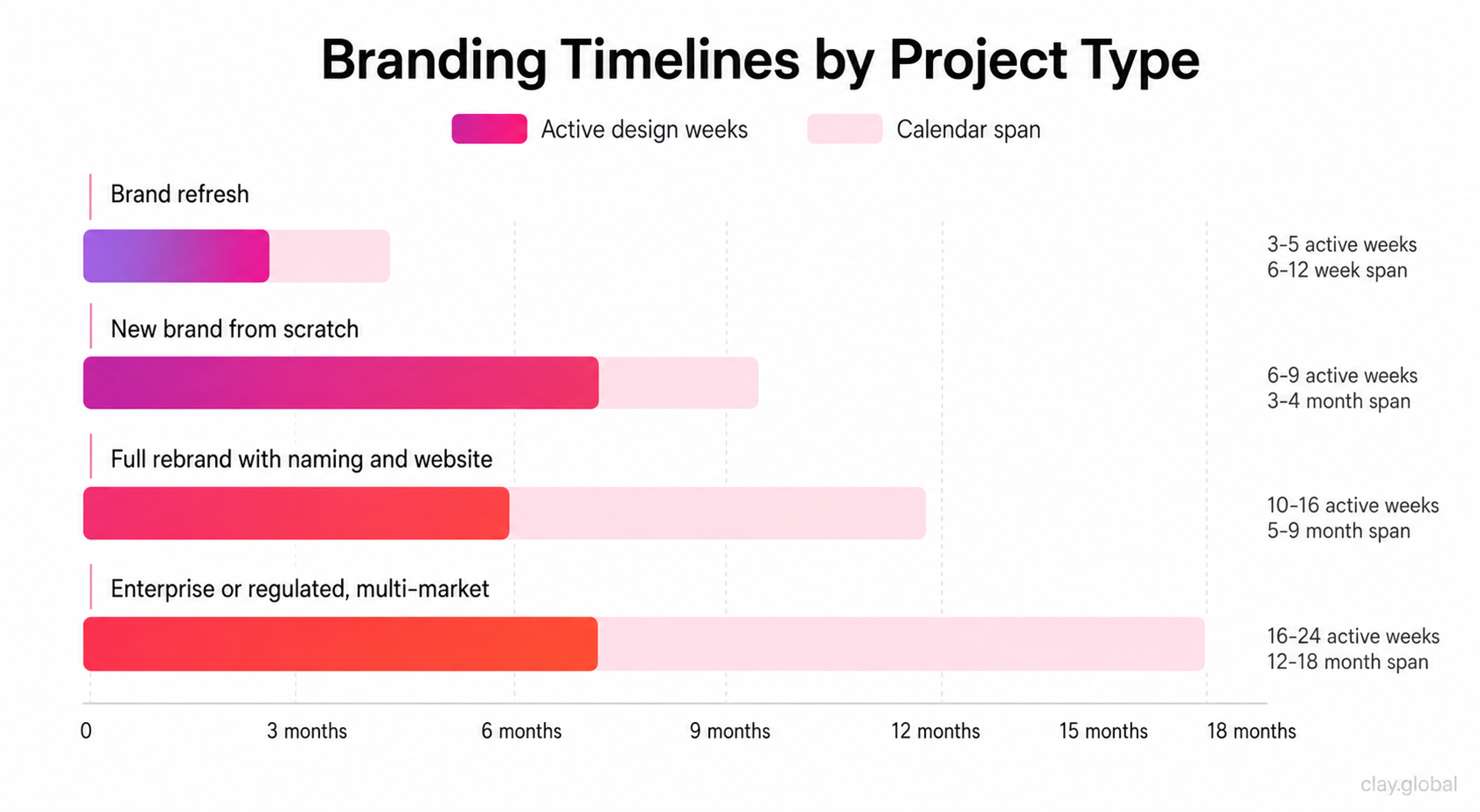
- Brand refresh, existing strategy holds. 3 to 5 active design weeks, across a 6 to 12 week calendar span.
- New brand from scratch, no legacy assets. 6 to 9 active design weeks, across 3 to 4 months.
- Full rebrand with naming and website. 10 to 16 active design weeks, across 5 to 9 months.
- Enterprise or regulated, physical assets, multi-market. 16 to 24 active design weeks, across 12 to 18 months.
Notice the ratio. On a full rebrand, roughly 12 weeks of work stretches across 30 weeks of calendar. That isn't padding, and it isn't an agency moving slowly. It's the accumulated cost of review cycles, legal checks, internal alignment, and production lead times.
The refresh row is where most people misjudge themselves. A refresh means your positioning is settled and you're updating expression: logo refinement, color, type, photography direction.
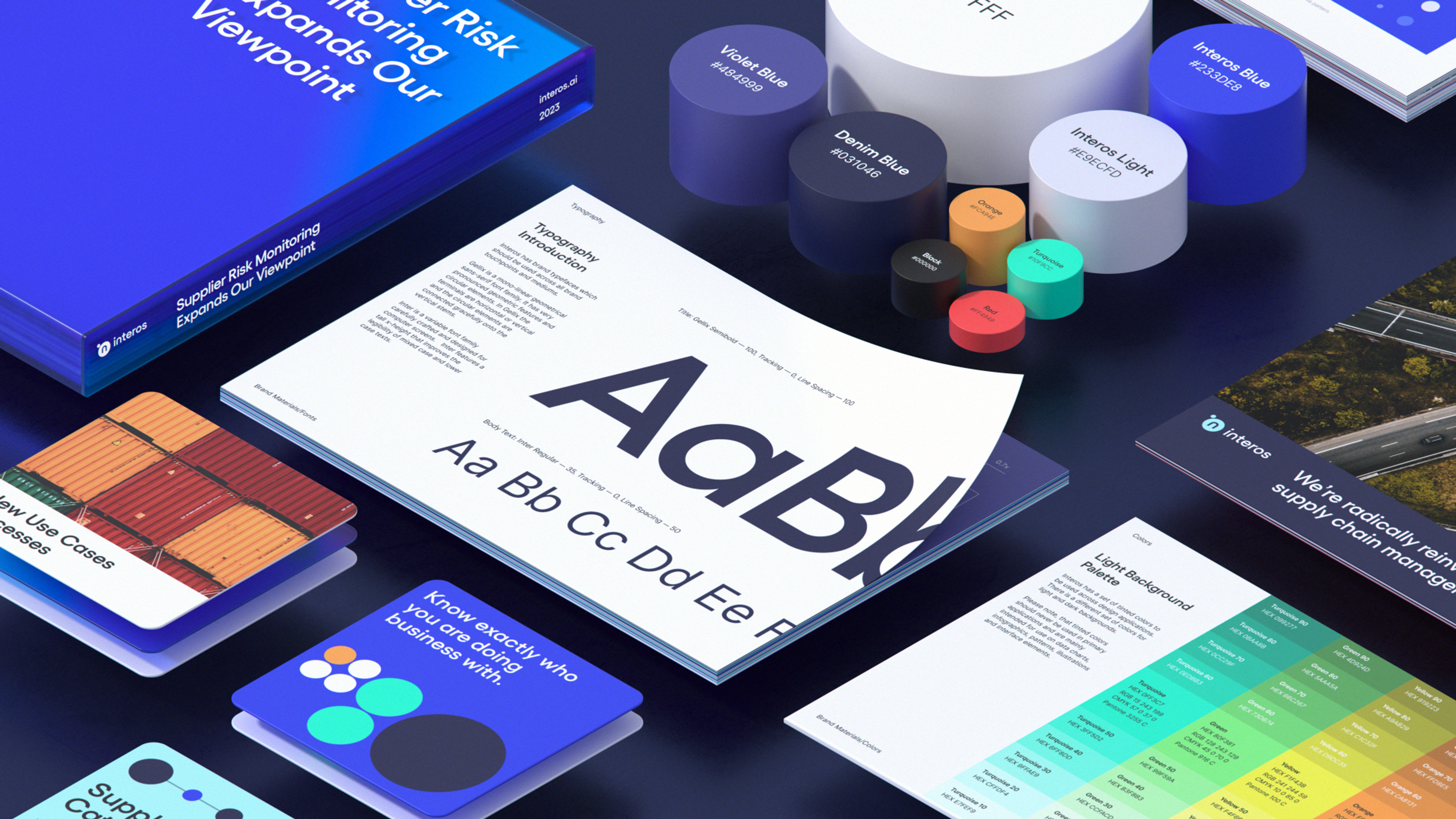
Clay's work with Interos followed that shape, upgrading the logo system and building out an icon library and guidelines after the company had already repositioned internally. If your positioning is genuinely unresolved, you're not doing a refresh, and the refresh timeline won't hold.
Interos Brand Identity by Clay Global
Why The Calendar Is Always Longer Than The Work Itself
Every agency blog blames "scope, stakeholders, and resources" for timeline slippage. True, and useless, because it doesn't tell you how much each one costs you in weeks. Here's the arithmetic that actually matters.
The Approval Gate Arithmetic
A standard branding engagement has five formal gates where work stops until you respond:
- the brief
- the strategy platform
- the initial identity direction
- the applied system
- the final guidelines
Run those five gates at a three-business-day turnaround, and you've spent three weeks of the calendar on review. Run them at two weeks each, which is normal for a company where the CEO reviews design between board meetings, and you've spent ten weeks. That's a seven-week difference on a project containing perhaps eight weeks of design work.
Read that again, because it's the whole point. Your review habit is roughly as large a timeline variable as the entire visual identity phase. Not the agency's team size. Not their process. But yours.
Worse, the cost compounds. Every gate you delay creates a resourcing gap on the agency side, and a team that gets pulled onto another project doesn't reassemble instantly. A two-week delay at gate three frequently becomes three weeks of lost calendar.
Why One Decision-Maker Beats a Committee
The second controllable variable is how many people hold veto power.
When five stakeholders review logo concepts, you don't get five useful opinions. You get five different aesthetic preferences, none of which can be overruled, and a design team trying to satisfy a composite that nobody actually wants.
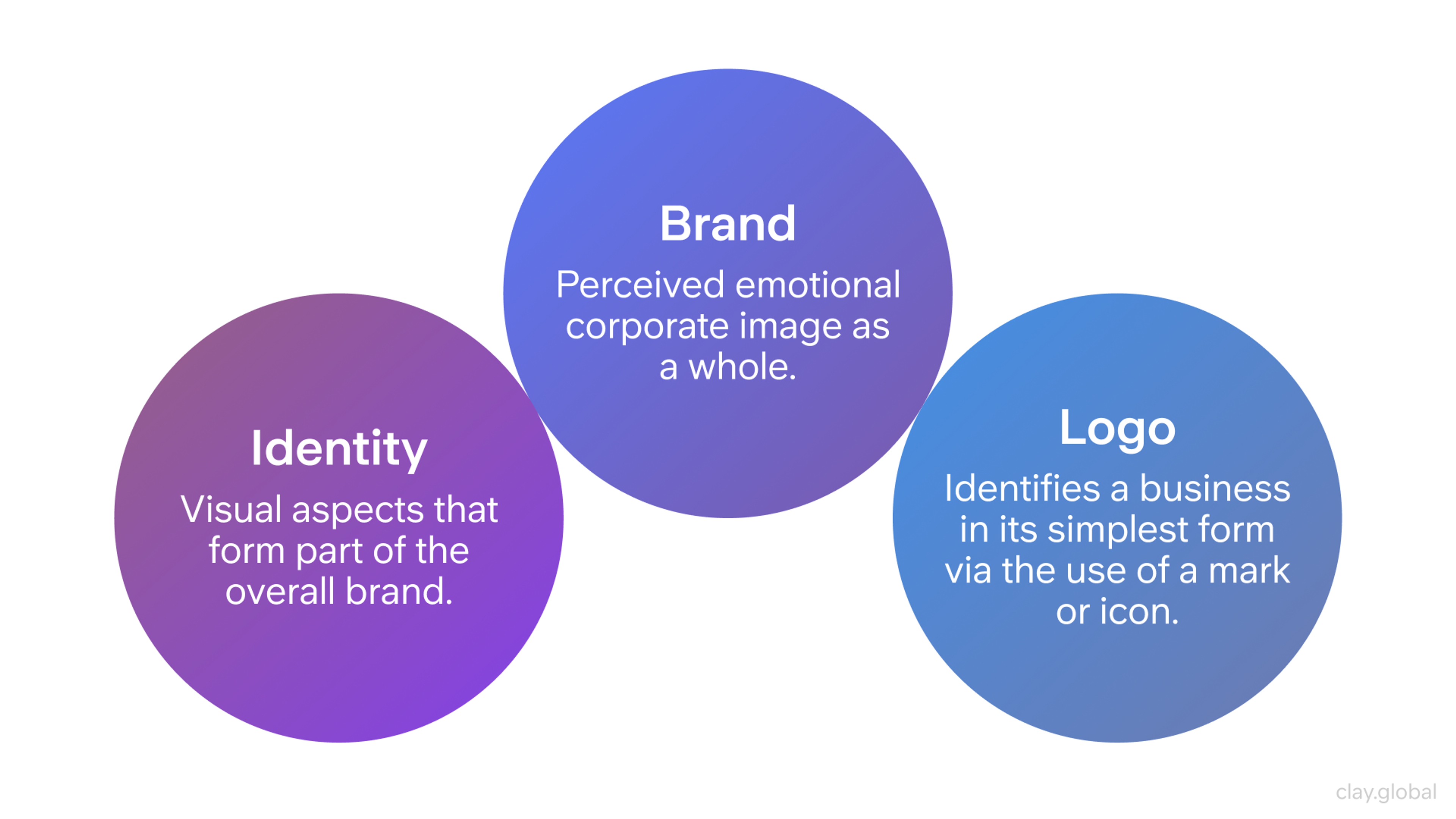
Brand Identity Elements by Clay
Rounds multiply. Directions get diluted toward whatever offends the fewest people.
Name one decision-maker before kickoff. Others can advise. One person signs. This single choice reliably saves more calendar time than any process improvement an agency can offer you.
Naming and Trademark
If your project includes a name change, you've added a dependency governed by a federal agency with its own queue. Most branding timeline articles skip this or quote a vague "12 to 18 months." The real numbers are published and worth knowing.
According to USPTO trademark processing data updated in August 2026, the average wait from filing a new application to a first examining action is 4.2 months. The average time from filing to either registration or abandonment is 9.7 months. Some queues are considerably worse: intent-to-use extension requests were averaging 198 days against a 15-day target.
Here's what that means for your launch date, and it isn't what most people assume.
You don't need a registered trademark to launch. You need clearance. A preliminary clearance search through a trademark attorney typically takes two to four weeks and tells you whether an identical or confusingly similar mark already exists in your category. The registration application then runs in parallel with everything else, and you can trade under the name while it sits in the queue.
The risk that actually eats calendar is a clearance failure. If your preferred name comes back blocked, you're back into naming, and that's two to four weeks of rework plus another clearance round. Sequence this early. Run clearance on your shortlist before visual identity work begins, not after, because a name that dies at gate four takes the logo with it.
One more sequencing note. Domain and social handle availability should be checked at the same time as legal clearance, not later. Acquiring a domain from a squatter can take weeks of negotiation and sometimes doesn't resolve the problem.
What Each Phase Takes
The phase breakdown is the part every competitor writes at length. Here it is compressed, because the numbers matter more than the narration.
1.
Discovery and research runs 1 to 3 weeks and produces the audit, stakeholder interviews, competitive landscape, and category conventions.2.
Positioning and strategy takes 2 to 3 weeks and settles audience, positioning, values, and the argument the identity has to express.3.
Verbal identity and naming run 2 to 6 weeks, covering name, voice, messaging framework, and key copy.4.
Visual identity takes 3 to 6 weeks for the logo system, color, typography, imagery, and initial applications.5.
Systemization and guidelines add 2 to 4 weeks of rules, edge cases, asset library, and templates.6.
Application and rollout can take anywhere from 3 weeks to 6 months and cover the website, product UI, collateral, packaging, and physical environments.
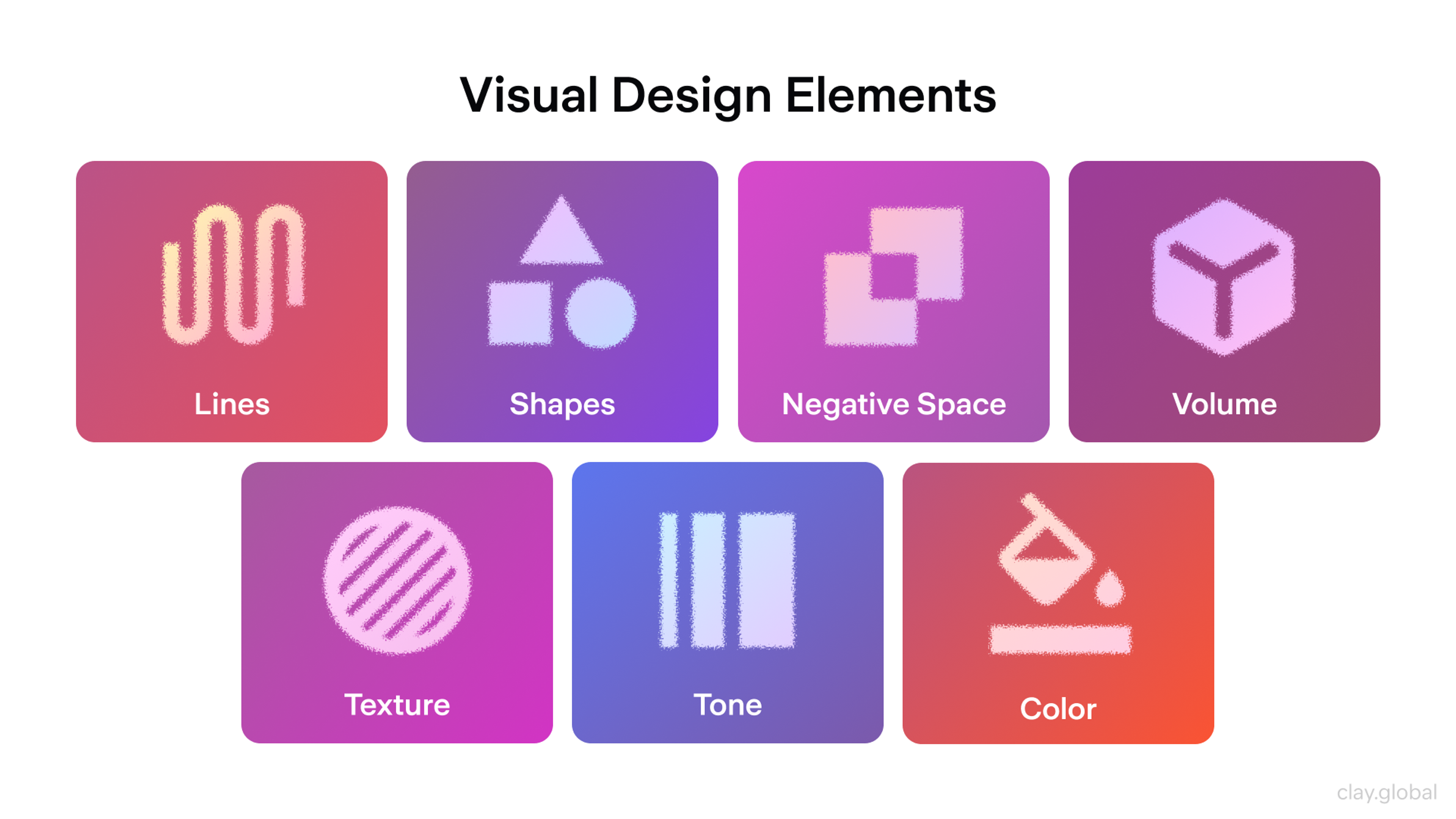
Visual Design Elements by Clay
Two of these deserve a warning.
Verbal identity is where projects stall unexpectedly. Messaging requires sign-off from people who weren't in the design reviews, usually sales and leadership, and they have opinions about words in a way they don't about kerning. Budget more review time here than the phase length suggests.
Application and rollout has the widest range on the page for a reason. It's less a phase than a container for everything the brand has to touch. A software company with a website and a product UI sits at the low end. A company with retail environments, packaging, and vehicle livery sits at the high end and then some.
What Can Run in Parallel, and What Can't
Some of this genuinely can happen at once. Trademark clearance runs perfectly well alongside strategy, since neither one waits on the other's output. You can commission photography while the system is still being built, and draft website content and page structure while visual exploration is open, because words don't need a finished logo to exist.
Guidelines are the interesting case. Write them during application work rather than after it, because the applications are what surface the edge cases the guidelines exist to settle.
Other things can't be forced into parallel, no matter what anyone promises. Strategy has to land before visual concepts, because concepts without a strategic argument can only be judged on taste. Identity direction needs locking before website visual design starts, since rebuilding page designs after a logo change costs more than waiting for one. And the core system comes before collateral, or you'll produce every asset twice.
The most common and most expensive sequencing error is starting the website build before the identity is locked. Clay's CafePay engagement ran identity and website as one continuous piece of work precisely so the visual system and the site were resolved against each other rather than the site chasing a moving target.
CafePay Branding and Website by Clay Global
If your agency proposes running them fully in parallel to save time, ask what happens to the site design if the logo changes at concept round two.
From early-stage startups to established platforms, we've built brands that hold up. If it's time to build yours properly, we'd love to hear from you.
Your Launch Date Is Not Your Finish Date
Teams plan for the launch and then discover the project keeps running for months. This is normal, and knowing it in advance keeps it from feeling like failure.
What typically trails the public launch:
- Physical assets have manufacturing lead times you can't compress. Signage is commonly six to twelve weeks from approved artwork to installation. Packaging runs on print schedules and existing inventory, so you may be shipping old packaging for a full sales cycle after launch.
- Legal entity changes, banking, contracts, and invoicing templates move at the speed of your finance and legal teams, which is to say not quickly.
- Third-party surfaces are slower than your own. App store listings, partner directories, review platforms, job boards, and integration marketplaces each have their own update process. Nobody owns this list unless you assign it.
- Internal adoption is the quietest one. Sales decks, email signatures, and proposal templates drift back to old assets unless the templates are genuinely easier to use than what people had before. This is where thin guidelines cost you for years.
Plan a rollout tail of two to six months past launch for a mid-sized company, and considerably longer if you have physical retail. Build it into the plan you present to leadership rather than discovering it in month seven.
What a Compressed Timeline Costs You
Sometimes the date is fixed. A funding announcement, a conference, or a merger close. Compression is a legitimate choice, but it doesn't remove work evenly across the project. It removes specific things in a predictable order, and you should choose which ones rather than letting the calendar choose for you.
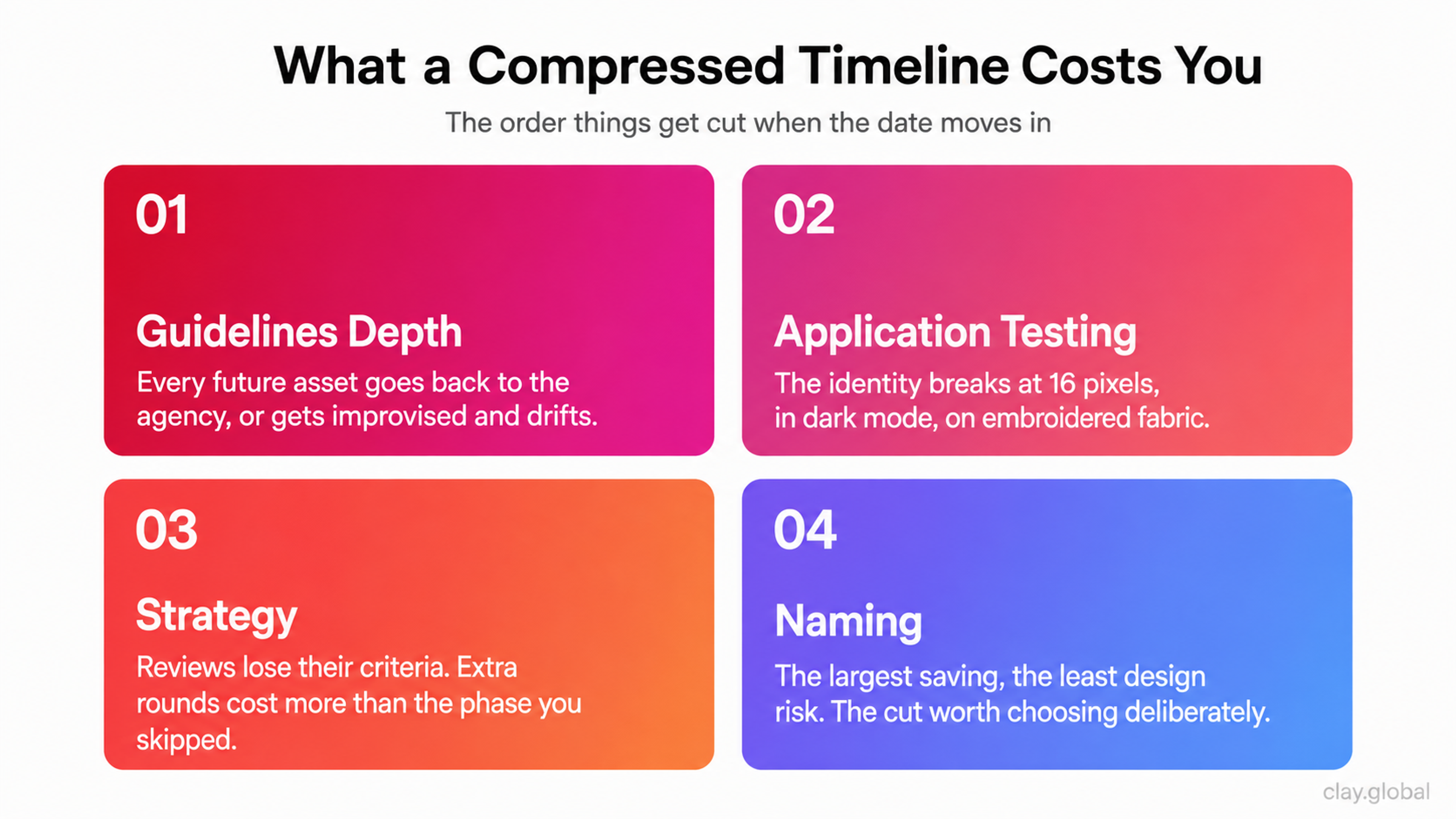
First to go: guidelines depth. The most compressible artifact is also the one with the longest tail. Thin guidelines mean every future asset either goes back to the agency at agency rates or gets improvised internally and slowly pulls the system apart.
Second: application testing. Skipping this means the identity looks excellent in the presentation and breaks the first time it meets a real constraint. A favicon at 16 pixels. A dark mode background. An embroidered polo shirt. You find out post-launch, and post-launch fixes are more expensive than pre-launch fixes.
Third: the strategy phase. This is the tempting cut and the false one. Removing strategy doesn't speed the project up - it slows it down, because review rounds have no criteria other than personal preference. Three extra rounds of "I'm not sure about the blue" cost more calendar time than the strategy phase you skipped.
Fourth, and only if you must: naming. Keep the existing name and change everything else. This is the single largest timeline reduction available, and it carries the least design risk.
What a Compressed Timeline Costs You
If you're weighing compression against budget, the two trade against each other in ways worth understanding before you negotiate.
How to Pressure-Test an Agency's Timeline Before You Sign
You're comparing proposals with different numbers on them. Here's how to tell which one is real.
Ask them to split the timeline into their working days and your review days. Plenty of capable agencies quote a single calendar span with review time already absorbed, so failing to volunteer the split isn't a mark against anyone. What matters is whether they can produce it when you ask. A vague answer tells you the date is an estimate rather than a plan, and more usefully, it tells you nobody has decided which side absorbs the risk when a review runs long. The strongest proposals name the review windows and state the turnaround they're assuming from you.
Ask what happens when you miss a review window. The honest answer describes a resourcing consequence and a revised date. The answer to worry about is reassurance that it'll be fine, which means the timeline has hidden slack or the date is fiction.
Ask which deliverables get cut if you pull the date forward by four weeks. A good agency answers immediately and specifically. A vague answer means they'll cut whatever is convenient in month three, and it will be your guidelines.
Ask who owns naming clearance and who pays for a reset. If naming is in scope, someone has to coordinate with trademark counsel, and someone absorbs the cost when a shortlist comes back blocked. Get this in writing.
Ask what "done" means. Which surfaces are included, which are explicitly excluded, and what the handover contains. Rollout scope is where quoted timelines diverge most and where post-project disputes concentrate.
The clearest red flag is a firm launch date offered before the agency knows how many decision-makers you have, whether the name is changing, and what your asset inventory looks like. A date given without those three answers is a guess dressed as a commitment.
Clay Global builds brand identities and the systems that keep them consistent after launch. If you're planning around a fixed date and want a timeline built backward from it, get in touch or look through our branding work first.
Read more
- Clay Global’s Branding Work
FAQ
How long does a logo design take on its own?
Two to four weeks of active work for exploration, refinement, and file preparation. A logo without a surrounding system isn't branding, though, and buying one in isolation usually means paying again later to build the system it should have been designed within.
Can branding be done in two weeks?
You can produce a logo, a palette, and a type pairing in two weeks. You cannot produce positioning, a tested system, and usable guidelines. Two-week engagements are appropriate for a pre-seed startup that needs to look credible immediately and expects to redo the work after product-market fit.
How long does a brand refresh take compared to a full rebrand?
A refresh runs 6 to 12 weeks because positioning is already settled and only expression changes. A full rebrand runs 5 to 9 months because it reopens strategy, frequently touches the name, and requires a rollout across every surface. The distinction is whether the underlying argument changes or only its presentation.
Does adding a website extend the branding timeline?
Yes, typically by 8 to 16 weeks, and the site can't be fully designed until identity direction is locked. For this reason, many teams run brand and web as one engagement.
How much time does naming add to the process?
Four to eight weeks of active work, plus two to four weeks for legal clearance, plus the risk of a reset if clearance fails. Budget six to twelve weeks of calendar time for naming overall, and start it before visual work rather than alongside it.
Do I need a registered trademark before I launch a new name?
No. You need clearance, which confirms no conflicting mark exists in your category. Registration typically completes well after launch. USPTO figures put the average from filing to registration or abandonment at 9.7 months, so waiting for it would delay most launches by the better part of a year.
How long before a rebrand shows business results?
Commercial signals such as win rate and inbound quality generally appear three to six months after launch. Awareness and perception shift more slowly, often six to twelve months, and only if the rebrand is supported by sustained marketing rather than treated as a one-off event.
What's the fastest realistic timeline for a funded startup?
Around ten to twelve weeks, assuming no name change, a single decision-maker, a three-day review turnaround, and a scope limited to identity, guidelines, and a marketing site. Faster than that means cutting the strategy phase, which usually costs the time back in extra review rounds.
Why do agencies quote such different timelines for the same brief?
Because they're pricing different projects under the same word. One quoted a logo refresh. Another quoted positioning, naming, a full system, guidelines, and a website build. Compare deliverable lists before comparing dates.
How much of the timeline is my responsibility?
Between a third and a half of the calendar on a typical engagement, concentrated in review turnaround, content and asset provision, and internal alignment. It's the largest single lever you control, and the one most teams underestimate.
Does an in-house team move faster than an agency?
Rarely, on a full rebrand. In-house teams carry existing workload, lack the specialist naming and strategy roles, and face more internal politics around brand decisions, not less. In-house is generally faster for ongoing application work after the system exists.
What happens if we miss a review deadline mid-project?
The agency reassigns the team, and getting them back isn't instant. Expect a two-week client delay to cost roughly three weeks of calendar time. Ask about this explicitly during proposal review so the consequence is agreed rather than negotiated later.
How long do brand guidelines take to produce?
Two to four weeks of active work, running partly in parallel with application design because applications surface the edge cases guidelines need to resolve. Guidelines written before any application work tend to be incomplete in exactly the places you'll need them.
Should we launch the brand all at once or phase it?
A single visible launch across your primary surfaces reads as intentional. A drawn-out phased reveal reads as disorganized. Launch the digital surfaces together, then let physical and third-party assets transition on their own lead times behind that moment.
How far ahead should we start if we have a fixed launch date?
Work backward from the ranges at the top of this article, add your rollout tail, and add four weeks of buffer. For a full rebrand tied to a hard date, that means starting nine to twelve months out. For an identity refresh, four to five months.
Planning a Date You Can Commit To
The branding process takes as long as your decisions, your legal exposure, and your surface area require. Design is the part that behaves predictably.
Which means the most useful thing you can do before a project starts has nothing to do with choosing an agency. Name your decision-maker. Run clearance on your name early. Count the surfaces the new brand has to reach, including the ones nobody in the room owns. Do those three, and a nine-month project becomes a six-month one without anyone working faster.


About Clay
Clay is a UI/UX design & branding agency in San Francisco. We team up with startups and leading brands to create transformative digital experience. Clients: Facebook, Slack, Google, Amazon, Credit Karma, Zenefits, etc.
Learn moreAbout Clay
Clay is a UI/UX design & branding agency in San Francisco. We team up with startups and leading brands to create transformative digital experience. Clients: Facebook, Slack, Google, Amazon, Credit Karma, Zenefits, etc.
Learn more