

UX teams reduce the risk of building the wrong thing. They translate messy human needs into concrete product decisions. When UX works well, teams catch problems early, reduce rework, and make products easier to learn and faster to use.
A core focus of a strong UX team is creating meaningful user experiences that engage users and foster loyalty. To achieve this, teams establish key UX design goals that guide their work, ensuring that every decision supports the development of effective and engaging user experiences.
UX also coordinates across functions. It sits at the intersection of what people want, what engineering can build, and what the business can sustain. Because of this position, UX teams often connect product, engineering, marketing, support, and data science. Agencies also help with this.
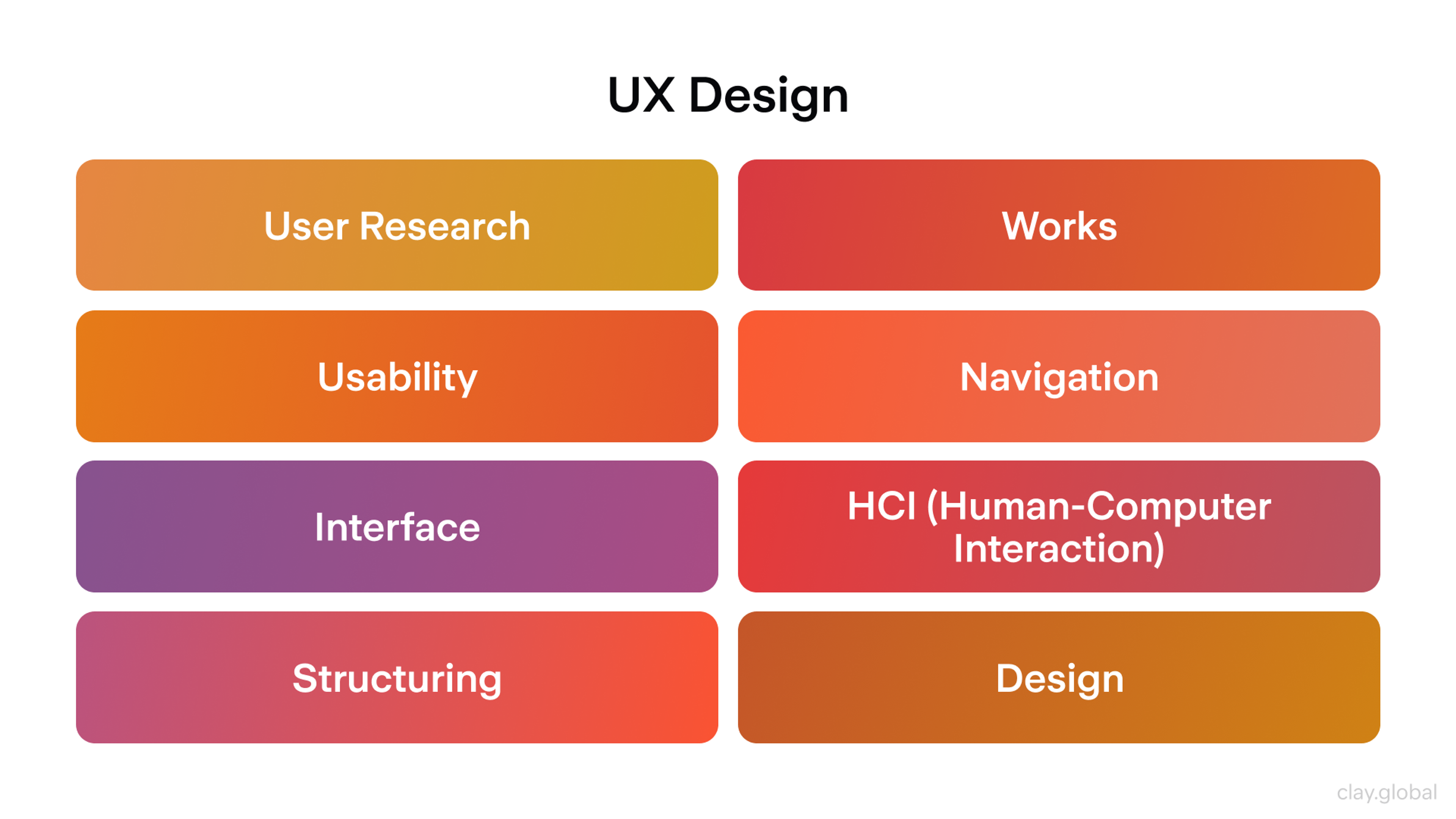
UX Design by Clay
How UX Teams Are Organized
Most companies use one of three structures, making team structure and design team structure key considerations for organizing UX teams.
A centralized model pools designers and researchers into a single group that services multiple product lines. This is known as a centralized UX team.
This approach improves quality, makes mentorship easier, and provides a natural home for design systems. Operating as one team in a centralized UX team helps maintain consistency and shared standards across projects. The trade-off is slower embedding in day-to-day delivery despite delivering an effective design solution.
An embedded model places designers and researchers inside a cross-functional team within cross-functional squads. Spotify pioneered this squad model, embedding designers within autonomous teams while maintaining alignment through shared design guilds.
Comparing different team structures, such as centralized, embedded, or hybrid models, shows how design team structure impacts workflow, collaboration, and brand consistency. The choice of team structures based on user-centered design principles should align with company goals and resources.
Core Roles and What They Focus On
UX Researcher
Focus: Understanding people, contexts, and behaviors to reduce uncertainty.
UX researchers plan and conduct user research and UX research to inform design decisions. Researchers plan and run studies, synthesize findings, and connect insights to decisions.
Typical artifacts include research plans, discussion guides, screeners, session notes, highlight reels, insight reports, research findings, and user insights. Good researchers frame questions related to user personas as decision support. They ask what the team will change if the answer is X versus Y.
What good looks like: actionable insights tied to a product decision, not a stack of quotes. Clear limits on what a study can and cannot infer. Repeatable methods, consistent recruiting, and ethical handling of participant data.
Anti-patterns: research as a final validation ritual, cargo-cult methods, or vanity metrics like number of interviews without decisions made.
UX research process by Clay

Product Designer (UX Designer)
Focus: Translating strategy and insights into flows, states, and interfaces.
Product designers and UX designers refer to the same role in most organizations. The product prefix emphasizes end-to-end ownership from problem framing to shipped interface, with product designers contributing at each stage of the design process.
The role combines interaction design and visual design: what happens, in what order, and how it looks and feels. Visual elements such as colors, typography, and icons, along with strong visual design skills, are essential in shaping user interfaces that are both attractive and functional.
Designers collaborate in real-time using tools like Figma, and proficiency in design tools and design skills is crucial for effective collaboration and creating high-quality outcomes. They create problem statements, information architecture sketches, flows, wireframes, prototypes, and high-fidelity design files.
What good looks like: clear task flows, sensible defaults, consistent patterns, and attention to empty, error, and loading states. Realistic data and content in mocks. Frequent collaborative reviews with engineering and content.
Anti-patterns: designing for the happy path only, shipping pixels without states, or treating handoff as throwing it over the wall.
Mockup vs Wireframe vs Prototype by Clay

Information Architect
Focus: Structure and organization of information across the product.
Information architects define navigation hierarchies, labeling systems, and content models. On complex products or content-heavy platforms, information architecture determines whether users can find anything at all.
Typical artifacts include site maps, taxonomy maps, category definitions, and metadata models. Information architecture work often includes card sorts, tree tests, and search log analysis.
What good looks like: labels that reflect user language, not internal jargon. A structure that scales as the product grows. Consistent, testable navigation.
Anti-patterns: reorganizing based on org charts, inventing clever names no one searches for, ignoring search behavior.
Content Designer (UX Writer)
Focus: The words and the meaning.
Content designers or UX writers shape microcopy, navigation labels, error messages, onboarding, and help content. They improve comprehension, reduce anxiety, and guide action.
Typical artifacts include content briefs, voice and tone guidelines, content inventories, and string maps. They partner with localization and legal to keep language accurate and inclusive.
What good looks like: verbs that match user intent, progressive disclosure, and clarity under stress like failed payments. Content standards that evolve with the product.
Anti-patterns: treating copy as spellcheck at the end, or allowing each feature to invent its own terms.
Visual Designer (Brand Designer)
Focus: Aesthetic cohesion and brand expression in product and marketing surfaces.
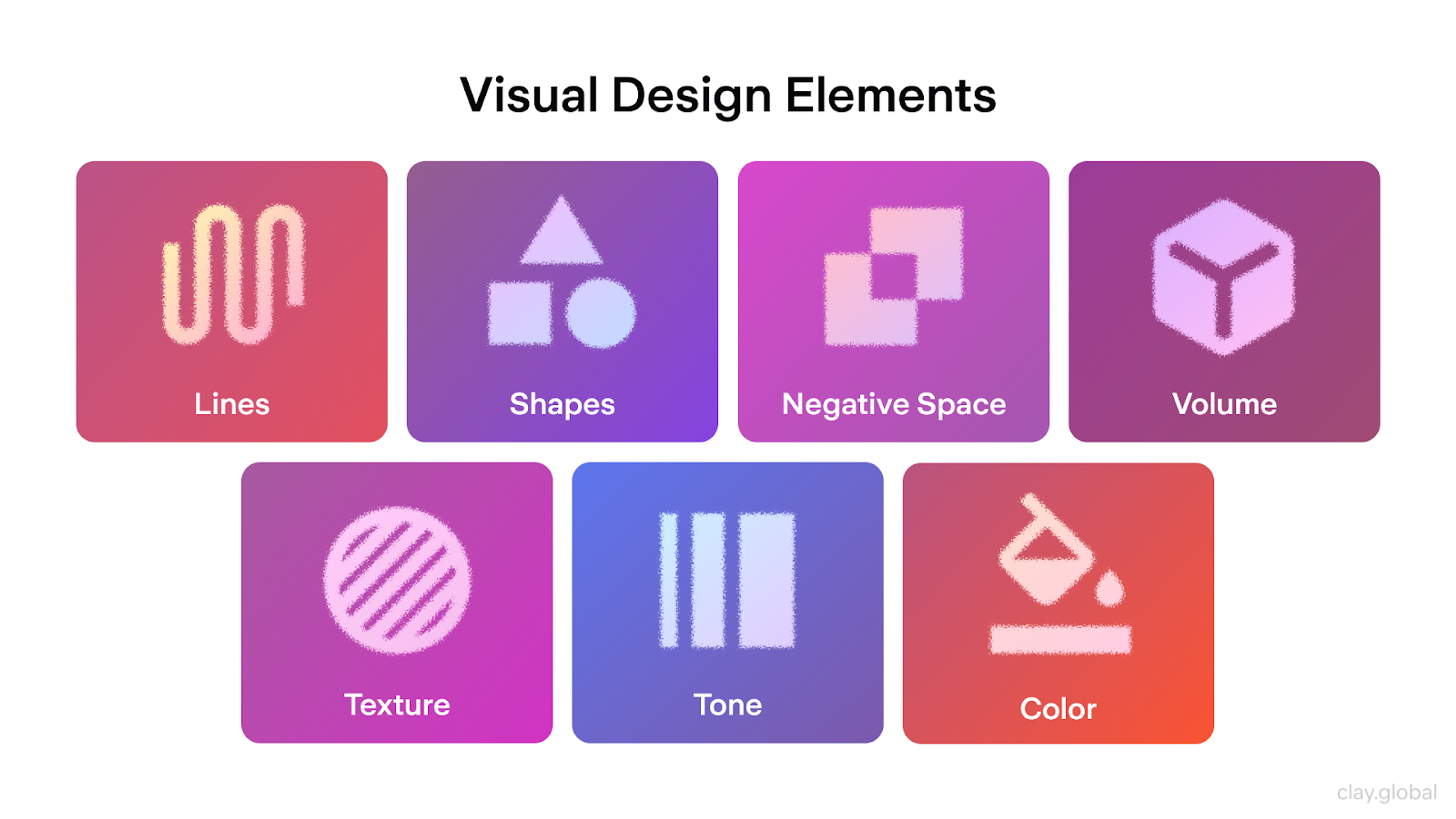
Visual designers refine typography, color, iconography, and motion to create a distinctive, accessible look and feel.
Typical artifacts include visual systems, illustration libraries, brand guidelines, and marketing assets that align with in-product UI.
What good looks like: a recognizable, accessible visual language that doesn't fight usability. Thoughtful contrast ratios and motion used to communicate state, not decorate.
Anti-patterns: heavy styles that reduce legibility or performance, diverging brand and product languages that confuse users.
Visual Design Elements by Clay
Prototyper (Motion Designer)
Focus: Bringing interaction to life.
Prototypers prove feasibility and nuance through gesture physics, transitions, and micro-interactions. Motion designers communicate hierarchy and causality with time and movement.
Typical artifacts include interactive prototypes and motion specs. Their work reduces ambiguity during build, especially for complex interactions.
What good looks like: prototypes that answer a specific question like is this menu discoverable, and motion that improves comprehension at speed.
Anti-patterns: spending weeks on film-quality prototypes for questions a paper sketch could answer, motion for motion's sake.
UX Engineer
Focus: The bridge between design and production code.
UX engineers differ from pure front-end developers in scope and timing. They build high-fidelity prototypes with actual components, explore technical constraints early, and contribute to design systems with accessible, performant components. The UX lead will prototype interactions and contribute to design decisions before implementation begins.
What good looks like: closing the gap between design intent and shipped UI, proactive trade-off proposals, measuring performance and accessibility.
Anti-patterns: building bespoke components that bypass the system and create maintenance debt.
Design Systems Designer
Focus: Shared foundations include tokens, components, patterns, and documentation.
The goal is speed with consistency. Companies including Google with Material Design, IBM with Carbon, and Salesforce with Lightning publish their design systems publicly, demonstrating enterprise-grade component architecture. These systems reduce design debt and enable consistent experiences across hundreds of products.
Typical artifacts include component specs, usage guidelines, accessibility notes, and change logs. Systems teams partner with engineering to version, deprecate, and migrate safely. Tools like Storybook and Zeroheight help teams document and maintain component libraries at scale.
What good looks like: a living system with adoption, contribution pathways, and governance that balances stability with evolution.
Anti-patterns: treating the system as a museum, allowing uncontrolled forks, ignoring real product constraints.
Accessibility Specialist
Focus: Inclusive, compliant experiences.
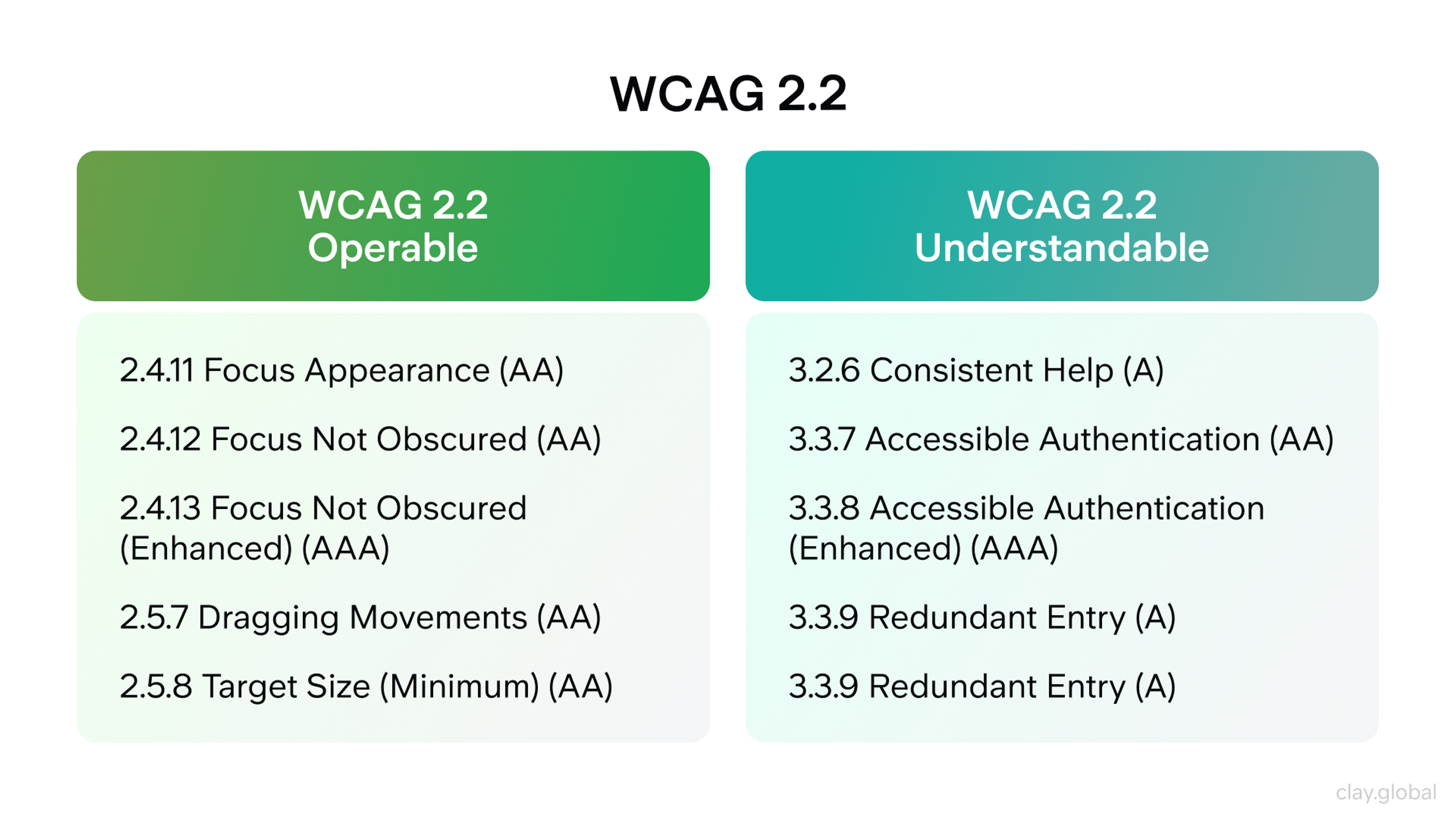
Accessibility specialists ensure WCAG 2.2 compliance through semantic markup, assistive technology testing, and inclusive design patterns. Accessibility specialists conduct research by testing with screen readers and other assistive technologies, writing inclusive specs, and training teams on accessibility guidelines.
WCAG 2.2 by Clay
Early investment in accessibility specialists prevents costly retrofits that can exceed ten times the upfront implementation cost.
Typical artifacts include accessibility reviews, audit reports, remediation plans, and patterns for common controls.
What good looks like: accessibility baked into definitions, designs, and quality assurance, not a late audit. Inclusive copy, keyboard navigation, semantics, and color contrast verified in code.
Anti-patterns: we'll fix it later, or equating accessibility with checkbox compliance rather than usable experiences.
Service Designer
Focus: The end-to-end service across channels and touchpoints.
Service designers map product, support, operations, and offline experiences. They chart journeys, blueprint backstage processes, and identify failure points and users’ pain points, including frustrations and challenges, across channels and touchpoints.
Typical artifacts include journey maps, service blueprints, backstage process maps, and opportunity backlogs.
What good looks like: coordinated experiences where the UI, policies, and people align. Clear handoffs between teams and channels.
Anti-patterns: optimizing one screen while the policy behind it creates friction, ignoring support workflows.
Data Analyst (Insights Analyst)
Focus: Behavioral evidence at scale.
Analysts instrument events, build dashboards, run experiments, and help teams interpret what usage means. They measure adoption patterns that inform the next research cycle.
Typical artifacts include metrics frameworks, experiment designs, and analysis reports that connect behavior to hypotheses.
What good looks like: clear definitions, guardrails against false positives, and analysis that complements, not replaces, qualitative research.
Anti-patterns: chasing vanity metrics, mistaking correlation for causation, or designing only for what is measurable.
Research Operations (Research Ops)
Focus: The systems that make research reliable and fast.
Research Ops manages recruiting, incentives, consent, repositories, and knowledge management. Remote research platforms like UserTesting and Lookback enable faster participant recruitment across geographic markets.
Typical artifacts include participant panels, templates, repositories, and governance policies.
What good looks like: less time on logistics, more time on insight. Ethical, inclusive recruiting and repeatable processes.
Anti-patterns: lost findings, ad-hoc recruiting, and privacy risks.
Design Operations (UX Program Manager)
Focus: The systems that help design scale.
Design Ops handles planning, intake, prioritization, capacity, tooling, and rituals. Design Ops ensures designers spend time designing and that leadership sees reliable delivery. Additionally, Design Ops supports the team's professional growth by facilitating training, mentorship, and career development activities.
Typical artifacts include roadmaps, intake briefs, resourcing plans, and process documentation.
What good looks like: predictable delivery without stifling creativity, transparent trade-offs, lightweight process that protects focus time.
Anti-patterns: process theater that creates status for status’ sake, treating all work as equal.
Product Manager (The Closest Partner)
Focus: Outcomes, scope, and sequencing.
Product managers define goals, shape strategy, collect constraints, and decide when to ship. Great product managers align UX efforts with business goals and business strategy, nurture UX, protect research time, and ground decisions in user and business impact.
In larger projects, the project manager plays a key role in supporting outcomes and delivery, working closely with the product manager to ensure smooth execution.
What good looks like: shared problem framing, tight decision loops, and a backlog influenced by evidence.
Anti-patterns: solutioneering without research, date first and scope later, or treating design as decoration.
Collaboration Across the Product Lifecycle
Most digital product teams follow a recurring lifecycle that moves from discovering opportunities to learning from real use. One simple version includes five stages: Discover, Define, Design, Deliver, and Learn. At each stage, different specialists work together to move the product forward.
In Discover, researchers and designers work with product managers and other team members to explore opportunities. They interview users, analyze support tickets, study competitive patterns, and map journeys. Data partners surface signals in behavioral logs. The output is a clear problem statement, success metrics, and constraints.
In Define, the team narrows scope. Information architects shape structure. Content designers set terminology. Designers sketch alternatives. Prototypers explore risky interactions. Engineers sanity-check feasibility. Service designers map the end-to-end flow so no one optimizes a single step in isolation. Collaboration among team members, including other ux professionals and development teams, ensures all perspectives are considered.
In Design, high-priority paths become detailed flows. Visual designers refine hierarchy and rhythm. Accessibility specialists review semantics and contrast. Design systems keep the work coherent. The triad negotiates trade-offs openly about what to include now and what to stage for later.
In Deliver, UX engineers and developers translate specs into code. Content designers finalize microcopy and help with localization. Design reviews and design quality assurance catch regressions. Data analysts set up events so the team can observe how users interact with the product after launch. Close collaboration with development teams and other team members supports project success.
In Learn, the team runs user testing, usability testing, surveys, and experiments. They compare outcomes to the original hypotheses and decide whether to iterate, scale, or retire a path. Gathering user feedback is essential to improve outcomes and ensure the product continues to meet users needs and user expectations. Research Ops and Design Ops archive learnings so future teams start smarter.
Read more:
FAQ
What Are The Main Roles In A UX Team?
A UX team usually includes UX designers, UI designers, UX researchers, product designers, content designers, and UX strategists. Each focuses on a specific part of the user experience.
What Does A UX Designer Do?
A UX designer creates user flows, wireframes, and prototypes to make digital products intuitive and easy to use. They focus on usability and overall user satisfaction.
What Is The Role Of A UX Researcher?
UX researchers study user behavior and needs through interviews, surveys, and testing. Their insights guide design decisions and help teams build products users actually want.
How Do UI And UX Roles Differ?
UI design focuses on how things look: colors, typography, and layout. UX design focuses on how things work, flow, and feel during interaction.
Conclusion
UX teams are built to make better decisions sooner. Titles vary, but the core focus stays steady. Understand people and contexts. Structure information. Design responsible interactions.
Express them clearly and beautifully. Ship them reliably. Learn as you go. The mix of roles you need depends on your stage, your product's complexity, and your appetite for risk.
If you're assembling a team, start with the problems you must solve in the next two quarters. Are you unsure what to build? Weight toward research and service design. Are you shipping but reworking constantly?


About Clay
Clay is a UI/UX design & branding agency in San Francisco. We team up with startups and leading brands to create transformative digital experience. Clients: Facebook, Slack, Google, Amazon, Credit Karma, Zenefits, etc.
Learn moreAbout Clay
Clay is a UI/UX design & branding agency in San Francisco. We team up with startups and leading brands to create transformative digital experience. Clients: Facebook, Slack, Google, Amazon, Credit Karma, Zenefits, etc.
Learn more