

Most brands don't fall apart overnight. They drift until a carefully built identity starts looking like three different companies.
Brand asset management is the discipline that helps stop that slide before it becomes a rebrand-sized problem.
If you've ever dug through shared folders looking for "the real logo" or watched a sales rep pitch with an old color palette, you already know what identity drift feels like.
Key Takeaways
- Brand asset management is the operational discipline for keeping logos, templates, guidelines, and other approved brand files organized and consistently used. Brand governance defines the rules, while processes and software help teams apply them day-to-day.
- A single source of truth for approved brand assets matters more than any individual tool. It's the difference between a team reliably finding the right file and guessing.
- Before choosing software, audit existing brand assets to identify gaps, duplicates, and outdated versions. You can't centralize what you haven't mapped.
- Role-based permissions can reduce unauthorized changes and limit access to sensitive assets, especially as more internal and external contributors work with the brand.
- Brand asset management best practices are ongoing habits. Drift can return when ownership, guidelines, and asset libraries stop being maintained.
What Is Brand Asset Management?
It's how brands organize, govern, maintain, and distribute the files and rules behind their visual identity and verbal tone, including logos, color values, fonts, templates, tone-of-voice guidance, and approved photography or illustration. These are the building blocks of a company's brand identity.
Brand asset management (BAM) is commonly treated as a focused area within or alongside digital asset management (DAM).
DAM and BAM compared
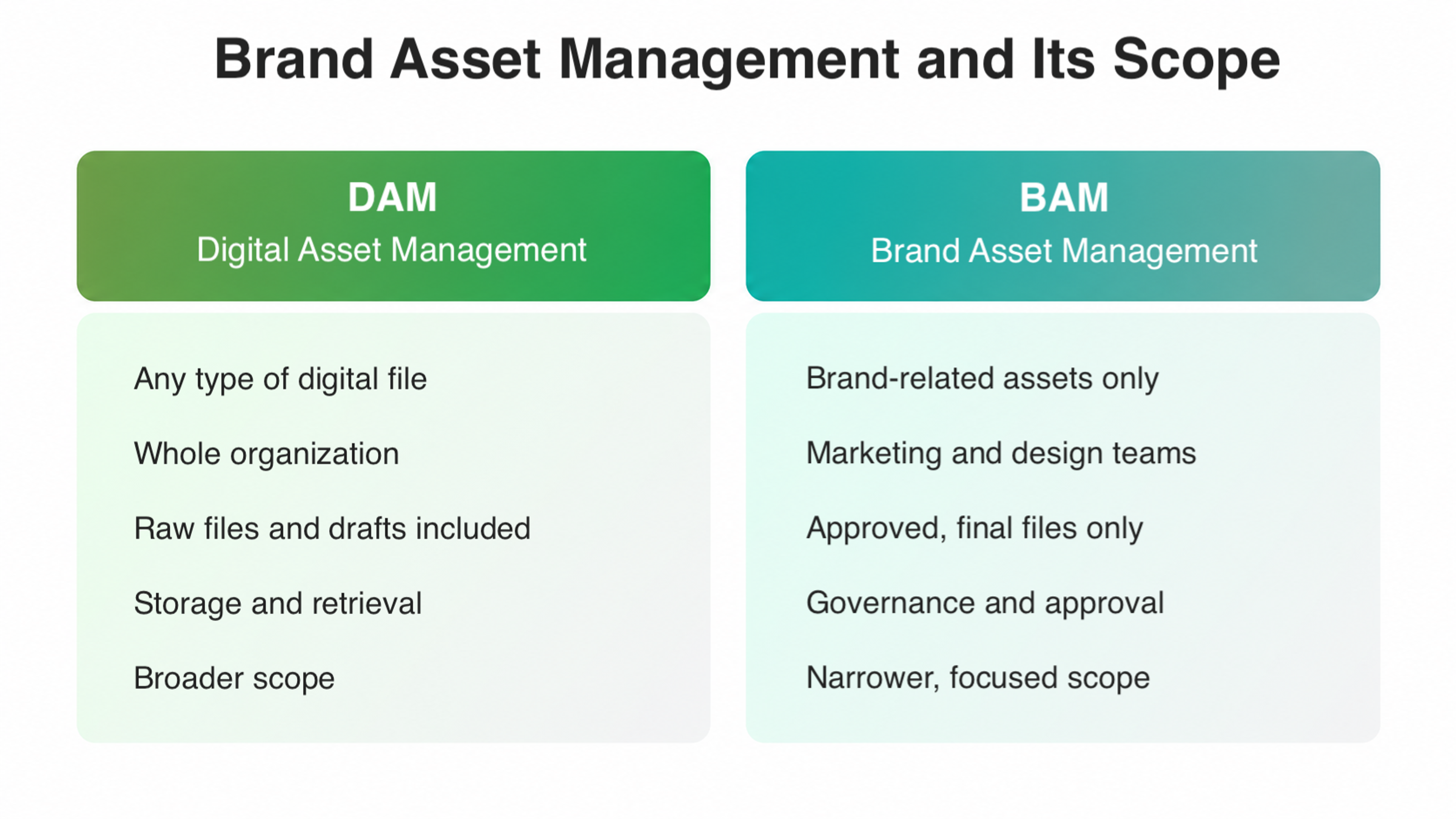
DAM has a broader scope and can manage many kinds of digital content, while BAM concentrates specifically on assets tied to the brand.
What Is "Brand Drift"?
"Brand drift" is what happens when that system breaks down.
Brand Chaos vs Brand Architecture by Clay Global

It can include situations like a freelancer resizing the logo slightly wrong, a regional office building its own slide template, or a new hire pulling brand colors from an old PDF because nobody told them where the current version lives.
None of these choices is dramatic on their own. Together, they can gradually weaken visual and verbal consistency across teams and channels.
Brand Guidelines vs. a Brand Asset Management Platform
Brand guidelines and a brand asset management platform address different parts of the same problem within a broader brand strategy. Brand guidelines are the rulebook, the document or digital resource that explains how logos, colors, typography, imagery, messaging, your brand value proposition, and other brand elements should be used.
Roles That Work Together
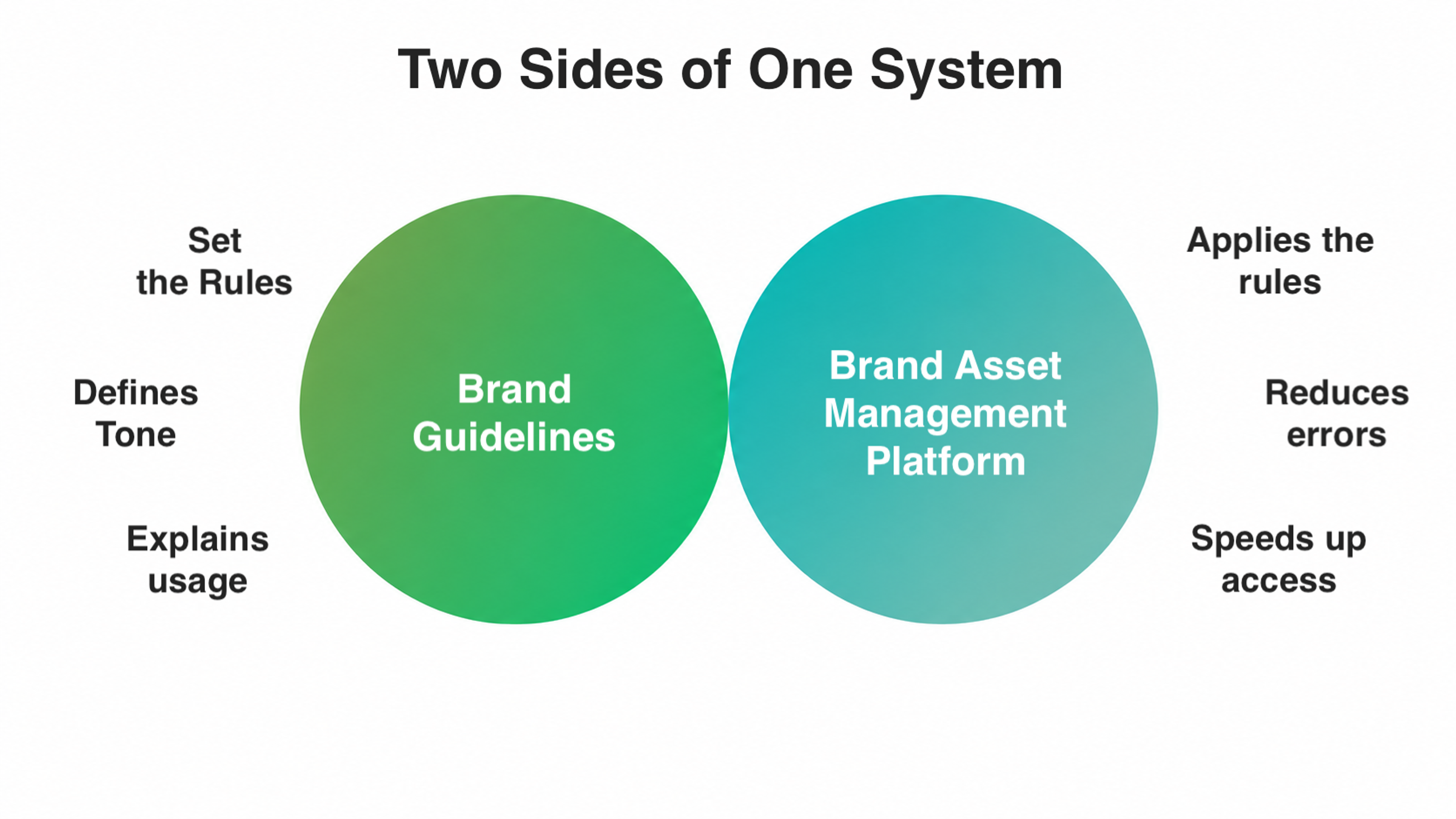
A BAM platform, a DAM, or another structured asset system can help teams apply those rules by giving them access to the correct assets and reducing opportunities to use obsolete or unapproved material.
Brand governance comes in here. Guidelines alone only work if people actually find, read, and follow them. Software can make that easier.
Depending on the platform and configuration, teams can use features such as approval workflows, permissions, asset status, expiration dates, locked templates, and controlled downloads to reduce incorrect usage. These capabilities vary by product, so they shouldn't be treated as universal BAM features.
Messaging can be managed in a similar way. Approved taglines, boilerplate copy, brand language, tone guidance, and templates can live alongside visual assets, so teams have a current reference instead of recreating language from memory.
Clay Global builds brand identities and the systems that keep them consistent after launch. If your identity needs a system as much as a redesign, explore our branding work.
Signs Your Brand Identity Is Drifting
Multiple Versions of the Same Logo
Old exports sit next to new ones in shared folders. Some have the wrong padding, some the wrong color mode, and nobody's sure which one is current.
Inconsistent Answers About the Final Files
Asking three people and getting three different answers is a reliable warning sign that no single version has been designated as authoritative.
Outdated Assets Still in Active Use
A sales deck from eighteen months ago keeps getting reused because it's the version someone can find quickly, or a retired campaign image reappears in a presentation.
New Hires Copying From Obsolete Material
New employees pull colors or messaging from an old document simply because nobody told them where the current version lives.
Messy Filenames Instead of Real Version Control
Files with names like "logo_final_v2_ACTUALFINAL.png" are often a sign that version status is being communicated manually rather than through a reliable system.
If this goes unchecked, it steadily erodes the brand recognition a company worked to build. Over time, it chips away at brand perception too.
Small teams aren't automatically protected from the problem. Drift can begin whenever multiple people are producing brand-facing material without a clearly maintained reference point.
How Centralization Keeps Everyone on the Same Page
Consistency Across Platforms by Clay Global
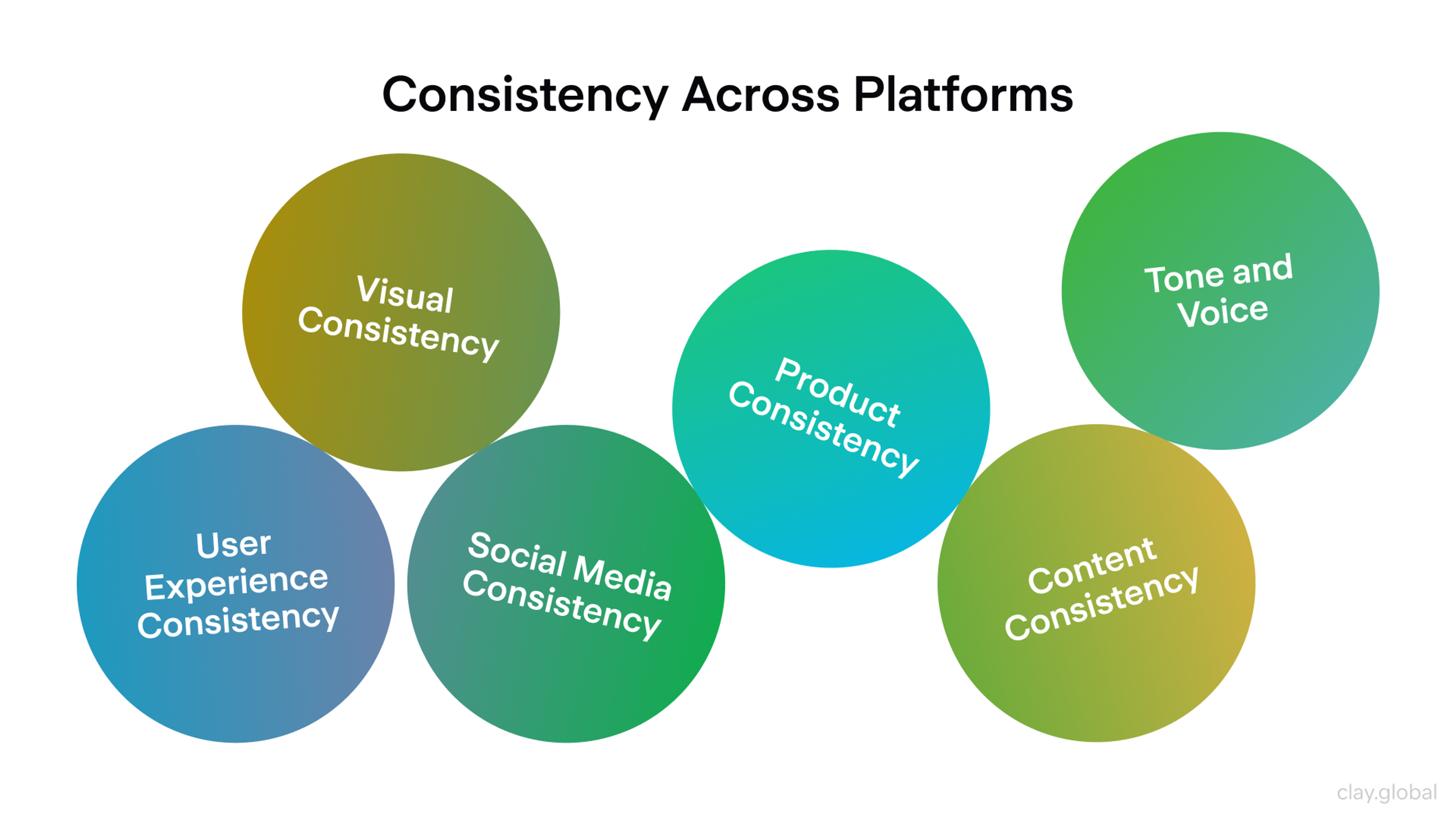
Centralization gives teams a designated source for approved assets.
That source doesn't necessarily have to be a dedicated BAM platform. Depending on the size and complexity of the organization, it could be an organized shared drive, a DAM, a brand portal, or another asset-management system.
Metadata, naming conventions, labels, and taxonomy become increasingly useful as the library grows.
They allow someone to search for a primary logo, campaign, market, product, asset type, or usage status without needing to know exactly which folder another person chose months earlier.
Google’s Material Symbols applies a similar idea to interface assets.
Instead of treating every icon variation as a separate, loosely managed file, the system defines controlled properties such as fill, weight, grade, and optical size.
Grade Axis Visualization from Google Material Symbols, CC BY 4.0
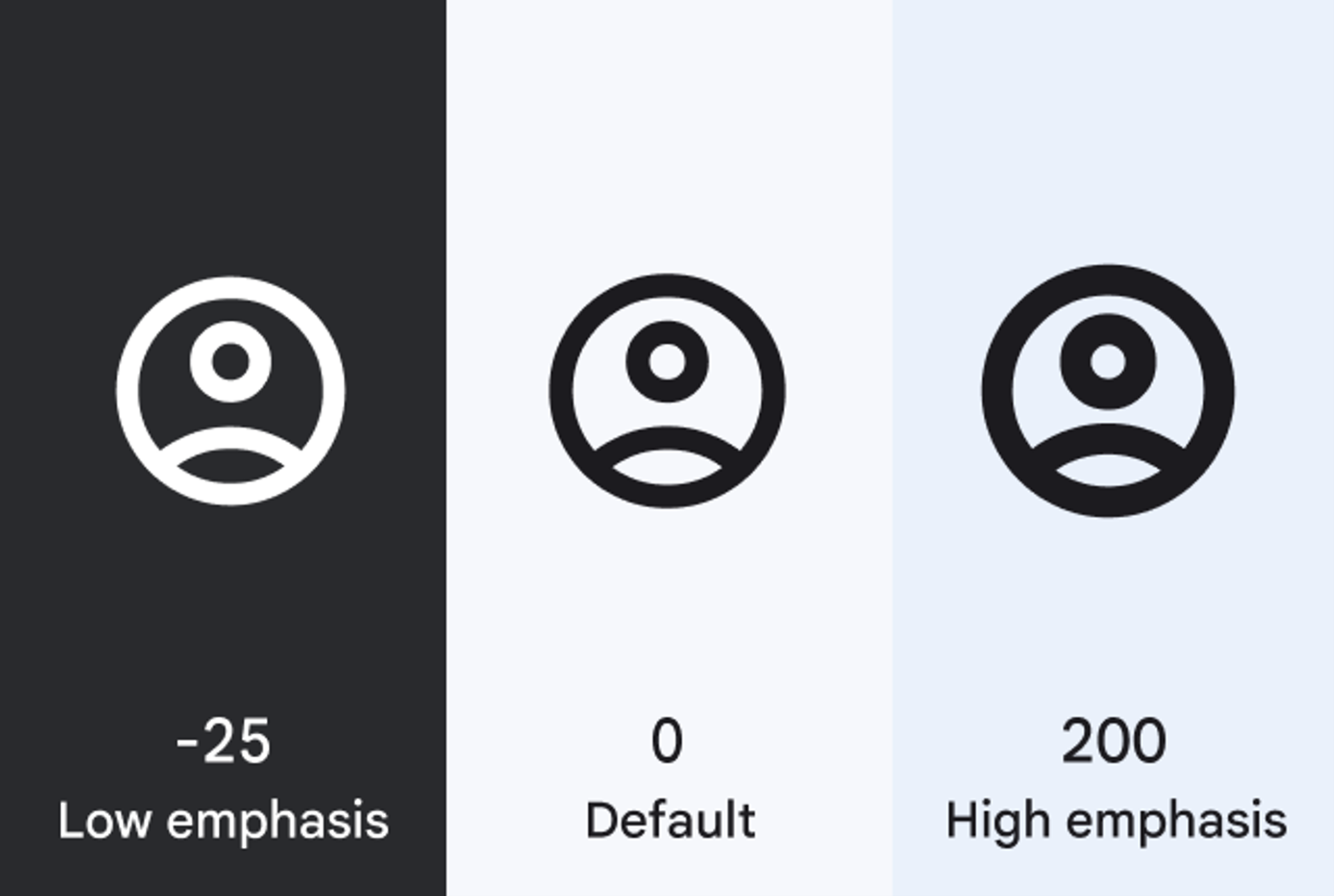
This makes variations predictable and reusable while keeping them part of the same asset system.
Access control matters too. Permissions can help determine who can view, edit, download, or distribute particular files. Internal teams, agencies, distributors, regional partners, and other stakeholders may need different access levels.
More advanced DAM and BAM implementations can also create targeted experiences for specific audiences. For example, a regional team might receive localized campaign materials while a partner receives only approved logos and product imagery.
A single source of truth makes the current, approved version of your brand aesthetic easy to identify and access.
The number of brand assets any given company has to track keeps climbing, too. Businesses worldwide now file 11.7 million trademark applications every year, and each registered mark is another asset that needs an approved file somewhere a team can actually find.
That pressure is intensifying further as AI changes branding and teams lean on AI tools to produce brand content faster than ever.
Once a brand's footprint reaches that scale, centralization stops being a nice-to-have. It's the only practical way anyone keeps track of what's approved and what's expired.
A related principle appears in our work with Corsair.
Component-Based Design System for Corsair by Clay Global
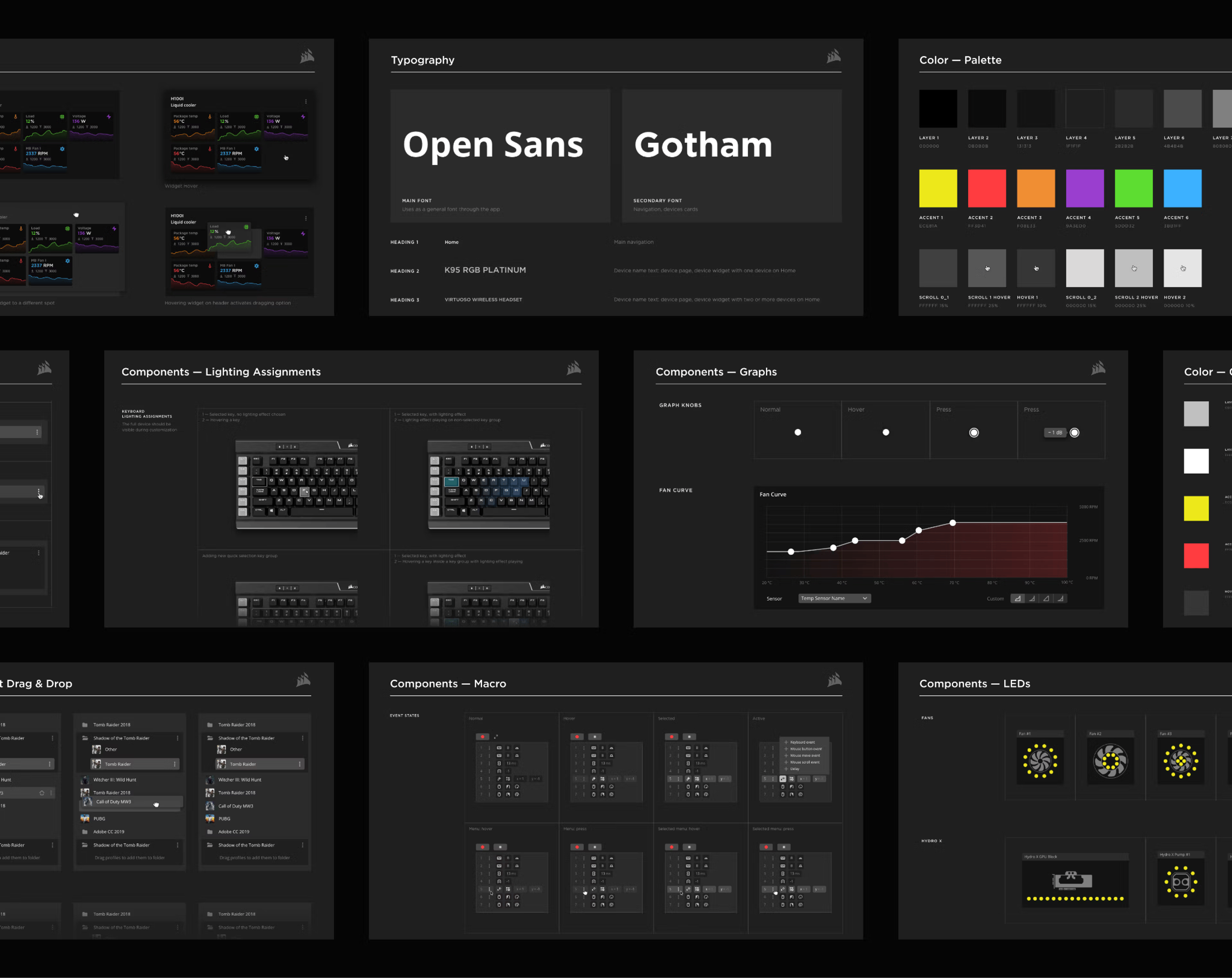
During a multi-year partnership, we created a component-based digital product design system with shared standards and reusable components for Corsair's internal teams, so teams didn't have to recreate decisions from scratch as the product ecosystem grew.
Setting Up Brand Asset Management
Building the Setup Foundation
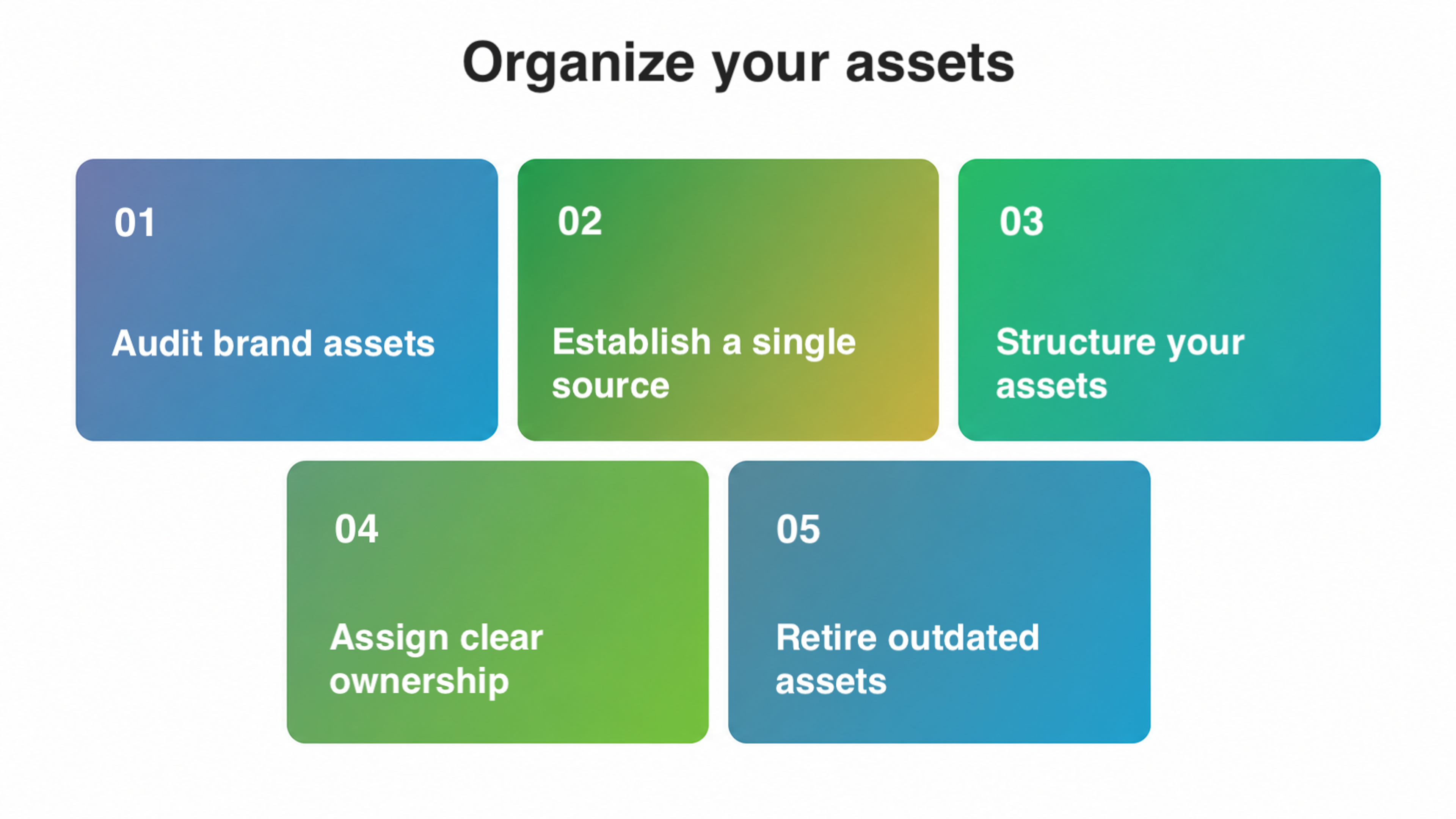
Setting up brand asset management starts with knowing what you actually have.
- Audit existing brand assets to identify gaps and duplicates. Pull together the logo files (including variations built around specific logo shapes), templates, guidelines, imagery, messaging resources, and other brand materials currently in circulation. Look for duplicates, outdated versions, ambiguous ownership, and assets that are missing entirely.
- Establish a designated source for approved brand assets. A relatively simple environment might just need an organized shared drive. Tools like Google Drive already support sharing permissions, version history, and file approval workflows (may vary by plan). More complex environments call for a dedicated DAM/BAM platform once teams need richer metadata, rights management, or more granular governance at scale.
- Create a clear taxonomy and metadata structure for assets. Decide how assets will be named, tagged, categorized, and searched before a large migration, using the same organizing logic behind brand architecture.
- Assign ownership and approval responsibilities. In a small company, this often sits with whoever is already closest to the brand, such as a marketing lead, creative lead, designer, or founder driving the company's brand development strategy. As needs grow, some companies bring in an outside partner. This is often one of the first branding services startups need. Guidelines exist, but nobody owns keeping them current. Around this point, many start reading up on what to expect from branding agencies before deciding whether to keep the work in-house.
- Implement a process to update and retire outdated assets. Old files may need to remain available for historical or operational reasons, but their status should be clear enough that people don't accidentally reuse them.
The right choice depends on factors like asset volume, contributors, distribution needs, metadata complexity, integrations, digital rights, and approval workflows. It could be dedicated BAM software, a DAM with brand-management capabilities, or a simpler collaboration platform.
It's worth budgeting real time for it, much like how long the branding process takes in the first place.
That investment is increasingly common. Spending on dedicated asset-management platforms is projected to reach $11.94 billion by 2030, as more companies decide a shared drive alone isn't enough.
Best Practices for Maintaining Brand Consistency Across Teams
Setup is only the beginning. Brand asset management works best as an ongoing practice.
Schedule Regular Reviews
Review the asset library and guidelines on a set cadence rather than relying on someone to notice when something becomes outdated.
Brand managers, marketing teams, or other designated owners should have a defined process for reviewing new assets and updating standards.
Set the Necessary Review Frequency
A relatively stable organization may need only periodic reviews, while a company that frequently launches products, campaigns, markets, or channels may need to check its assets much more often.
Treat Consistency as Ongoing Judgment
Brand asset management can help maintain consistency across the brand experience at every customer touchpoint, but new websites, campaigns, products, social channels, partnerships, and markets still require judgment calls as they come up.
Allow Controlled Adaptation
Global brands may deliberately adapt language, imagery, campaigns, and even some visual elements for local markets while maintaining a recognizable core identity, which is a different exercise from deciding when to evolve your brand altogether.
Keep the Fixed and Flexible Parts Clearly Separated
Teams should understand which parts of the brand are fixed, which can adapt, and where to find the current materials for both.
What Stays Fixed and What Can Adapt in a Consistent Brand
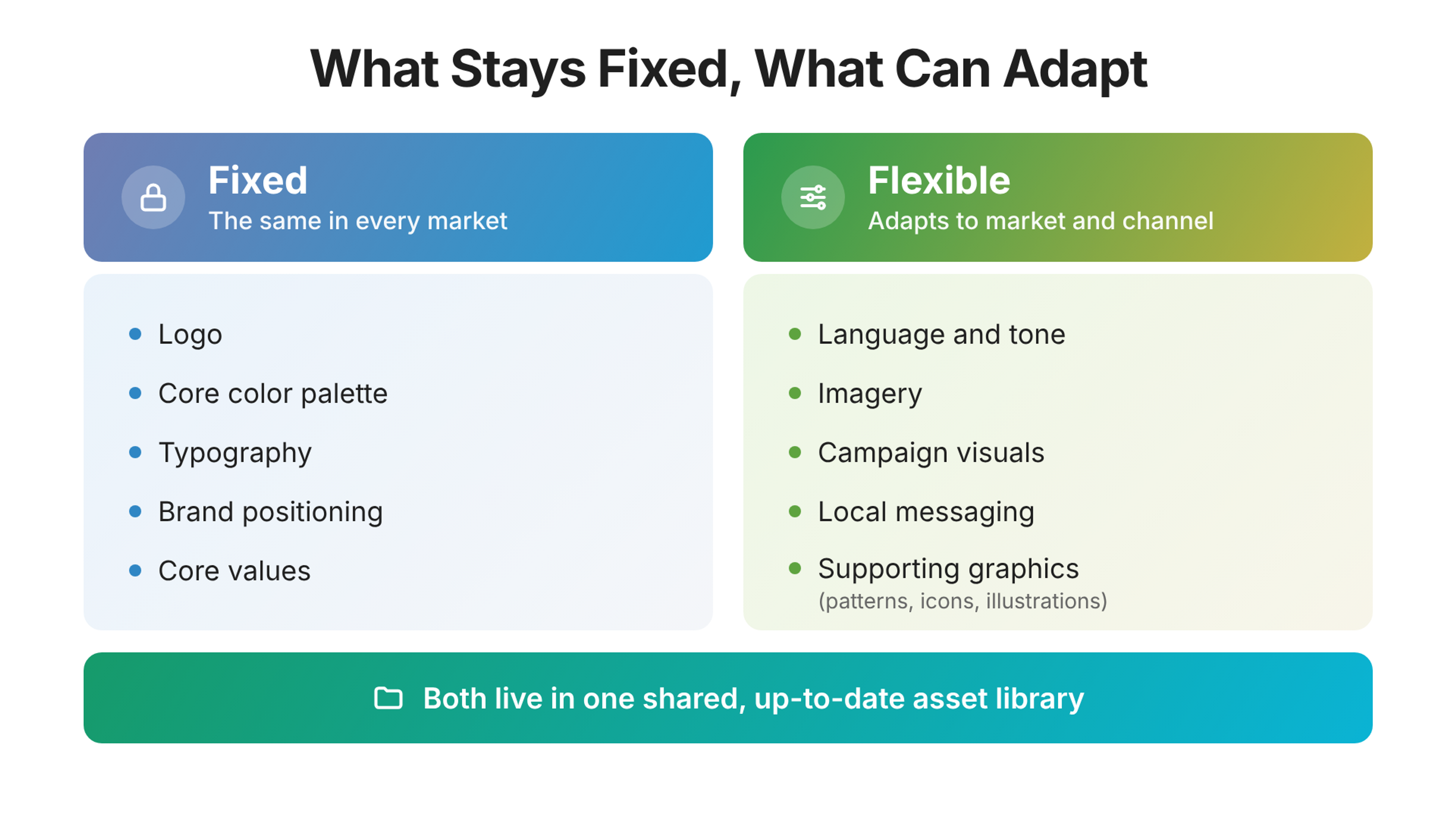
This clarity is what makes consistency pay off, through stronger customer loyalty over time.
A brand doesn't stay consistent on good intentions alone. If yours is starting to drift, get in touch.
Read More
FAQs
What tools are available for brand asset management?
Several types of tools can support BAM. These often include DAM platforms like Brandfolder, Bynder, and Frontify, as well as brand portals and asset libraries built into design or collaboration tools.
Most offer similar core capabilities, such as permissions, version history, approval workflows, metadata and tagging, and distribution to different audiences.
The right fit depends less on the brand itself and more on team size, asset volume, and how many contributors and channels need access.
What is an example of a brand asset?
Logos, color palettes, typography resources, templates, icon sets, approved photography, illustration systems, messaging guidance, and brand guidelines can all be brand assets.
In practice, a brand asset is anything that stands for the brand or helps communicate it.
Is brand asset management (BAM) the same as digital asset management (DAM) software?
Not exactly.
Digital asset management is the broader discipline and software category covering how organizations organize, govern, find, distribute, and manage digital assets.
BAM focuses specifically on brand-related assets and how approved versions are maintained and used.
There is substantial overlap. Many modern DAM platforms already include the permissions, workflows, portals, rights management, and governance capabilities needed to support BAM.
Is a shared drive like Google Drive enough for brand asset management?
A properly configured shared drive can provide centralized storage, permissions, version history, collaboration, and more.
A dedicated DAM or BAM platform becomes more useful when you need sophisticated metadata, rights management, large-scale distribution, branded portals, or governance across a large asset library.
The decision depends more on operational complexity than team size alone.
Do I still need brand guidelines if I already have asset management software?
Yes. Software can distribute approved assets and help apply certain rules, but it doesn't replace the strategic decisions behind a brand system.
Guidelines explain what the identity is, how it should behave, and where flexibility is allowed. Asset-management software helps make those standards easier to access and apply.
How often should brand assets be audited?
There is no universal industry-standard audit interval.
As a practical starting point, many teams can schedule a formal review once or twice a year and also review assets after major events such as a rebrand, product launch, market expansion, or major campaign.
Can a small startup skip brand asset management entirely?
A startup may not need dedicated brand asset management software.
It should still have some way to identify approved assets and keep current versions accessible. At an early stage, that might be as simple as a clearly structured shared folder, documented guidelines, and an agreed owner.
The system can become more sophisticated as the number of assets, contributors, and channels grows.
What's the difference between a brand portal and a general asset library?
A general asset library is the broader repository used to store and organize assets.
A brand portal is often a user-facing access point that makes a selected set of approved assets, guidance, or resources available to a particular audience.
Final Thoughts
Brand asset management makes it easier to maintain your brand's identity as more people, assets, channels, and partners get involved.
Companies that manage brand assets effectively create a reliable source of truth, define ownership, make approved materials easy to find, and keep the system current as the brand evolves.


About Clay
Clay is a UI/UX design & branding agency in San Francisco. We team up with startups and leading brands to create transformative digital experience. Clients: Facebook, Slack, Google, Amazon, Credit Karma, Zenefits, etc.
Learn moreAbout Clay
Clay is a UI/UX design & branding agency in San Francisco. We team up with startups and leading brands to create transformative digital experience. Clients: Facebook, Slack, Google, Amazon, Credit Karma, Zenefits, etc.
Learn more