

Every few years, something shifts the playing field so hard that the brands that ignore it fall behind before they realize what happened.
Desktop publishing, the web, and social media all did it in their time. And now, AI branding is doing it again, faster and with wider reach than any of those transitions before it.
The difference this time is scope. Artificial intelligence is touching every corner of how brands are built and managed. For professional designers and brand strategists, this changes how work gets done. Founders and marketers commissioning that work are operating in a different landscape now.
Key Takeaways
- AI accelerates the execution of branding work without replacing the strategic and creative judgment behind it.
- Generative AI has given experienced designers and brand teams capabilities that simply didn't exist five years ago.
- Brand strategy, visual craft, and brand voice still require human expertise, and AI makes that expertise go further.
- Founders and marketers who understand how AI fits into the branding process will commission better work and make better decisions.
- Brand consistency across channels is easier to maintain when AI-assisted design and content systems are in the hands of people who know how to use them.
- If you want AI-powered branding without the learning curve, working with an AI-first agency is the most direct path to results.
AI Branding Speeds Up Design While People Still Lead
For most of modern business history, brand identity design was constrained by time as much as talent. The creative process moved at the pace of production, and production was slow.
That constraint shaped what clients could afford to ask for. Branding moved slowly and expensively, with little room to explore or change direction once work was underway.
Artificial intelligence has changed the constraints. Not the judgment, because the judgment matters more than ever, but the production overhead attached to exercising it. AI tools now handle the groundwork that used to consume the majority of a designer's working hours:
- Generating initial directions.
- Resizing assets across formats.
- Adapting visual systems to new contexts.
- Maintaining brand consistency across an expanding library of materials.
AI vs Human Intelligence by Clay
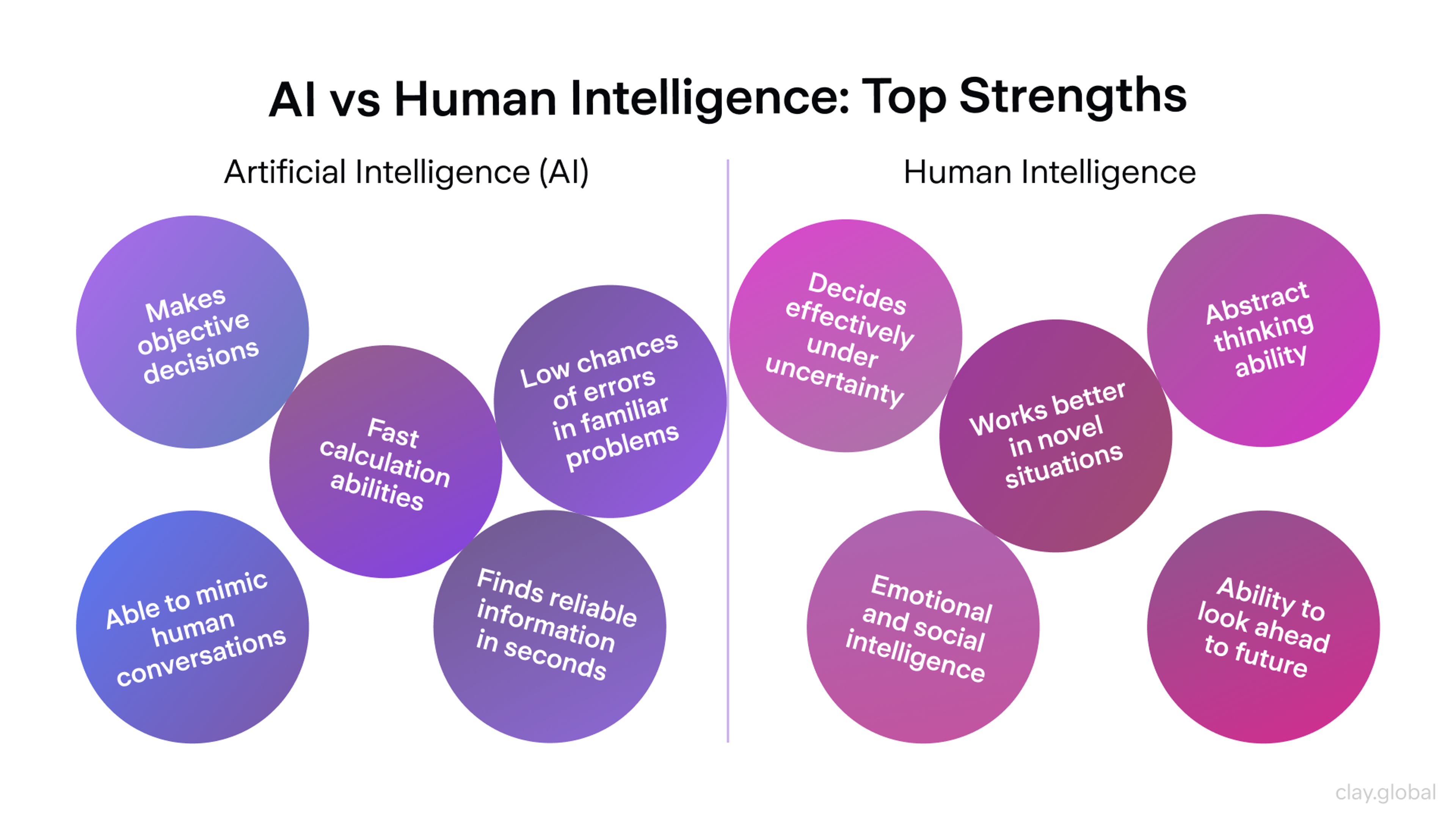
The scale of adoption backs this up. According to McKinsey's State of AI 2024 report, 65% of organizations were already using generative AI in their operations by early 2024, nearly double the share from the year before. The craft judgment about what's right for a specific brand still comes from the person behind the work.
Brand Strategy Still Has to Come First
Before any tool enters the picture, the foundations haven’t changed. Brand strategy is what everything else is built on. Who you are, who you serve, what you stand for, how you want your audience to feel when they encounter you. None of that comes from a prompt box.
Artificial intelligence can help execute on a clear brand strategy with speed and precision, but it can't develop that strategy for you.
What AI has changed is what happens once that foundation exists. The execution layer that used to consume weeks of production time can now move at a completely different pace:
- Brand intelligence gathering that once required expensive research firms can be done with AI-powered sentiment analysis and social listening tools.
- Competitive audits that took days can be assembled in hours.
- Customer persona research that relied on lengthy qualitative studies can be enriched with AI-gathered data from a far wider pool of signals.
The businesses using AI for branding most effectively are the ones who’ve built clear answers to the strategic questions and then used AI to close the gap between their brand vision and what actually ships.
Clay Global combines AI with creative human expertise to build brands that hold up. See how we integrated AI into one of our latest projects here.
What AI Changes for Designers in 2026
The most visible application of AI in branding is visual, and the shift for experienced designers is significant. Generative AI has made it possible to explore visual directions faster and at a greater scale, changing how design decisions get made.
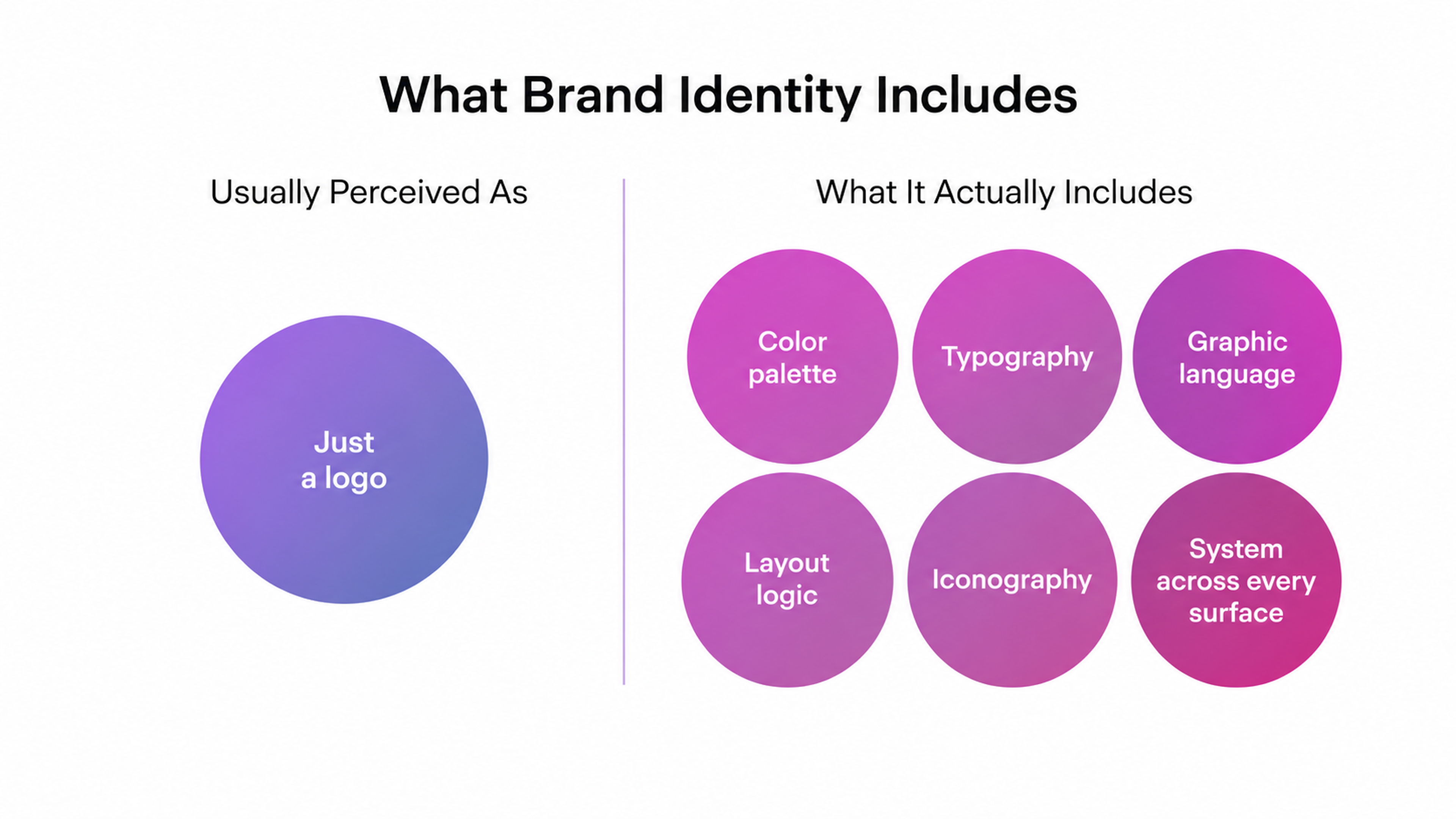
Brand identity design covers a lot more than a single mark. It's the full visual system, which includes:
- The color palette
- The typography
- The graphic language
- The layout logic
- The iconography
- The way all of those elements work together across every surface where a brand appears
AI accelerates that process without replacing the expertise driving it.
Brand Identity Elements
The blank page problem of finding a direction worth refining is where AI contributes most. Tools like Adobe Firefly and Canva's AI suite let designers work with natural language to rapidly generate and stress-test visual directions that would previously have required days of manual exploration.
To see how AI for branding works in practice, logo creation is one of the best places to look. A designer starts by feeding the brief into an AI logo generator. They simply enter the brand name, the industry, the target audience, and a few notes on the desired feeling. Within minutes, the platform generates a wide range of visual prompts to respond to.
From there, the designer uses professional judgment to identify which directions have potential, then develops those threads further, testing how the mark holds up at different sizes and working through variations far faster than manual methods would allow. What used to take weeks of AI logo branding concept development can now move through initial exploration in days.
The best AI logo generator platforms go beyond the mark itself, producing a full suite of coherent brand assets. The creative output comes from genuine design thinking, beautiful logos, and considered visual systems, not just geometry with a business name dropped in.
What AI logo design changes, practically, is the depth of exploration possible within a given timeline. A designer can now bring ten well-developed directions to a first presentation rather than three, and stunning logos and cohesive visual systems come from that combination of AI-accelerated exploration and human creative judgment.
Brand Voice Consistency at Scale
Visual identity gets most of the attention, but brand voice is equally important to how customers experience a brand, and equally transformed by AI in the hands of people who know how to use it.
Creating a Consistent Brand Voice
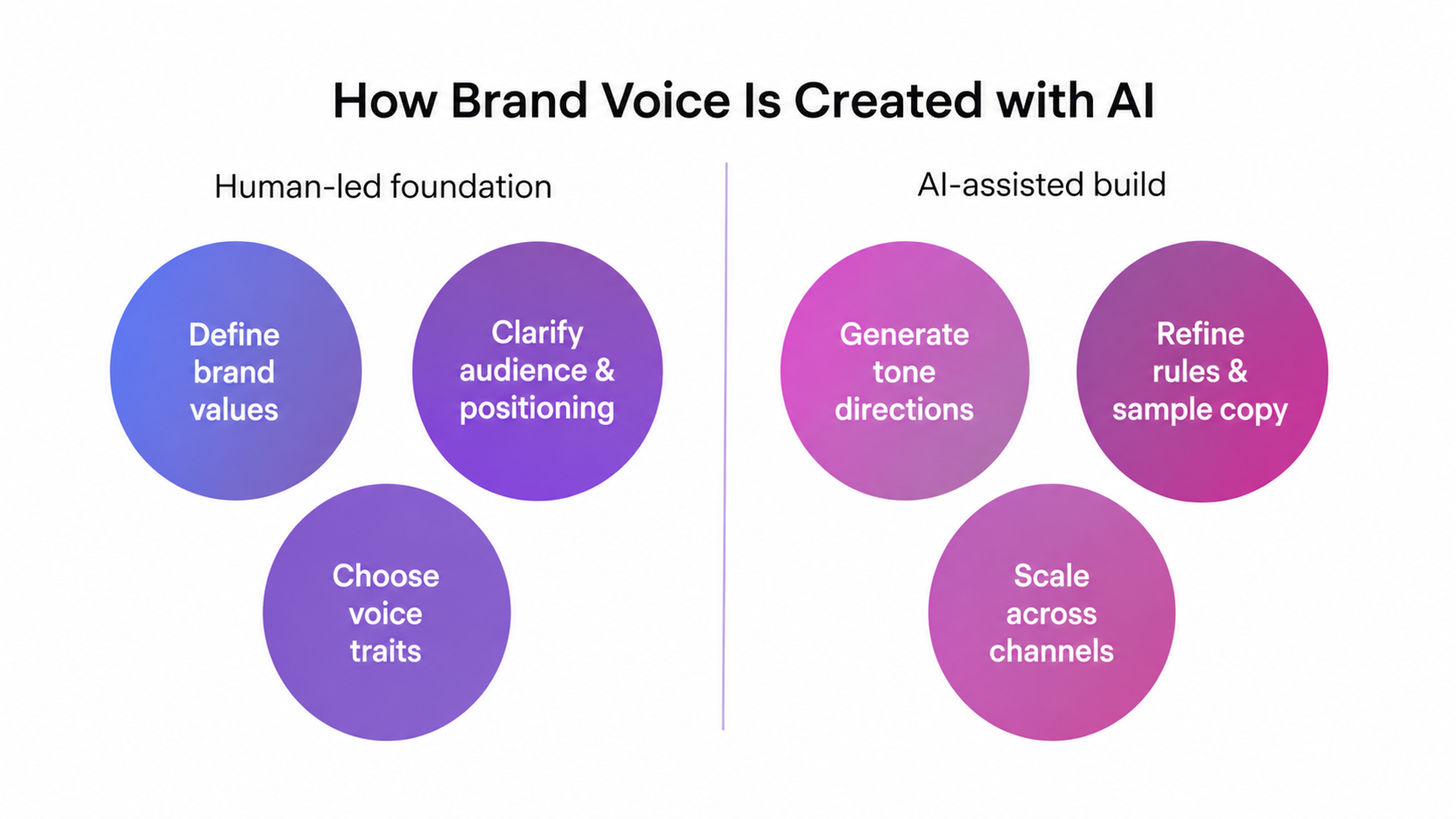
Brand voice is the personality of a brand expressed through language. Platforms like Jasper and Copy.ai let you train a model on approved content and generate new material that matches established patterns. You can simply describe the tone and register, build out variations, and encode that as the baseline for everything the teams produce going forward.
But the results depend entirely on the quality of the foundation. According to Salesforce's 2024 State of Marketing report, 71% of marketers say generative AI helps them focus more on strategic work rather than repetitive tasks. Here's what separates brands that get this right from those that don't:
- Brand voice is defined properly before any production volume goes to AI.
- Experienced copywriters and strategists set the standard, not discover it through iteration.
- An AI trained on mediocre copy produces more mediocre copy faster, so the input quality matters as much as the tool.
- Brand integrity is treated as a strategic priority, not a content task.
- The outcome is a consistent brand experience across every channel, at a scale that would be impossible to manage manually.
Content, Imagery, and the Production Acceleration
The creative process from brief to finished asset used to involve multiple rounds of back-and-forth, approval stages, and production work that slowed everything down. Generative AI has significantly compressed the production stages, changing what experienced creative teams can deliver within a given timeline.
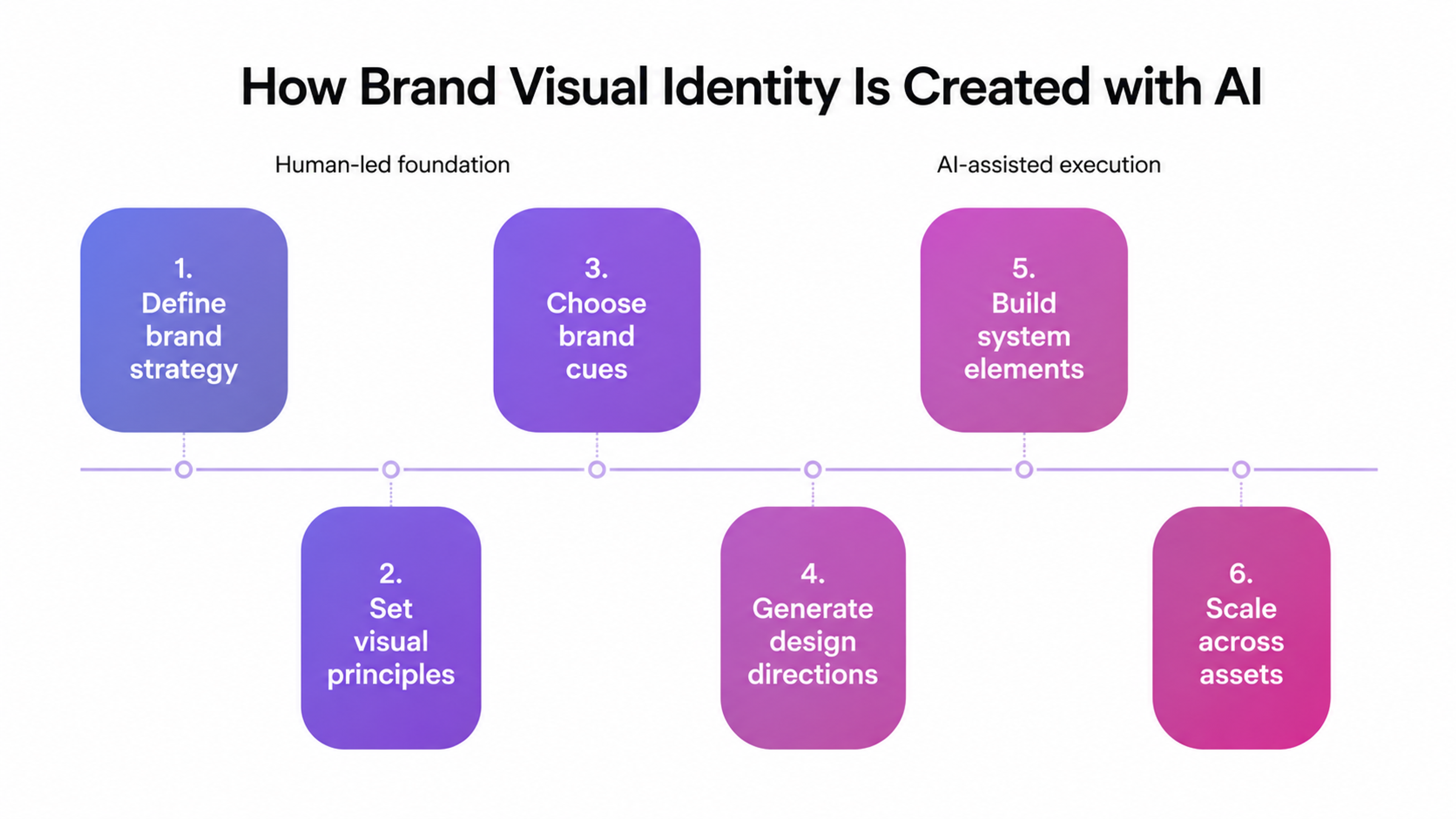
Image generation tools like Midjourney and Recraft give designers and art directors the ability to produce on-brand visual assets without a full production shoot. The key is a well-defined visual identity system.
When the color palette, lighting approach, and aesthetic direction are precisely articulated, image generation produces assets that feel like they belong to the brand. When there is no such system, the output is generic regardless of how sophisticated the prompt is.
Creating a Brand Visual Identity
On the copy side, AI handles drafting and templating work with a well-crafted text prompt, freeing experienced writers to focus on editing, voice refinement, and strategic direction.
Creative output per person increases, and maintaining brand consistency across a website, a set of social media designs, email campaigns, and paid advertising is now achievable without sacrificing quality.
The AI Brand Design Experience Layer
The most forward-looking application of AI in branding is the brand experience itself. When a customer interacts with a company's AI assistant, they're forming an impression of that brand based on how it communicates and whether the interaction feels coherent with everything else the company puts in the world.
Companies that treat this as a technical feature rather than a brand decision create a gap between their stated identity and their actual brand experience, and customers feel that gap even when they can't articulate it.
The brands doing this well extend their brand voice guidelines into their AI integrations, treating every decision about how the system communicates as a brand strategy call.
Customer experience is also where brand intelligence pays off most clearly. AI-powered analysis of customer feedback and social sentiment gives brand teams a far more granular picture of how the brand is actually being perceived versus how it's intended to be.
That gap between brand vision and customer reality is where most brand problems live, and AI makes it visible in near real-time rather than in a quarterly report.
Can The Creative Process Be Fully Automated?
There's a persistent worry that AI tools are flattening the creative process. That concern is misplaced. What AI tools do is remove the friction between an idea and its first real execution. The quality of the idea still comes from experienced people.
Facts & Myths about AI by Clay
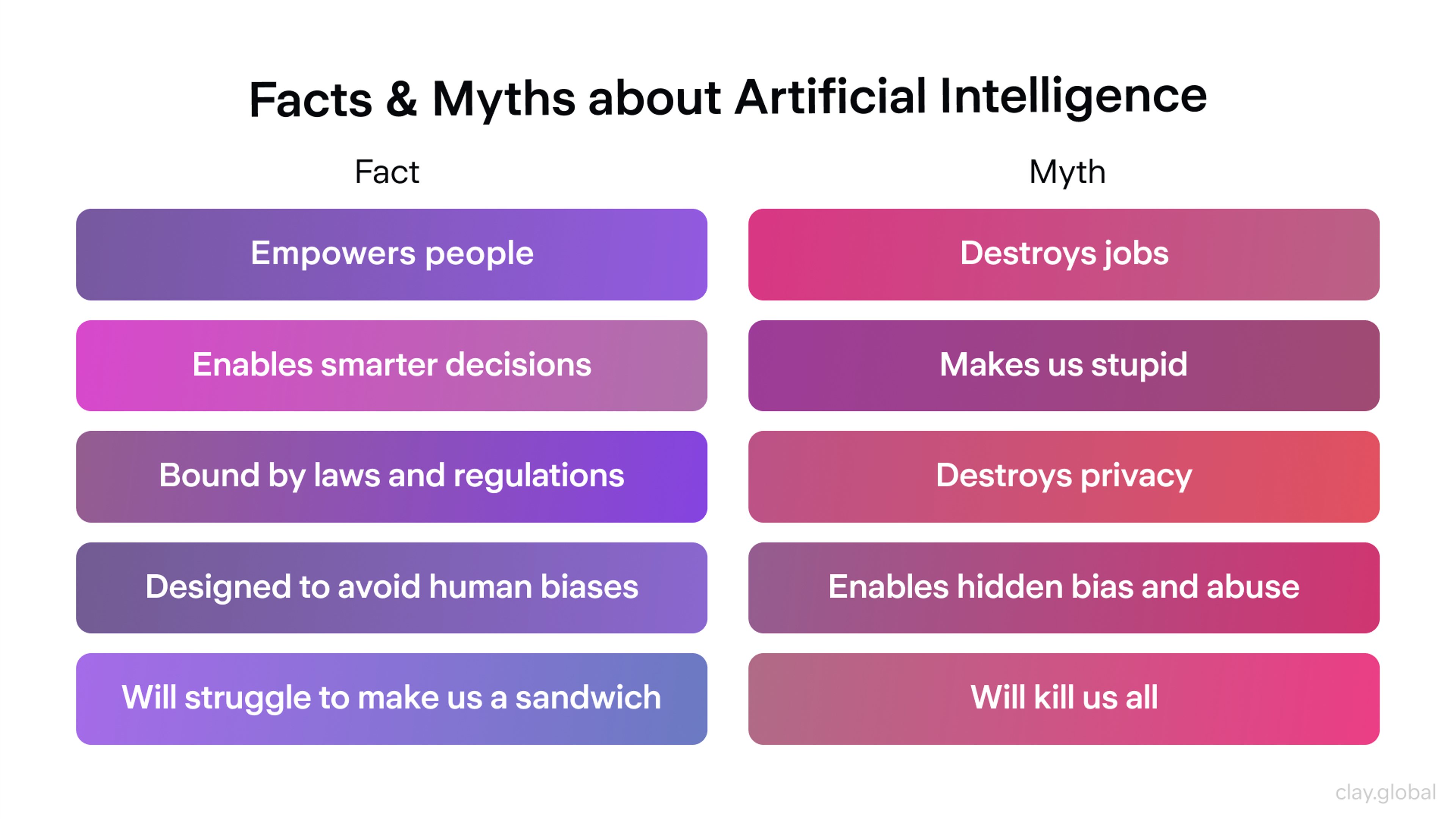
Creative control hasn't gone anywhere. Designers can upload reference images and define style parameters, adjust outputs with precision, add text treatments that match the brand's typographic system, and iterate rapidly without losing the thread of the original creative direction.
The machine generates, and the expert decides. What's changed is the speed. At all skill levels within a design team, AI is redistributing effort away from production execution and toward the creative and strategic judgment that was always the valuable part.
The risk is fast generation without deep thinking, a visual identity built on the machine's preferences rather than the brand's actual strategic needs. A tool that generates professional logos is still just a tool.
Commissioning AI for Branding Work
For founders and marketers, understanding how AI fits into the branding process matters more than it used to. Not to manage the tools, but to ask the right questions and set the right expectations.
AI has raised the floor on what any competent agency can produce. A brief that would have produced three directions two years ago now produces ten, which means the quality of the brief and the feedback matter more than ever.
The real distinction isn't between agencies that excel at AI branding and those that don't. It's between the ones that have deeply integrated AI into their workflow in ways that produce better work faster, and agencies using it superficially to cut corners while charging the same rates.
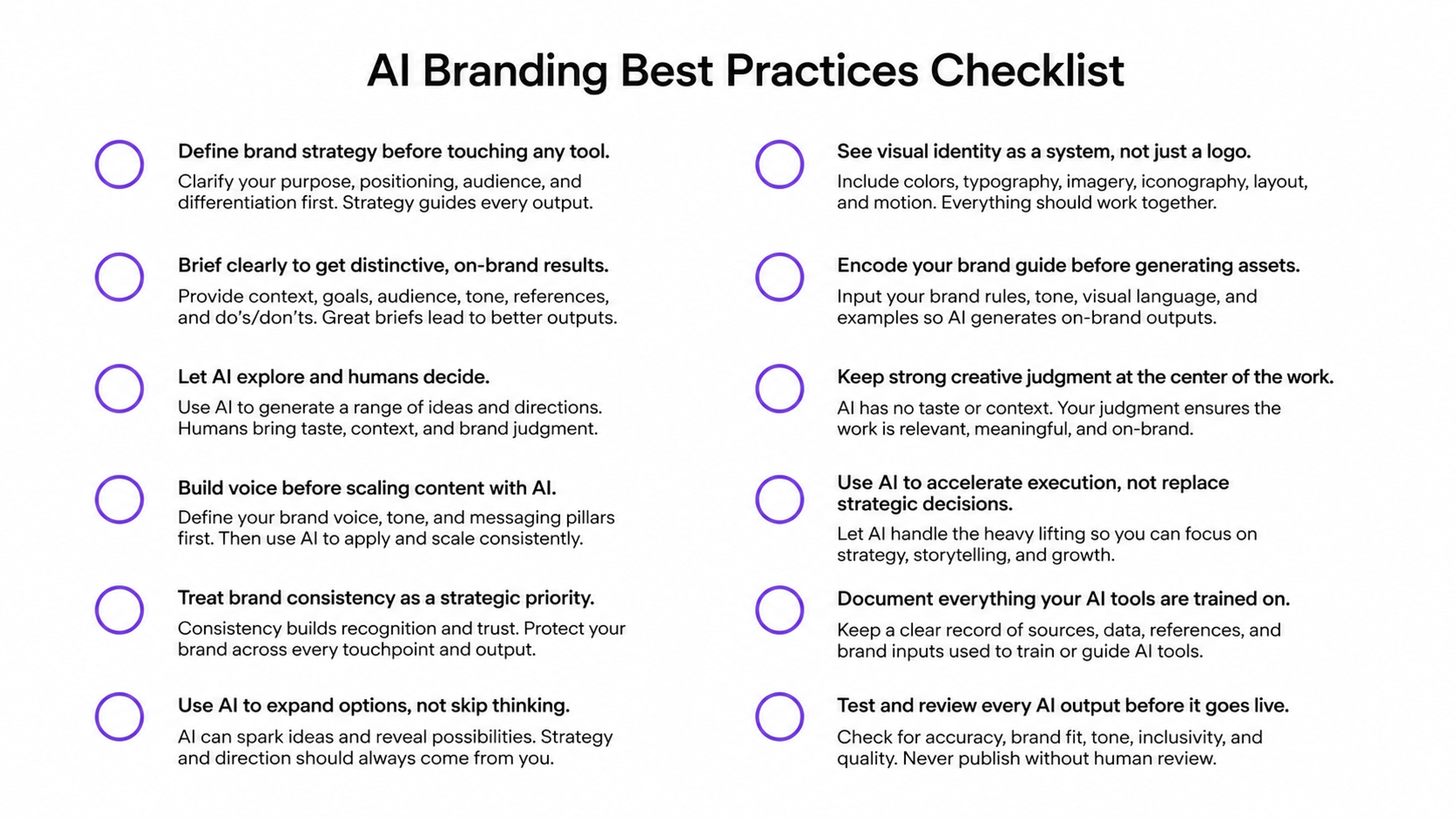
Whether you work with one or not, use this checklist to understand what good AI branding practice actually looks like:
AI Branding Checklist
Ready to take your brand to the next level with Clay Global? We’ve done it for Yahoo, Meta, and Fiverr, and you can be the next. Let’s talk.
Read more
- Sky DeFi Platform Branding and Visual Identity by Clay Global
FAQ
What does AI branding actually cover?
AI branding covers every dimension of how a brand is built and managed, including visual identity, brand voice, content production, customer experience design, market research, and competitive analysis.
The most significant applications are in accelerating exploration and production, giving experienced designers, strategists, and writers more leverage on the work that requires human judgment.
How does AI change brand strategy work?
AI doesn't replace brand strategy, it accelerates the research and intelligence gathering that surrounds it.
Competitive audits, sentiment analysis, and market positioning research that used to take weeks can now move much faster, freeing strategists to spend more time on decision-making.
Does AI replace the need for professional brand designers?
No. The decisions that actually shape a brand's identity can't be delegated to a tool. AI removes production overhead and expands what's explorable, and human expertise determines what's worth keeping.
How do designers use tools like an AI logo generator and similar tools the right way?
An AI logo generator and other AI branding tools are a starting point, not a finishing tool.
A designer feeds it the brief, the business name, the industry context, and the aesthetic direction they're working toward. The platform produces a wide range of concepts quickly, and the designer's job is to look at that output with a critical eye.
What should I look for in an AI-first branding agency?
Look for agencies that have built AI into their core processes to explore new directions, produce better work, and maintain tighter consistency across deliverables.
Ask specifically how AI shows up in their visual identity process, how they use it for brand voice and content, and what they can now offer that wasn't possible before.
Can AI maintain brand consistency across a large team?
Voice tools can encode a brand's language patterns so everyone on the team writes from the same baseline. Design tools enforce visual standards at the asset generation stage.
The result is a more consistent brand experience across channels, but the consistency is only as strong as the brand system that was defined and encoded in the first place.
What role does brand voice play in AI branding?
Brand voice is central. How a brand communicates in language shapes customer perception as much as the visual identity does.
AI tools amplify whatever foundation was set by experienced writers and strategists. Strong voice in, strong output out.
How does AI image generation fit into professional brand work?
AI image generation lets designers produce on-brand visual assets without a full production shoot for every use case. When a clear visual identity system is in place, generation tools produce work that belongs to the brand. Without that system, the output defaults to generic aesthetics regardless of how the prompts are written.
How does AI change the client-agency relationship?
The production timeline has compressed, which changes expectations on both sides. Clients can now see more directions earlier in the process, which requires more engaged feedback.
Agencies using AI well can move faster without cutting corners, but they need sharper briefs and more decisive client input to take advantage of it.
What's brand intelligence, and how does AI support it?
Brand intelligence is the working knowledge of how a brand is actually perceived versus how it's intended to be perceived.
AI tools support this through sentiment analysis, social listening, and synthesis of customer feedback at a scale manual research couldn't match. Interpretation still requires experienced human judgment about strategic direction.
How do I use AI for branding without making my brand look generic?
Specificity in the brief and expertise in the execution. The more precisely a brand's strategic position, audience, and visual personality have been defined by people who know what they're doing, the more distinctive the AI output will be.
Brands that use AI to execute a sharp strategy look nothing like brands that use AI to avoid developing one.
What's the relationship between AI tools and creative control?
AI tools are built around creative direction, not in opposition to it. Designers can upload reference images, define style parameters, iterate on outputs, and shape every element of what gets produced. Creative control stays with the person who understands the brand.
Does AI for branding work differently for B2B versus B2C companies?
The tools are the same, but the priorities differ. B2C brands often benefit most from visual identity and content tools.
B2B brands typically see the biggest returns in voice consistency and brand intelligence, where maintaining a coherent position across long sales cycles requires consistent positioning.
What should I have in place before starting a branding project with an AI-first agency?
A clear starting point on strategy is an honest answer to what your brand stands for and who it's meant to serve. Having thought seriously about these questions will produce dramatically better results than arriving without a point of view. The stronger the strategic clarity, the more the AI acceleration means in practice.
How do I ensure AI-assisted branding holds up over time?
A well-maintained brand guide helps AI tools stay aligned with your brand as it evolves. The best agencies build this into their deliverables, not just finished assets. But the system and guidelines that keep those assets coherent as your brand grows.
Final Thoughts
AI hasn't made great branding easier to fake. It's made expertise faster to deliver.
The brands winning right now brought sharp strategy, experienced creative judgment, and the right tools together in the same process. But the gap between a thoughtfully built brand and a carelessly generated one has widened.
Speed without direction produces polished noise. A well-crafted brand strategy, executed by people who understand both the craft and the tools, is what turns AI's capabilities into a real competitive asset.

About Clay
Clay is a UI/UX design & branding agency in San Francisco. We team up with startups and leading brands to create transformative digital experience. Clients: Facebook, Slack, Google, Amazon, Credit Karma, Zenefits, etc.
Learn moreAbout Clay
Clay is a UI/UX design & branding agency in San Francisco. We team up with startups and leading brands to create transformative digital experience. Clients: Facebook, Slack, Google, Amazon, Credit Karma, Zenefits, etc.
Learn more