

A website redesign typically takes 6 to 12 weeks for a small marketing website, 10 to 20 weeks for a custom website, and two to six months or longer for complex ecommerce and enterprise projects. These are preliminary planning estimates, not fixed delivery commitments.
Page count alone tells you surprisingly little about the schedule. A 50-page website built from four reusable templates may require less design work than a 15-page website with unique layouts, advanced animations, and custom functionality.
Content readiness, technical dependencies, and stakeholder approvals can influence your launch date just as much as design complexity.
A realistic website redesign timeline starts with understanding what needs to change, what can stay, and which activities depend on one another.
Key Takeaways
- A visual refresh generally takes less time than a structural redesign or complete website rebuild.
- Unique page templates, technical requirements, and content complexity are often better indicators of project duration than total page count.
- Design, development, and content production can overlap, reducing the overall project timeline.
- Late approvals, incomplete content, and changing requirements can delay a project even when the production team is on schedule.
- SEO migration, quality assurance, and post-launch monitoring should be included when planning an end-to-end website redesign.
How Long Does a Website Redesign Take?
The duration of a website redesign depends largely on how much of the existing website you intend to retain. Updating visual elements within an established content management system (CMS) requires a different level of effort than rebuilding the site's architecture, functionality, and technical infrastructure.
Website Redesign Scope and Timeline
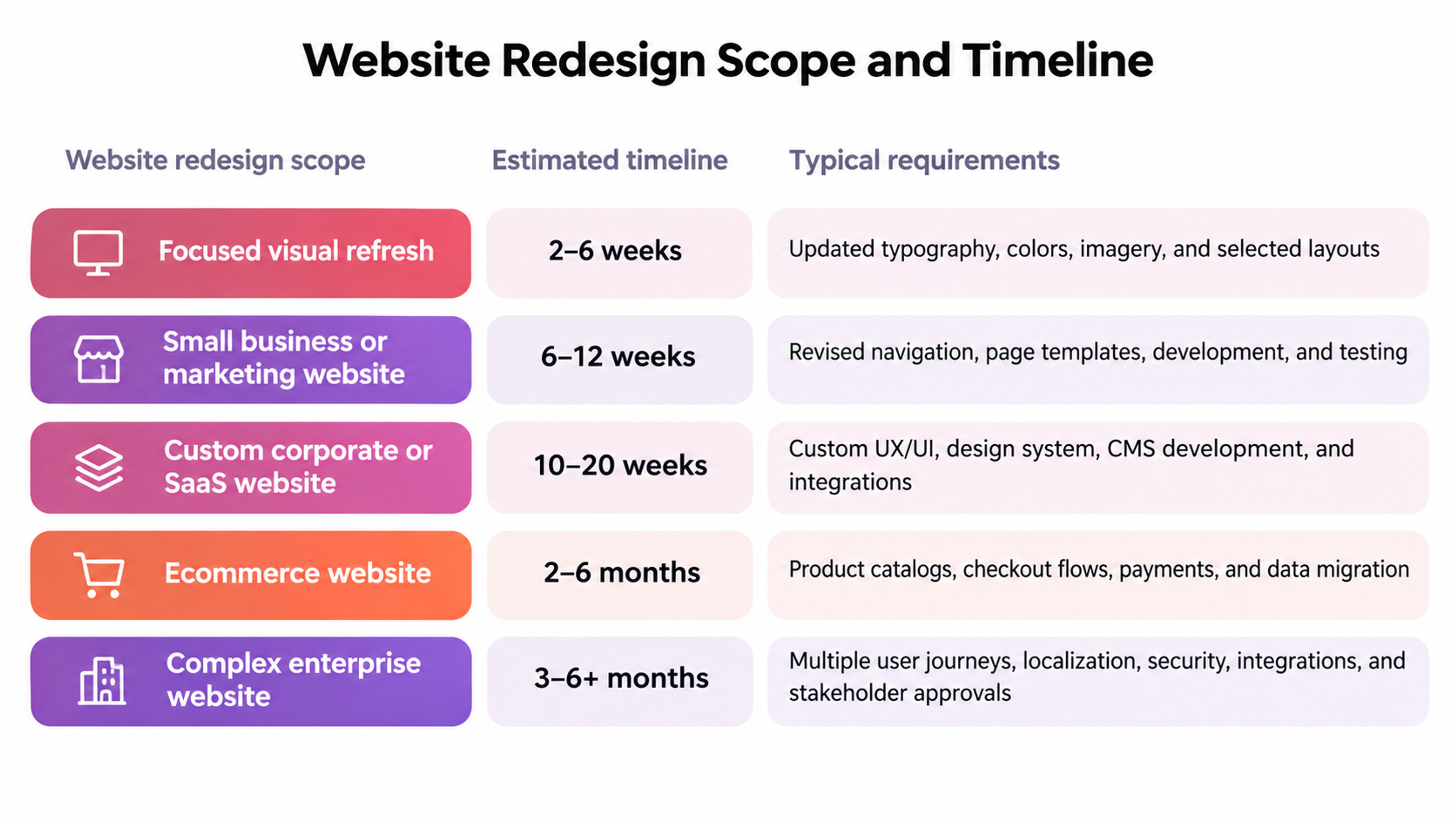
Visual Refresh: 4-10 Weeks
A visual refresh focuses on updating typography, colors, imagery, and selected layouts without fundamentally changing the website's structure. Retaining existing functionality and infrastructure reduces development requirements, making this one of the shorter redesign engagements.
Small Business or Marketing Website: 6-12 Weeks
A small business website redesign typically involves revising navigation, improving key conversion pages, creating reusable templates, and implementing responsive layouts.
Projects within this timeframe generally have limited technical integrations and relatively straightforward content requirements.
Custom Corporate or SaaS Website: 10-20 Weeks
Custom websites often require more extensive UX research, a dedicated design system, unique page templates, and tailored CMS functionality. The timeline increases when the website serves multiple audience segments or needs to communicate complex products and services.
UX Research Methods Chart by Clay

Ecommerce Website: 2-6 Months
Ecommerce redesigns introduce additional requirements, including product catalogs, checkout flows, payment processing, inventory management, and customer data migration. Each of these systems requires careful implementation and testing to maintain business continuity.
Complex Enterprise Website: 3-6 Months or Longer
Enterprise redesigns frequently involve multiple user journeys, localization, security requirements, legacy systems, and numerous stakeholders. Coordinating these dependencies can take as much time as the design and development work itself.
Treat these ranges as preliminary planning estimates rather than fixed delivery commitments. The categories overlap because functionality and implementation requirements vary considerably between projects.
Website Design vs. Website Redesign
Designing a website from scratch is not necessarily slower than redesigning an existing one.
An established website provides useful starting points. You already have content, analytics, brand assets, and insights into user behavior. However, legacy technology, outdated navigation, technical debt, and existing search rankings introduce constraints that a new website may not have.
The distinction becomes particularly important when comparing agency proposals. Four common engagement types have different completion criteria.
Website design only covers research, UX, UI, and design specifications. The engagement concludes when the approved design files are ready for development.
Website design and development extends beyond visual design to include coding, CMS implementation, and functional testing. The deliverable is a working website ready for deployment.
End-to-end website redesign includes evaluating the existing website, redesigning its experience, implementing new functionality, migrating content, and launching the updated website.
Web Design Process by Clay
Website redesign with post-launch support extends the engagement beyond deployment to include production monitoring, issue resolution, and an agreed support handoff.
A six-week design engagement and a twelve-week end-to-end redesign may involve similar amounts of design work. The difference lies in what happens before and after the designs are approved.
Confirm the scope before comparing timelines.
How to Estimate Your Website Redesign Timeline
You don't need a finalized design brief to begin estimating your project. You do need a clear understanding of the work involved.
Five variables provide a useful starting point.
1. Count Unique Page Templates, Not Just Pages
A page template is a reusable layout designed for a particular type of content or user journey. A homepage, product detail page, service page, and blog article usually require different templates.
Consider two hypothetical websites:
50 Page Website vs 15 Page Website
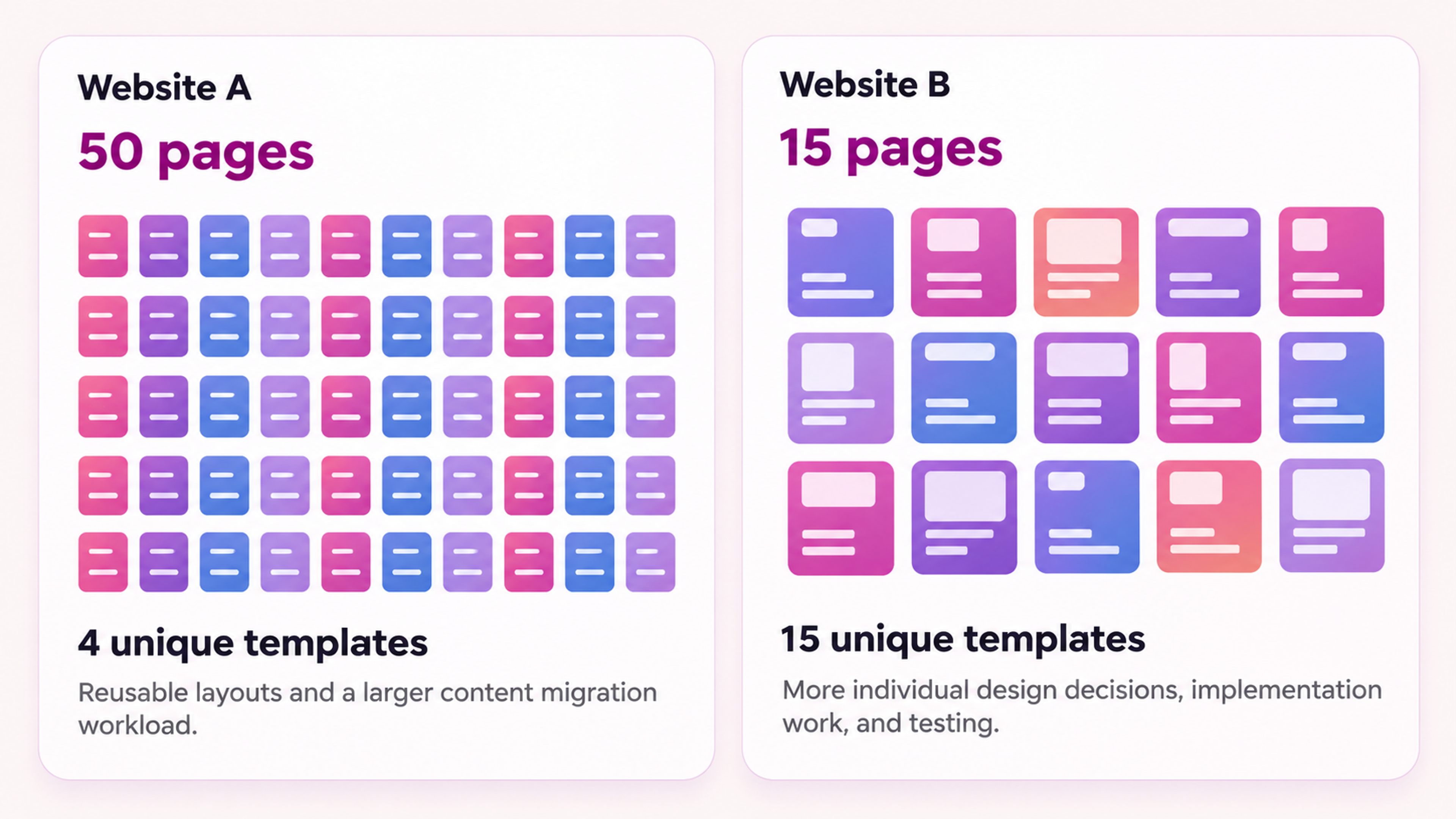
Website B may require more design and development time despite having fewer pages. Website A, however, may require more time for content preparation and migration.
Separate these workloads when estimating your project.
2. Evaluate Content Readiness
Content influences design decisions earlier than many businesses expect. Headlines determine layout proportions, product information shapes navigation, and messaging affects the structure of key conversion pages.
Identify which existing pages you can retain, which need substantial editing, and which require entirely new content.
If your redesign includes new positioning or brand messaging, involve your content team during discovery. Waiting until the design is complete often creates unnecessary revisions.
3. Identify Technical Complexity
Technical requirements can change a project's duration considerably, particularly when they involve systems outside the design team's control.
A marketing website with standard forms and analytics has different implementation requirements from a platform with personalized content, customer accounts, payment processing, and third-party integrations.
Before committing to a schedule, investigate your CMS limitations, existing infrastructure, integration requirements, and custom functionality. Unresolved technical questions should become discovery tasks rather than optimistic assumptions.
4. Account for Stakeholder Approvals
Production time and calendar time are different things.
A designer might complete a deliverable in three working days, but if stakeholders need another week to review it, the next dependent activity may have to wait.
Establish who has final approval authority, how feedback will be consolidated, and how quickly decisions need to be made. A clear approval process can protect the schedule more effectively than adding another designer.
5. Establish the Critical Path
The critical path is the longest sequence of dependent activities that determines the earliest possible project completion date.
UI vs UX Elements by Clay
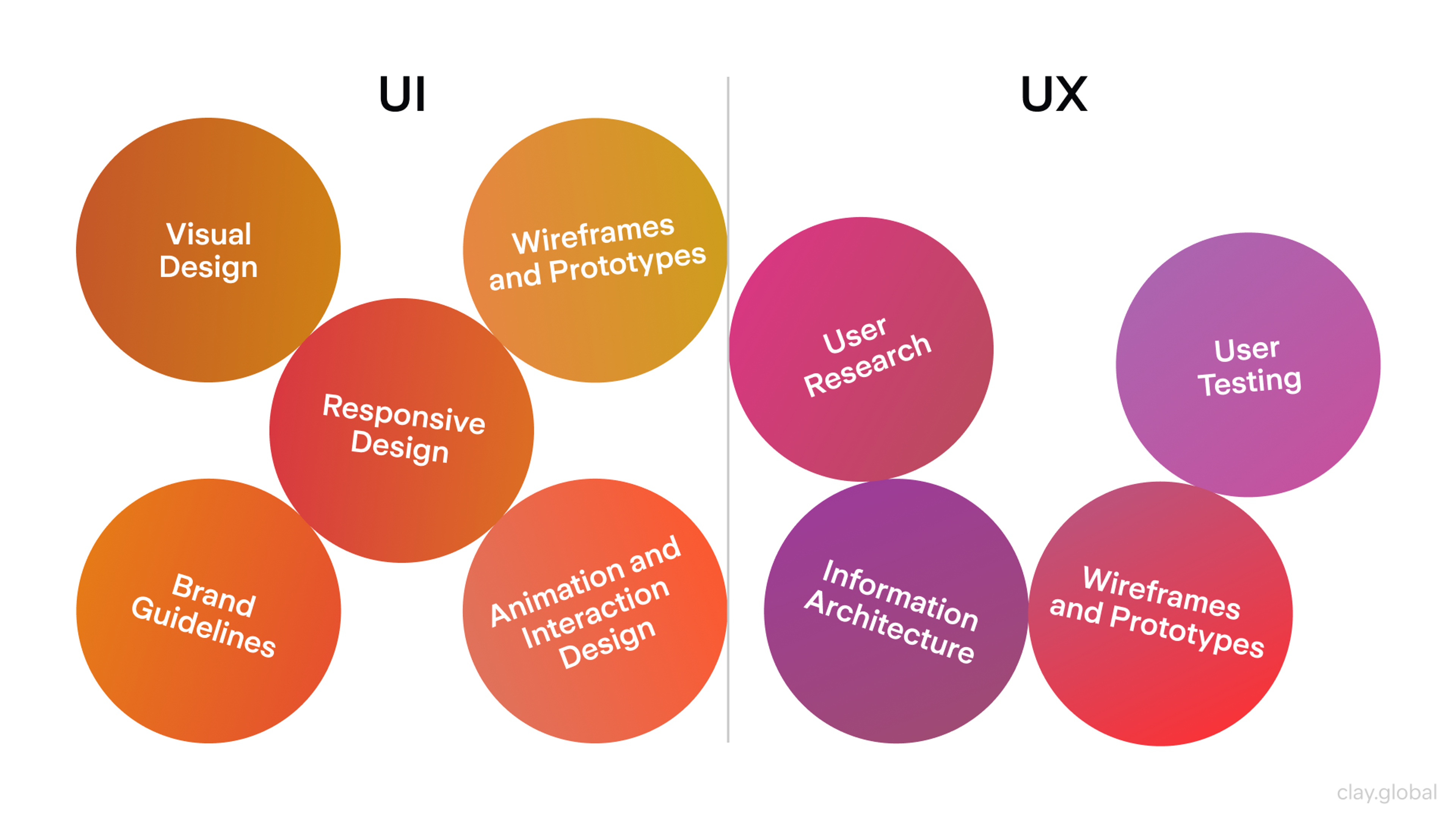
Content production can run alongside UI design. Developers can prepare infrastructure while designers refine approved layouts. However, final page validation cannot finish until the relevant templates, functionality, and content are ready.
A reliable estimate accounts for these dependencies, team capacity, approval windows, and contingency. Simply adding every phase duration together ignores opportunities for parallel work.
Website Redesign Timeline by Phase
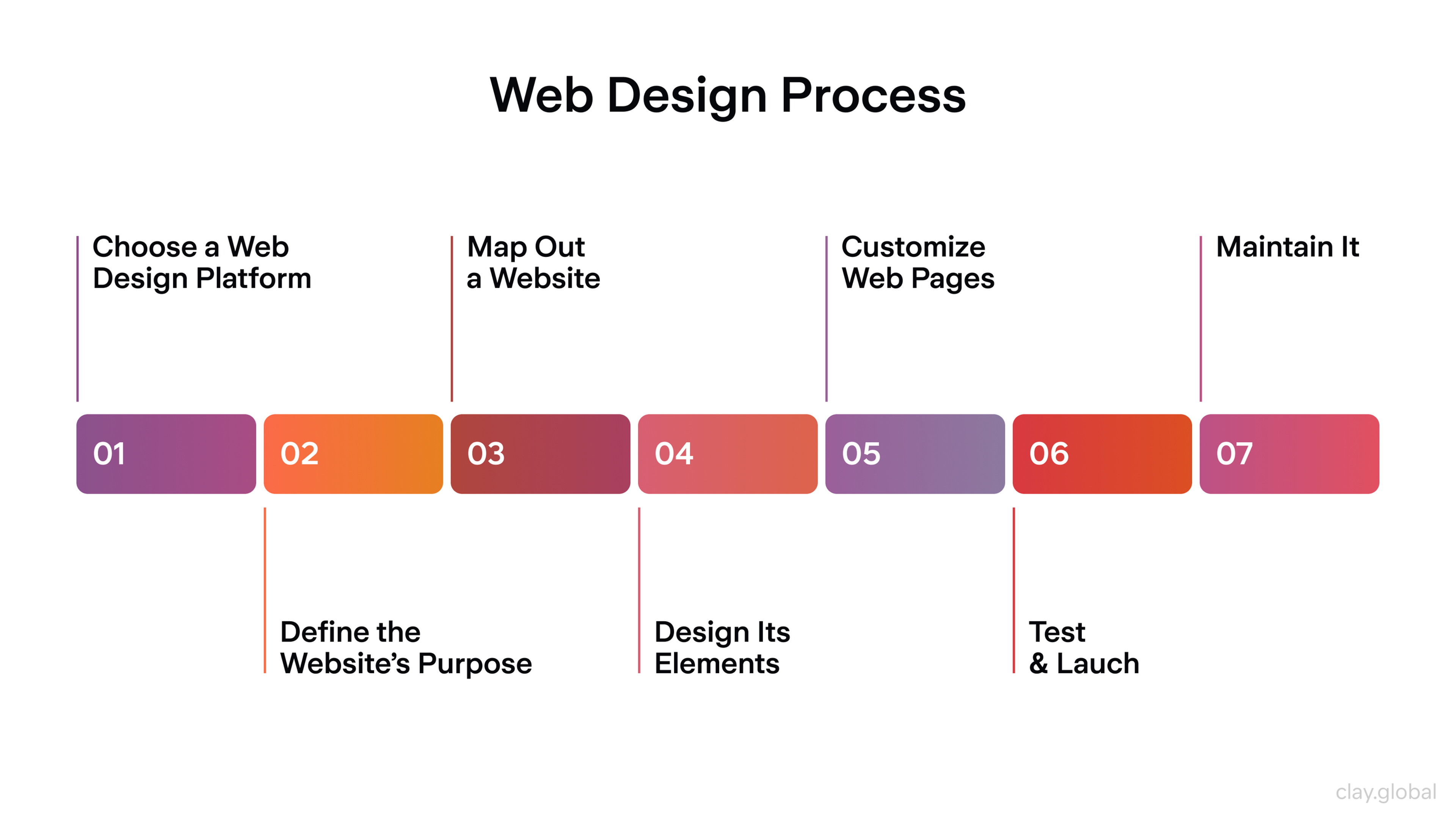
Most website redesign projects follow seven phases: discovery, UX design, UI design, development, content migration, quality assurance, and launch.
These phases have individual deliverables and approval requirements, but they rarely operate in isolation. Understanding where activities overlap helps you establish a more realistic completion date.
These estimates reflect a moderately complex redesign. Enterprise websites and projects involving extensive research or custom functionality may require substantially longer phases.
Website Redesign Timeline by Phase
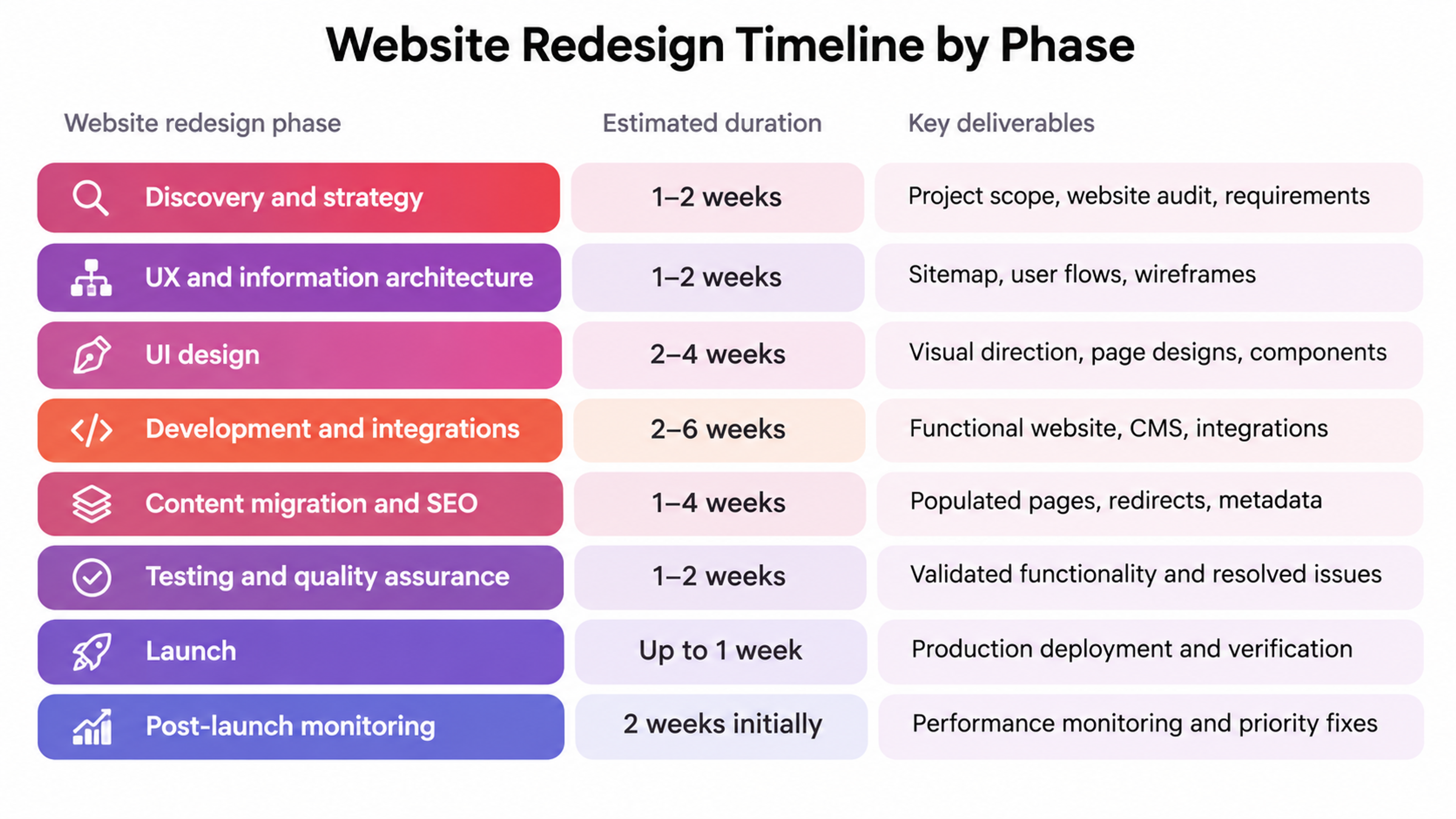
Discovery and Strategy: 1-2 Weeks
Good redesigns begin with difficult questions. Which parts of the existing website perform well? Where do visitors encounter friction? What has changed about your business since the current website launched?
During discovery, the team reviews analytics, evaluates user experience, examines technical limitations, and identifies opportunities for improvement. The objective is to establish what the redesign must accomplish before investing in production.
By the end of this phase, you should have an agreed scope, measurable objectives, initial technical requirements, and a clear decision-making process.
Unresolved requirements at this point create uncertainty throughout the remaining schedule.
UX and Information Architecture: 1-2 Weeks
This phase determines how people navigate the website, discover information, and complete important actions.
Designers develop a sitemap, map user journeys, and create wireframes for key page templates. More complex websites may require user interviews, usability testing, or detailed exploration of alternative navigation structures.
Approving the information architecture before investing heavily in visual design reduces the likelihood of expensive structural revisions later.
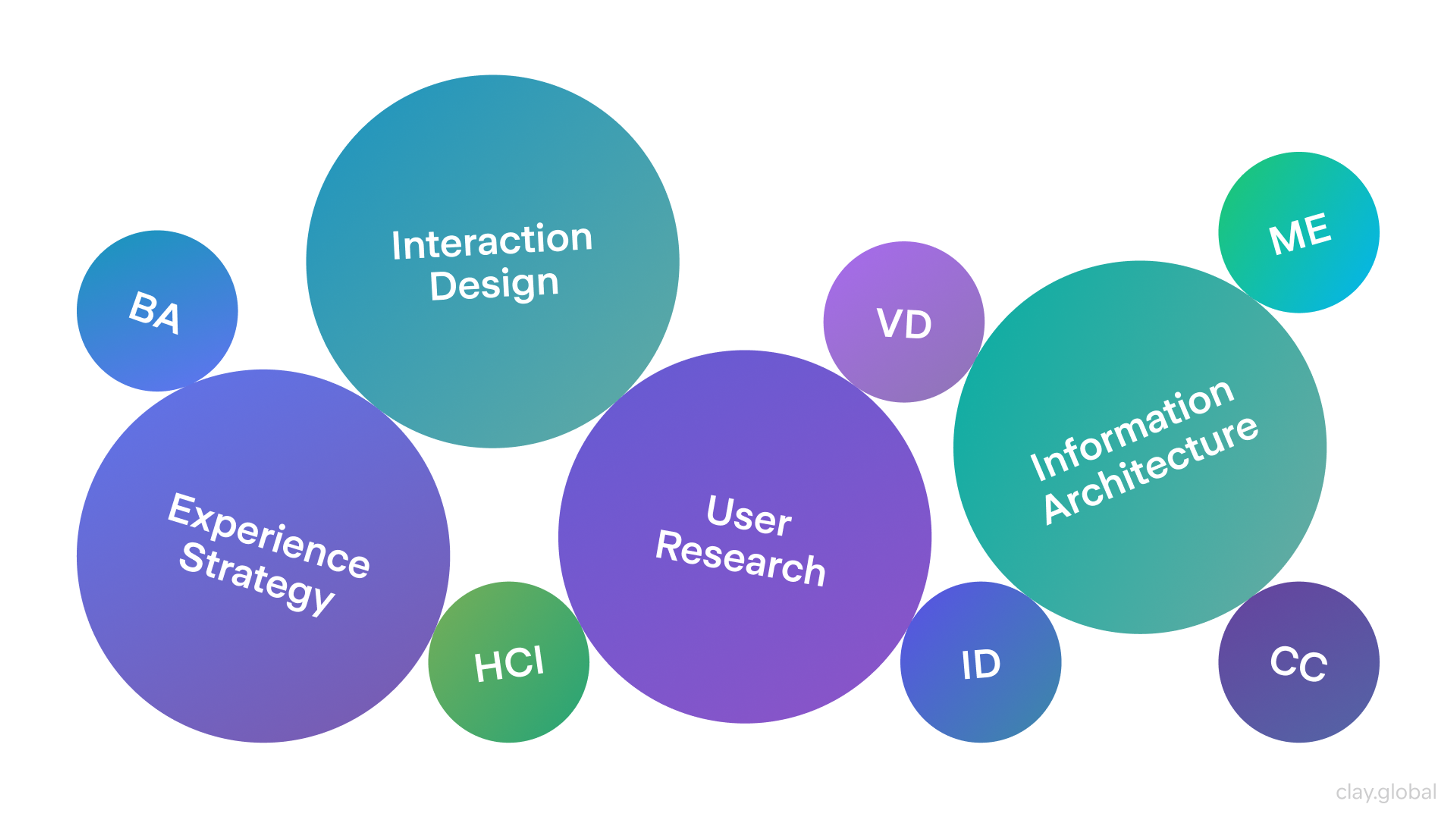
UX Design Disciplines by Clay
UI Design: 2-4 Weeks
Visual design translates the approved structure into a recognizable brand experience. Designers establish typography, color palettes, layouts, imagery, interactive elements, and reusable interface components.
The duration depends on the number of unique templates, the maturity of your existing brand identity, and the complexity of the intended experience.
A well-defined design system can accelerate both design and development by allowing teams to reuse established patterns instead of creating every interface element independently.
UI/UX Elements by Clay
Development and Integrations: 2-6 Weeks
Development turns approved designs into a working website. Engineers implement responsive layouts, establish CMS architecture, configure integrations, and build interactive functionality.
Standard marketing websites generally require less technical investigation than platforms involving payment systems, authentication, complex search, or personalized experiences.
Development doesn't always need to wait until every page is designed. Once foundational components and key templates receive approval, engineers can begin implementation while designers complete the remaining work.
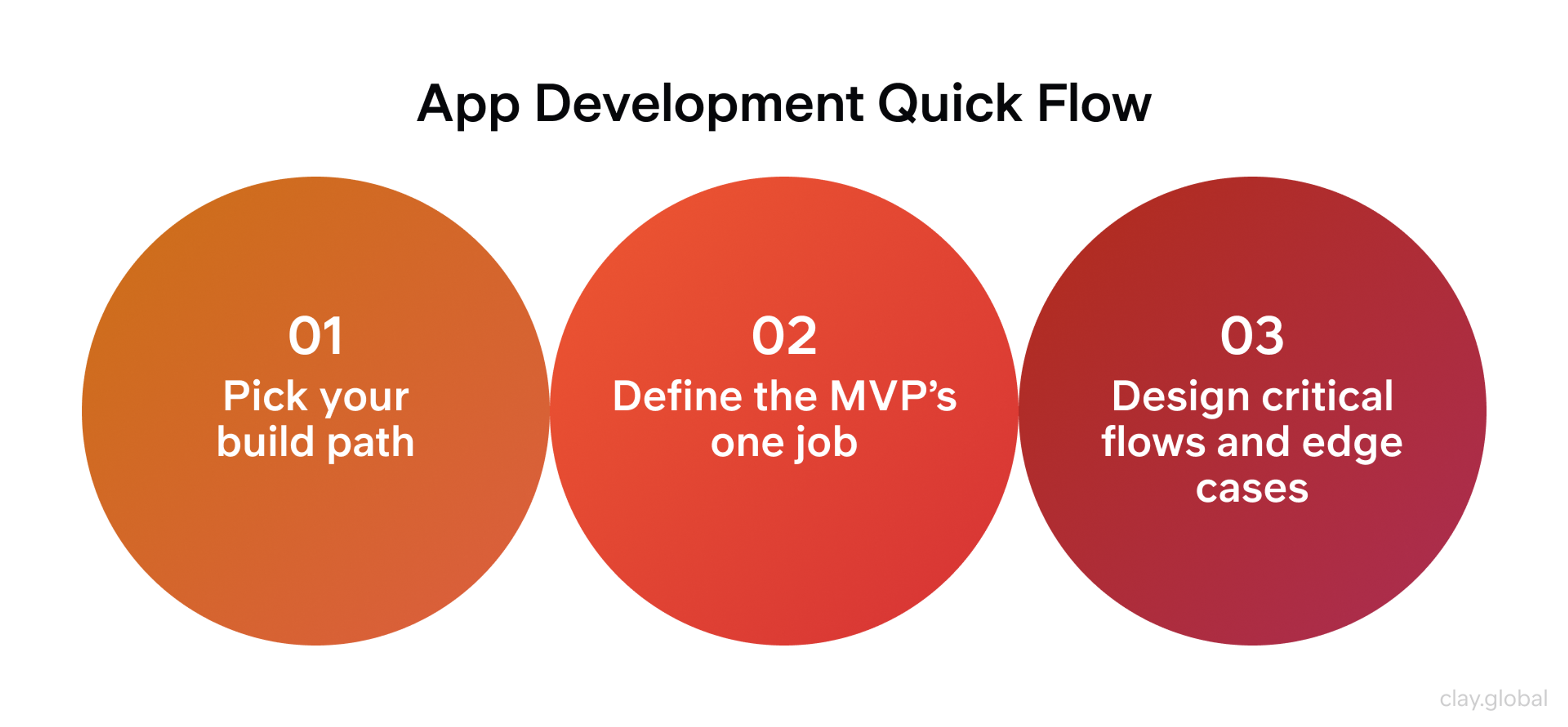
Practical Step to App Development by Clay
Ready to build a web layout that performs across every device and keeps users engaged? Let our team take it from wireframe to launch. Get in touch.
Content Migration and SEO: 1-4 Weeks
Content migration includes transferring existing material, populating new templates, updating metadata, implementing redirects, and validating internal links.
The effort increases when your redesign involves hundreds of URLs, multiple languages, extensive copywriting, or a change of CMS.
Content production should begin well before this phase. The earlier your team identifies migration requirements, the easier it becomes to coordinate content, design, and development.
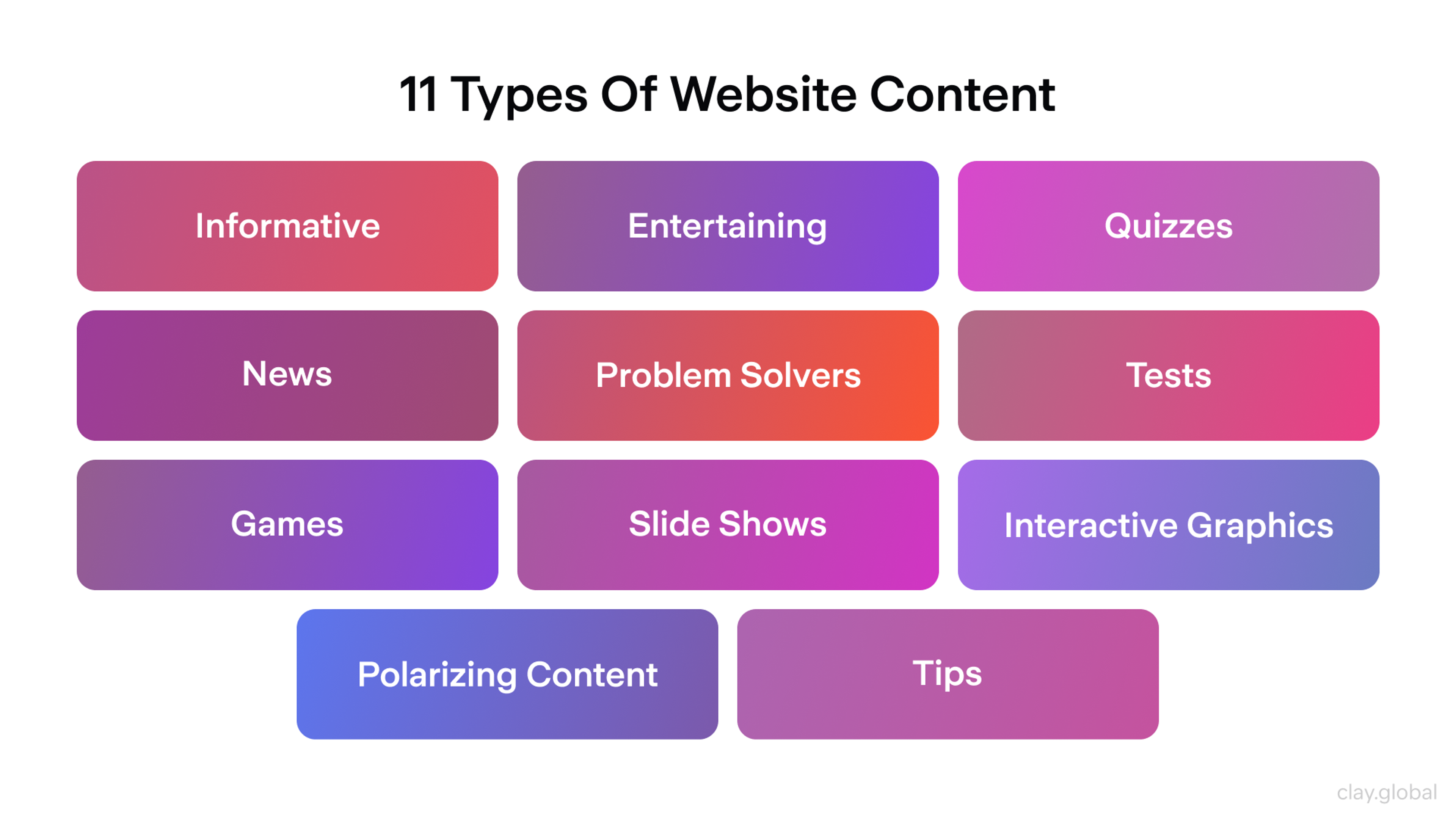
11 Types of Website Content by Clay
Testing and Quality Assurance: 1-2 Weeks
A website that looks finished isn't necessarily ready to launch.
Quality assurance (QA) verifies responsive behavior, browser compatibility, accessibility, functionality, performance, and conversion tracking. Redesign projects also require checks for broken links, indexing problems, and incorrect redirects.
The 2026 WebAIM Million report found that 83.9% of analyzed homepages contained low-contrast text. It also found that 33.1% of detected form inputs lacked proper labels. These findings illustrate why accessibility needs attention throughout production rather than being treated as a final visual check.
Testing should happen continuously during development, with a dedicated final validation period before deployment.
Launch and Post-Launch Monitoring
Launch involves moving the website from a staging environment into production, completing final configuration, and verifying that critical functionality works under real conditions.
The deployment itself may take only a few hours. Preparation, approvals, verification, and contingency planning can occupy several days.
After launch, allocate an initial monitoring period to identify production issues, assess user behavior, and validate business-critical functionality.
What Does a Realistic 10-Week Website Redesign Timeline Look Like?
Consider a marketing website with an established brand identity, moderately complex custom templates, available content resources, and limited third-party integrations.
Its project schedule might look like this:
Realistic 10-Week Website Redesign Timeline Example
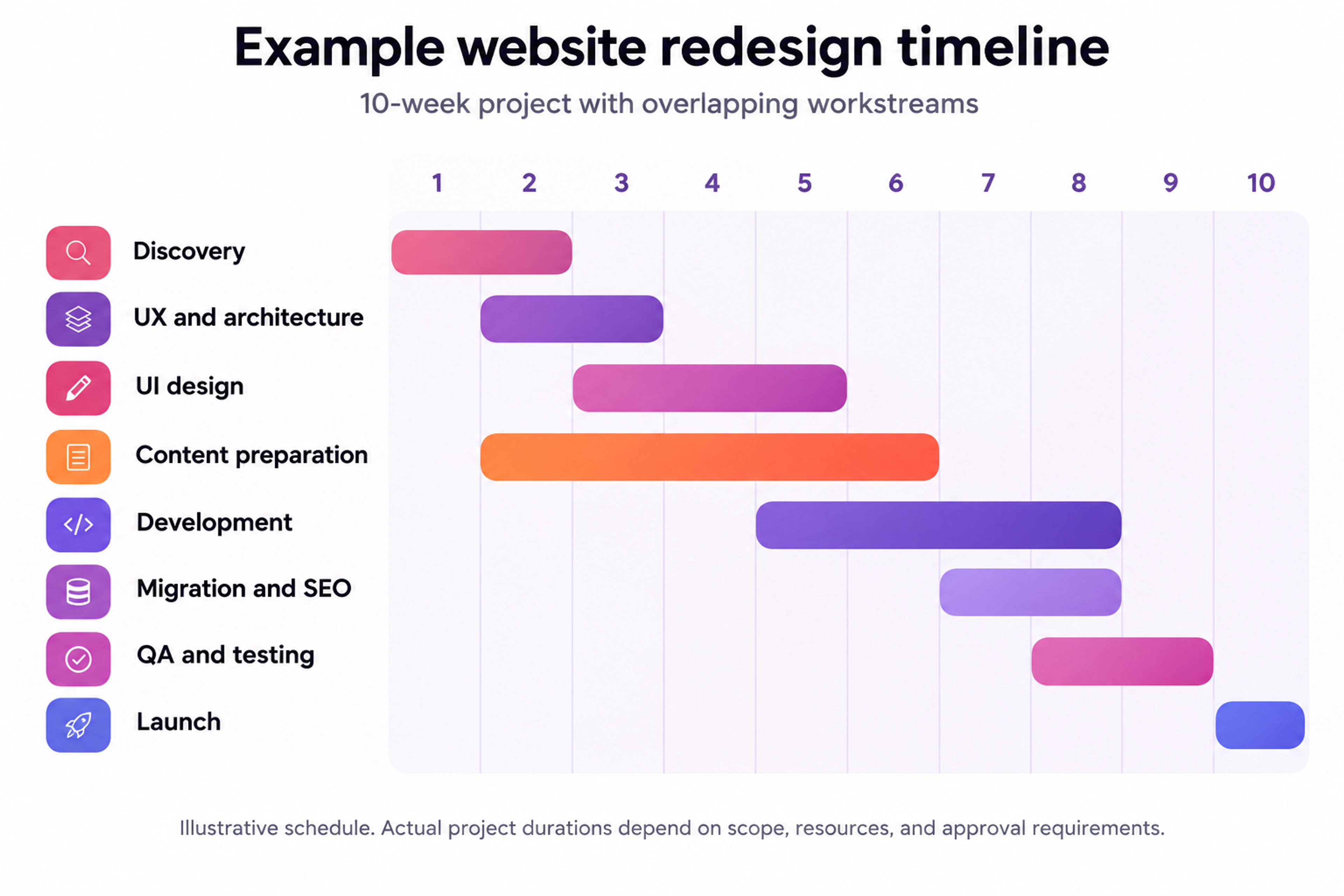
Notice that content preparation begins during discovery and continues throughout design. Development starts before all visual work is finished, while testing begins before implementation concludes.
This approach makes better use of available resources without eliminating necessary validation.
What Causes Website Redesign Projects to Get Delayed?
The most disruptive delays occur when one team cannot proceed because another activity remains unfinished.
A missing product description might prevent designers from validating a page layout. An unresolved API requirement could block development. Conflicting stakeholder feedback might force the team to revisit an approved design direction.
These problems have different origins, but they share a common characteristic: unresolved dependencies.
Common Delays in Website Redesign Projects
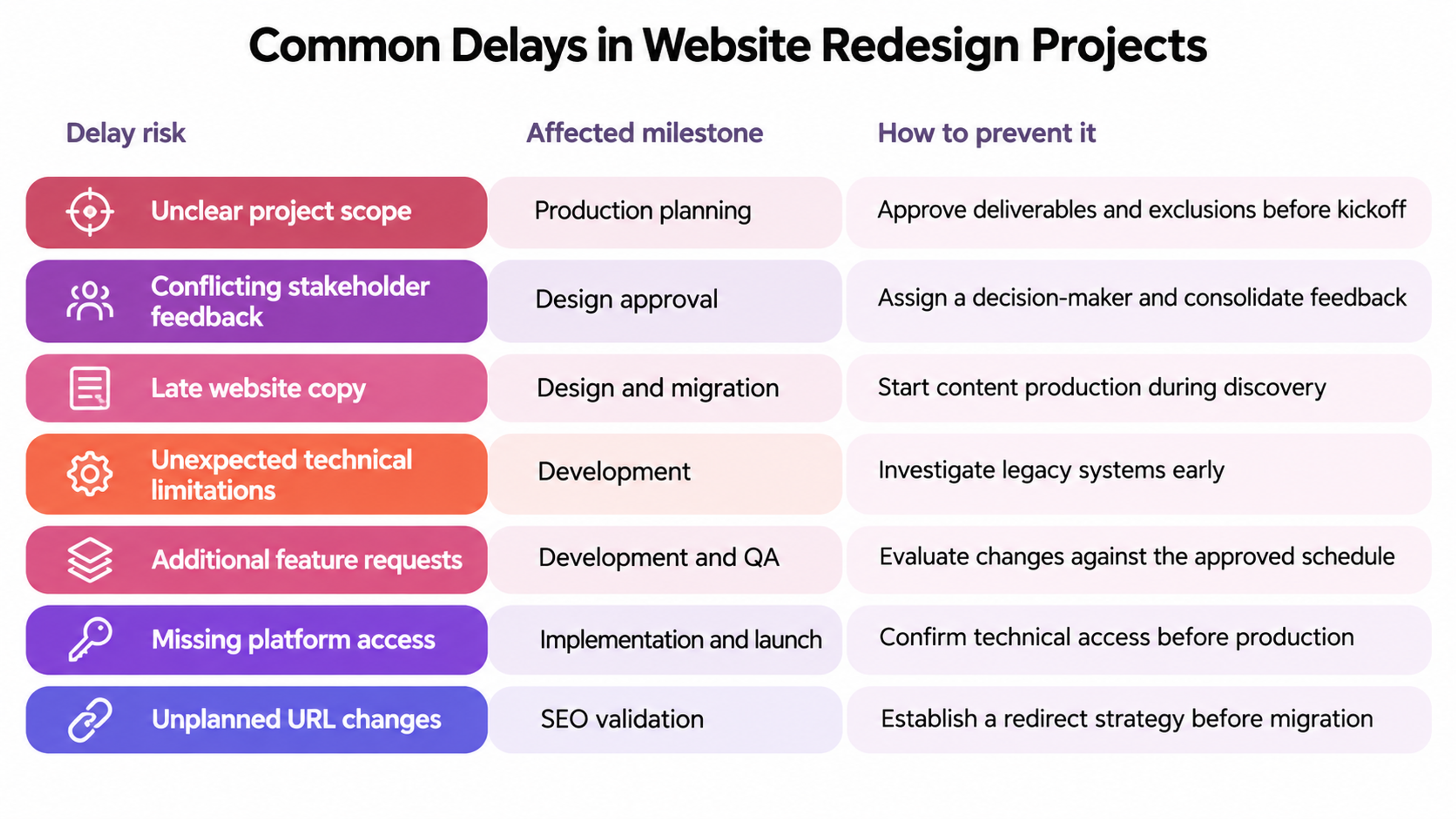
Assign ownership to each critical dependency. Your agency should know when it needs specific inputs, and your internal team should understand the consequences of missing those deadlines.
A project schedule becomes much more useful when it connects dates to responsibilities.
How Content Migration and SEO Affect the Redesign Timeline
An existing website carries accumulated value. Search rankings, backlinks, established landing pages, historical analytics, and familiar user journeys all deserve consideration during a redesign.
Changing the website without protecting those assets can introduce problems that extend well beyond the launch date.
Content migration involves two distinct workloads. The first is editorial: evaluating, rewriting, translating, and organizing content. The second is technical: transferring material, mapping URLs, implementing redirects, and maintaining accurate indexing signals.
For content-heavy websites, both workstreams can require substantial preparation.
Google's site migration guidance explains that processing URL changes across a small or medium-sized website can take several weeks, with larger websites requiring more time. Temporary search ranking fluctuations may also occur during the transition.
This means the technical launch date and SEO stabilization date are not necessarily the same.
SEO Strategy by Clay
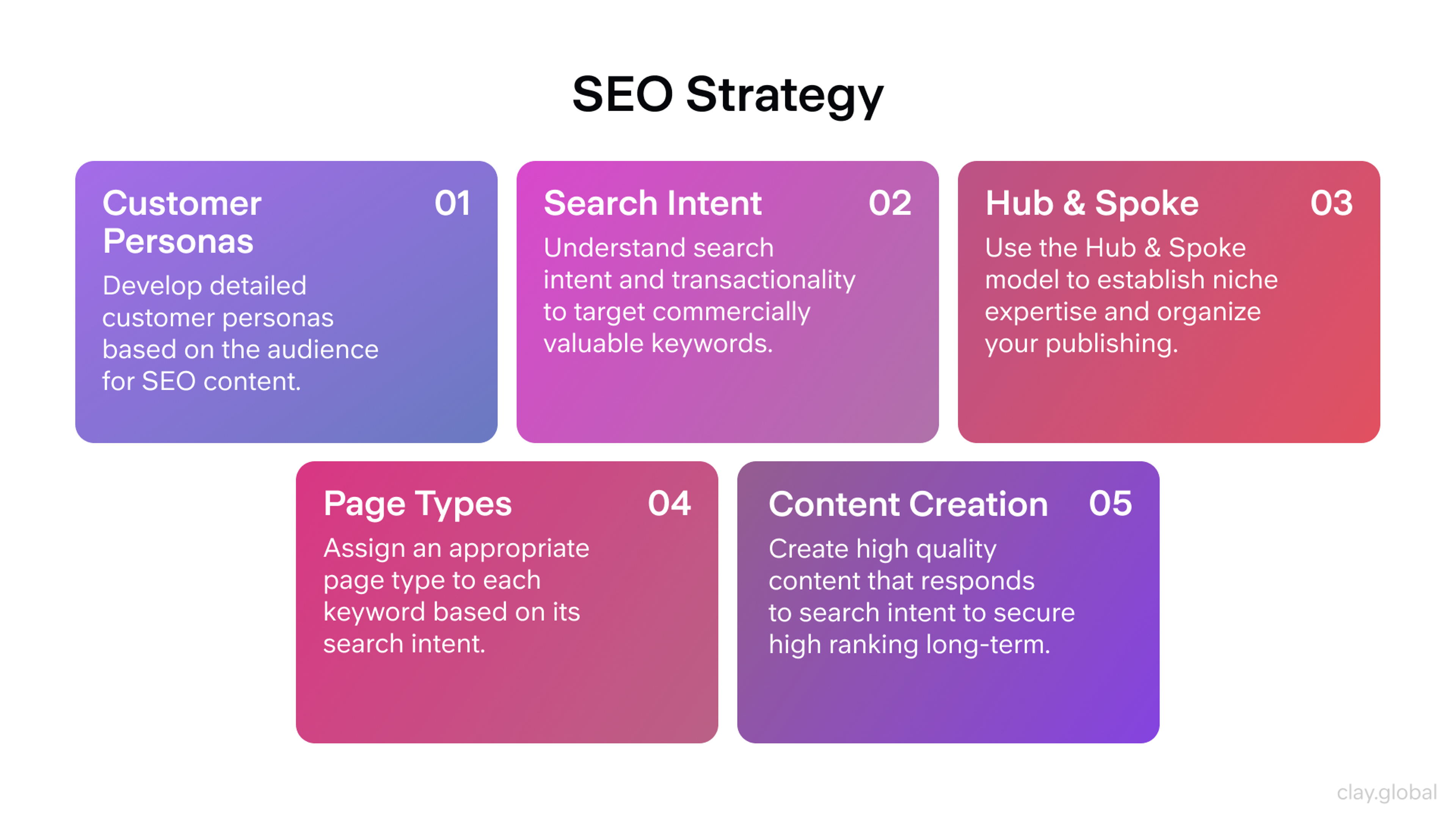
Before deployment, your team should establish:
- An inventory of important existing URLs and landing pages.
- A redirect map for changed or consolidated pages.
- A plan for preserving relevant metadata and internal links.
- Validation procedures for canonical tags, indexing settings, and XML sitemaps.
- Baseline organic traffic and conversion measurements.
Treat SEO migration as part of the redesign scope from the beginning, rather than an additional task discovered during launch preparation.
Can You Redesign a Website Faster?
Yes, provided you're willing to reconsider project constraints.
Compressing a schedule without changing scope, resources, or dependencies often introduces avoidable risks. A better approach is to identify which activities can be simplified, delegated, or completed simultaneously.
Reduce Scope Without Reducing Quality
If your website must launch before a product announcement or major campaign, prioritize the pages and functionality essential to that event.
Secondary landing pages, advanced animations, and nonessential features can follow in later releases. This allows your team to protect the quality of the core experience while meeting an important business deadline.
Reuse What Already Works
Not every website component needs redesigning. Existing CMS infrastructure, effective page layouts, brand assets, and reliable integrations may remain useful.
Evaluate these assets before replacing them. Preserving a dependable technical foundation can save significant implementation and testing effort.
Project Constraint and Recommended Approach
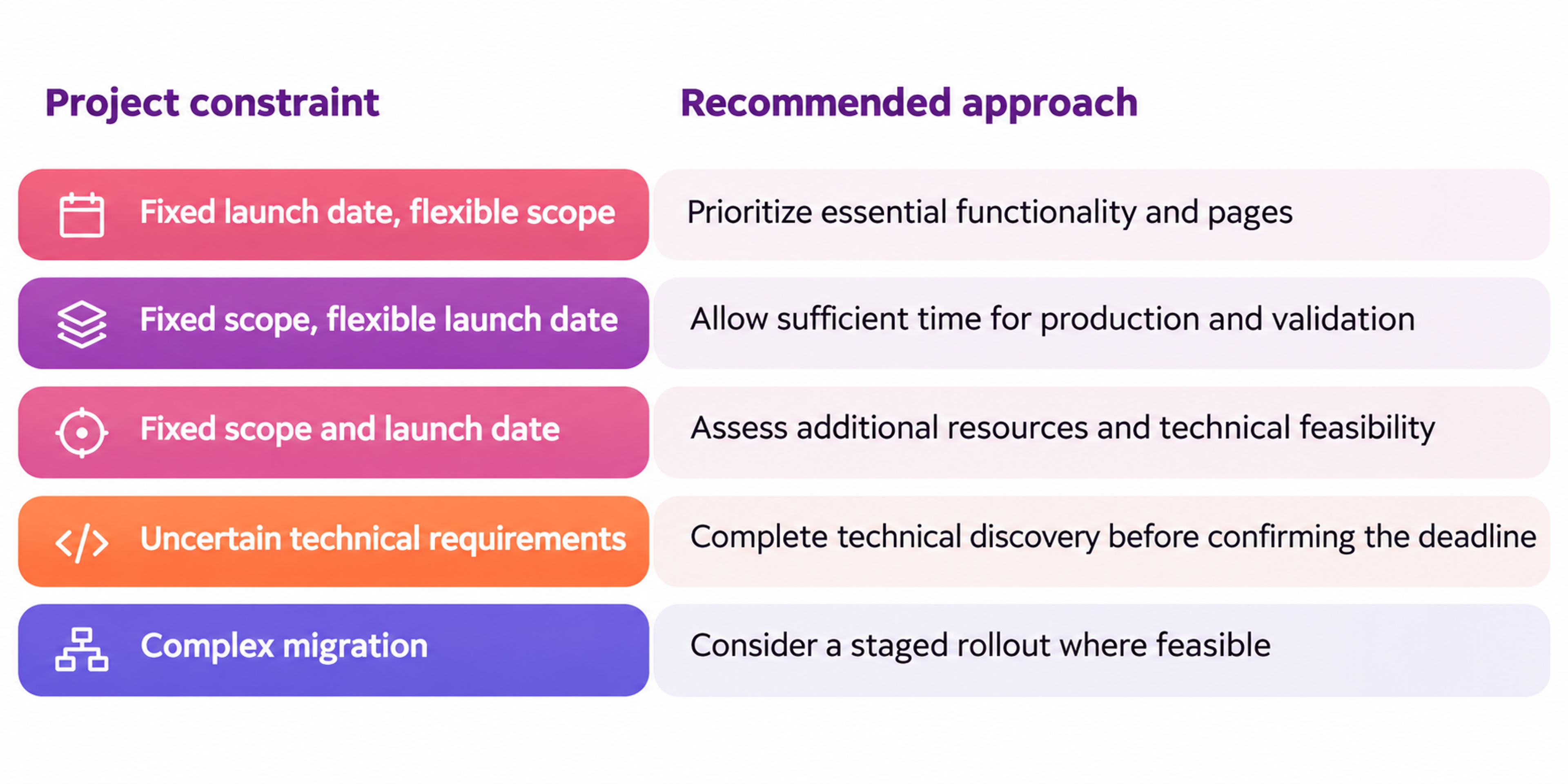
AI-assisted design and development tools can also accelerate selected production tasks, such as prototyping, content exploration, and code generation. However, they don't eliminate the need for strategic decisions, stakeholder approvals, accessibility validation, or integration testing.
The fastest reliable redesign is one with fewer unnecessary dependencies, not fewer quality checks.
What Happens After a Website Redesign Goes Live?
Deployment marks the transition from a controlled development environment to real-world usage.
During the initial post-launch period, monitor whether users can complete important actions, whether analytics capture them correctly, and whether search engines can access the intended pages.
Pay particular attention to conversion funnels, form submissions, checkout flows, performance metrics, crawl errors, and unexpected changes in organic traffic.
For websites undergoing URL migrations, monitoring should continue beyond the initial two-week stabilization period. Search visibility may take longer to settle, especially when the website contains many pages.
Define post-launch responsibilities before deployment. Your team should know who investigates production issues, who approves fixes, and which problems require immediate attention.
How to Evaluate an Agency's Website Redesign Timeline
A shorter proposal isn't necessarily a better proposal.
Two agencies might estimate different durations because they make different assumptions about research, content, revisions, development, and technical validation.
Before selecting a professional web design agency, use these questions to establish whether its proposed schedule is realistic.
Website Redesign Checklist
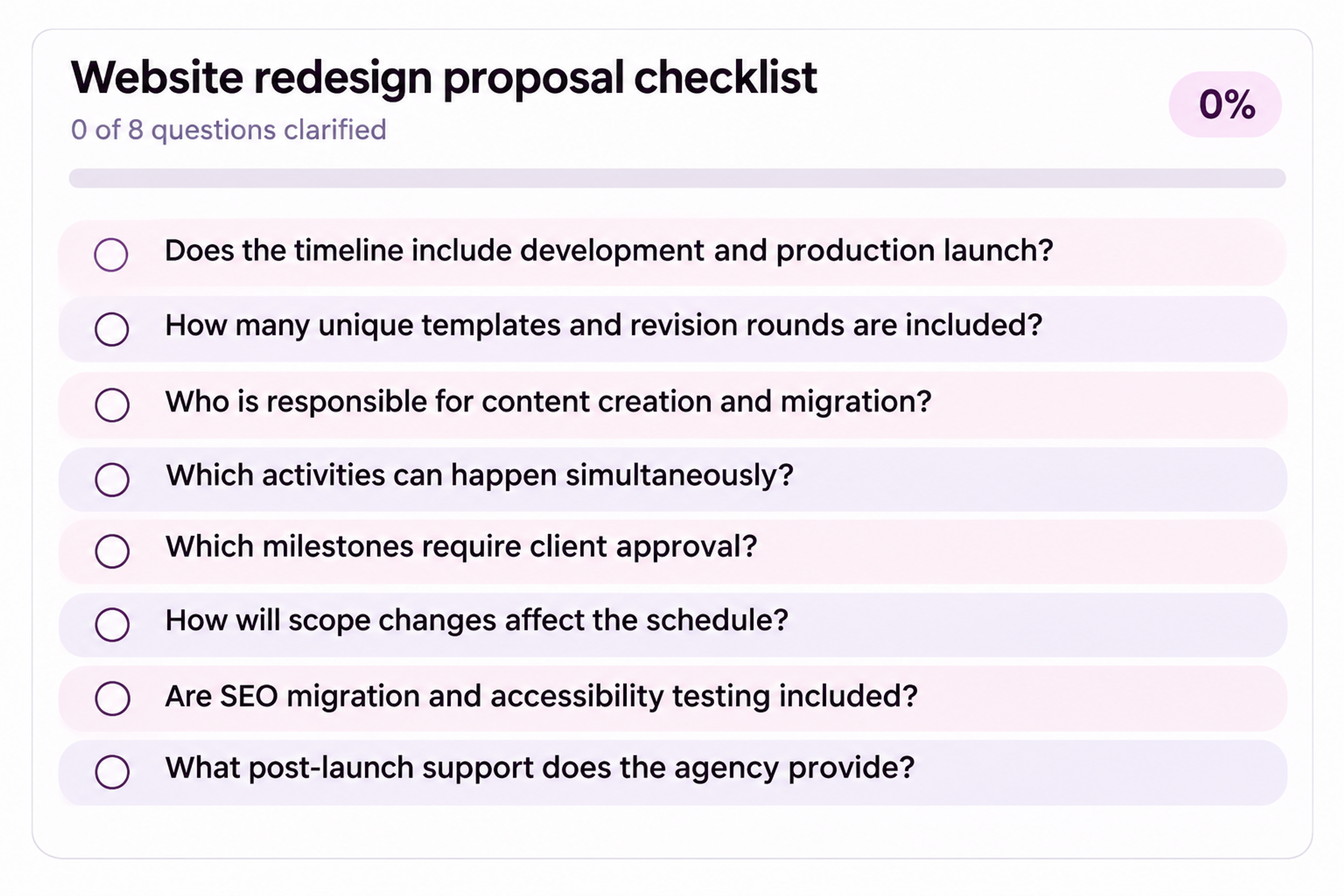
A credible agency can explain how its estimate was developed, which assumptions support it, and what circumstances might change the completion date.
Dates alone aren't a project plan. Look for deliverables, dependencies, responsibilities, and measurable approval criteria.
We've built comprehensive web experiences for Slack, Stripe, Grayscale, and Marqeta - companies that needed more than a pretty site. If yours does too, let's talk.
Read More
- Clay Global’s Web Design Case Studies
FAQ
Can a website redesign be completed in two weeks?
A two-week redesign may be feasible for a focused visual update using existing templates, infrastructure, and approved content. A full redesign involving UX research, custom development, migration, and extensive testing is unlikely to fit that schedule without substantial limitations.
How long does it take to redesign a homepage?
A homepage-only redesign may take one to three weeks for design work when brand guidelines, messaging, and objectives are established. Custom development, animation, research, and stakeholder revisions can extend the engagement.
Can you redesign a website while the old website stays live?
Yes. Teams typically build the redesigned website in a separate staging environment while the existing website remains accessible. For ecommerce and other frequently updated platforms, additional synchronization may be necessary to preserve recent transactions and content changes.
Does changing your CMS increase the redesign timeline?
Usually. Moving to a new CMS introduces additional work involving content models, data transformation, template development, permissions, integrations, and editorial workflows. The impact depends on compatibility between the existing and replacement platforms.
How long does it take to design a website without development?
A small marketing website may require two to six weeks of design work. Larger projects involving extensive research, unique templates, complex interactions, and design systems can require considerably longer. Development and deployment are separate estimates unless explicitly included.
How much time should you allocate for website design revisions?
Agree on the number of revision rounds and response deadlines before production begins. As a planning example, two review rounds with three working days of client feedback each require six working days of review time, in addition to the time designers spend implementing changes.
Does redesigning a multilingual website take longer?
Generally, yes. Multilingual websites require translation, localized content, layout validation, language switching, regional SEO configuration, and testing. Languages with different writing directions or substantially different text lengths may require additional design adjustments.
Can you launch a redesigned website before every page is finished?
A phased launch can work when unfinished sections are nonessential and the transition won't disrupt navigation, indexing, or user journeys. Existing high-value pages should remain accessible until their replacements are ready.
How long does SEO recovery take after a website redesign?
There is no guaranteed recovery period. Minor redesigns that retain URLs and relevant content may experience little disruption. Larger migrations can produce fluctuations lasting several weeks or longer, depending on website size, implementation quality, and search engine processing.
Should you complete a rebrand before redesigning your website?
Finalize core brand positioning and visual direction before committing to detailed website design. Brand development and website research can happen simultaneously, but unresolved identity decisions may create rework if website production progresses too far ahead.
Is it faster to use a website template or create a custom design?
A template can reduce production time when its structure supports your content and functionality. Extensive customization may diminish those savings, particularly if developers need to work around architectural limitations or replace existing components.
When should you start planning a website redesign?
Begin planning as soon as you identify a business milestone that depends on the new website. Allow time for agency selection, internal preparation, technical investigation, and content planning before the formal production schedule begins.
Conclusion
Your website redesign should begin with a realistic assessment of the work, not an arbitrary launch date.
Understand which parts of your existing website create value, identify the changes that will improve your business outcomes, and establish the resources and decisions required to deliver them.
A well-planned redesign gives you visibility into what happens next, why each activity matters, and how the team will respond when circumstances change.
The goal isn't simply to launch sooner. It's to launch a website that performs better without sacrificing the value you've already built.


About Clay
Clay is a UI/UX design & branding agency in San Francisco. We team up with startups and leading brands to create transformative digital experience. Clients: Facebook, Slack, Google, Amazon, Credit Karma, Zenefits, etc.
Learn moreAbout Clay
Clay is a UI/UX design & branding agency in San Francisco. We team up with startups and leading brands to create transformative digital experience. Clients: Facebook, Slack, Google, Amazon, Credit Karma, Zenefits, etc.
Learn more