

Choosing a design agency takes real effort, and it's a big decision. How the collaboration runs after the contract is signed deserves the same attention because that's where most projects gain or lose momentum.
We've seen this across many engagements. Even with a strong team and a great kickoff, a project's pace depends on how smoothly the work runs day to day.
That's where process and talent matter equally. Knowing how to work with a design agency, from what you prepare to who makes the final call, shapes the result as much as the portfolio of the agency you hired.
Key Takeaways
- Prepare context before kickoff. A clear brief, brand assets, research, and access to analytics save weeks of discovery.
- Name one decision-maker or document exactly how approvals work across several stakeholders.
- Bring every person with veto power into the process early, ideally during discovery.
- Tie feedback to goals, users, or constraints and send it through one channel.
- Agree on how scope changes get priced before the first change request arrives.
How to Work With a Design Agency From Start to Finish
Every project is a little different. Still, most of the projects we've worked on follow the same six stages, and at each one the client has a specific role to play.
Choose the Right Partner
Start with case studies, capabilities, and the people who'll actually work on your project.
Industry experience helps. Experience with similar audiences, business models, or technical constraints is often just as valuable.
Agency size is a trade-off. A larger studio can staff several disciplines at once. A smaller team usually gives you more direct access to senior specialists.
Either way, ask who will be in the room after the contract is signed.
When you look through past projects, go beyond the visuals and ask a few specific questions.
- What problem were you solving, and what constraints did you work within?
- How did research shape the solution?
- How did you handle disagreements or changes in direction?
- Who on your team did the work?
- What happened after launch?
Ask the agency to walk you through its design process and pay attention to what it asks you in return.
We treat the first calls as a fit test for both sides. An agency that talks only about aesthetics and never asks about your users, business goals, or existing research will probably design in a vacuum.
Agree on Scope, Pricing, and the Contract
Once you've picked an agency, make sure you put everything you've agreed on in a contract before any work begins.
Depending on the project and jurisdiction, that may be a master services agreement, a statement of work, a design services agreement, or a combination of documents.
The paperwork should cover services, deliverables, the timeline, fees, responsibilities, the review process, and how scope changes get handled. Four areas deserve extra attention.
Pricing model. The right model depends on how well you can define the scope today.
- Hourly pricing suits exploratory work where the scope is likely to shift.
- A retainer (a set monthly fee) sits between the two, covering ongoing design work where the direction is clear but priorities change from release to release.
- A fixed project fee (one price for the whole project) makes budgeting easier when deliverables and boundaries are clear.
Pricing Model Spectrum
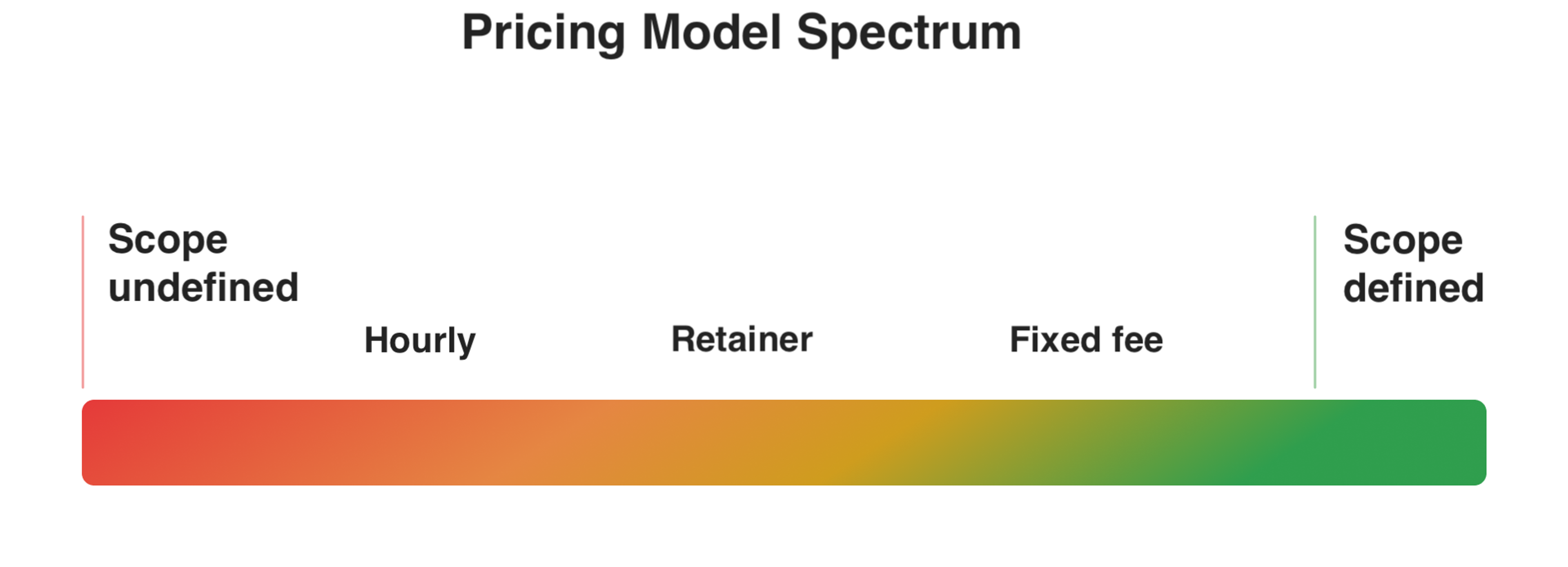
A fixed fee buys predictability. It doesn't automatically make a project cheaper. When you compare proposals, check how many revision rounds each one covers and what assumptions it rests on.
Change requests. Define what counts as additional work and how it gets estimated and approved.
Two Paths for a New Request
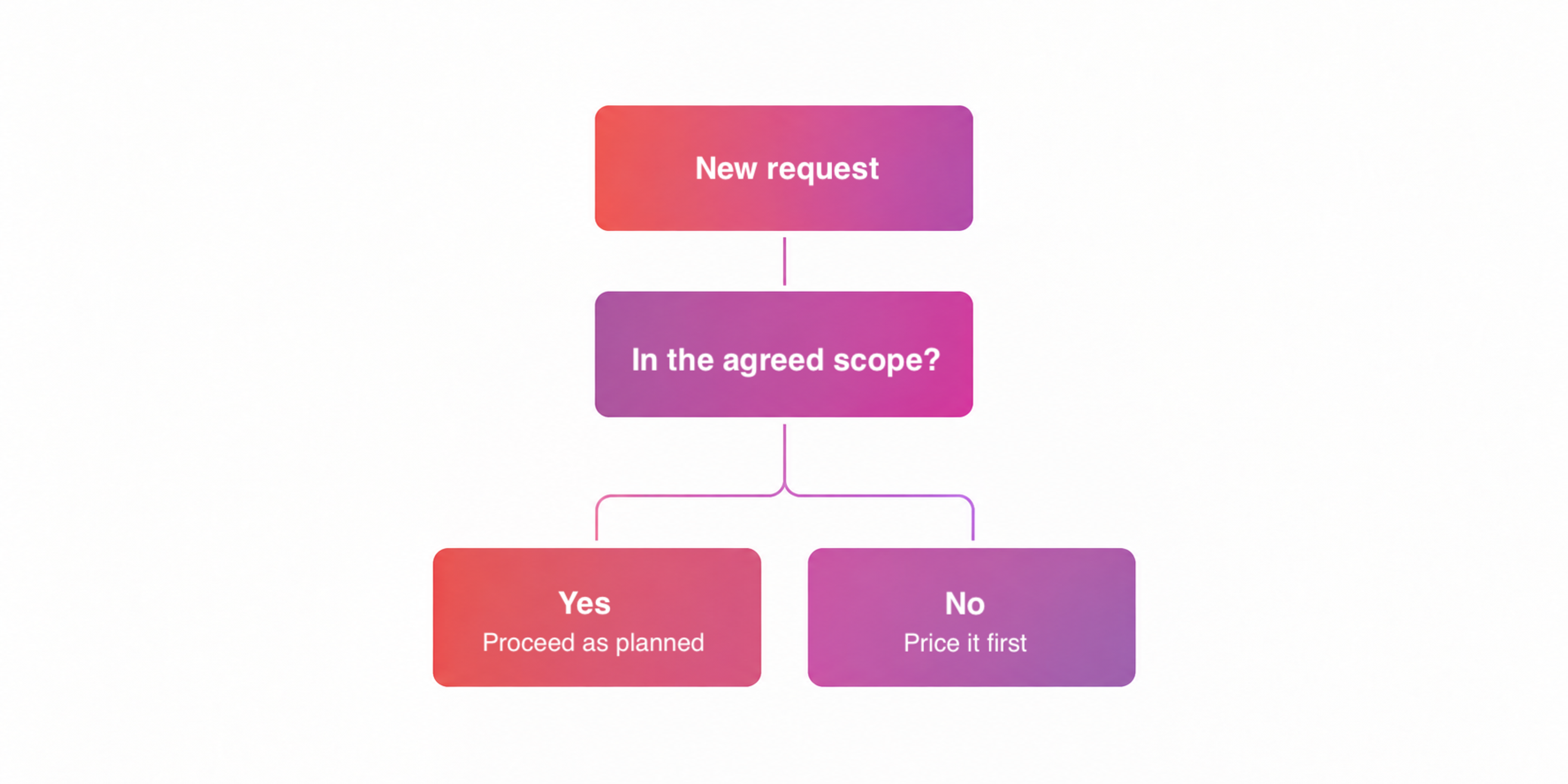
Take a web design project as an example. Adding animation or restructuring the site navigation might be priced separately and approved before work starts.
We push for this clarity early because it protects both sides. Changes stay visible, and nobody discovers a budget problem at the invoice stage.
Intellectual property. Paying for design work doesn't automatically transfer every font, photograph, illustration, framework, or third-party component to you.
Asset Owners
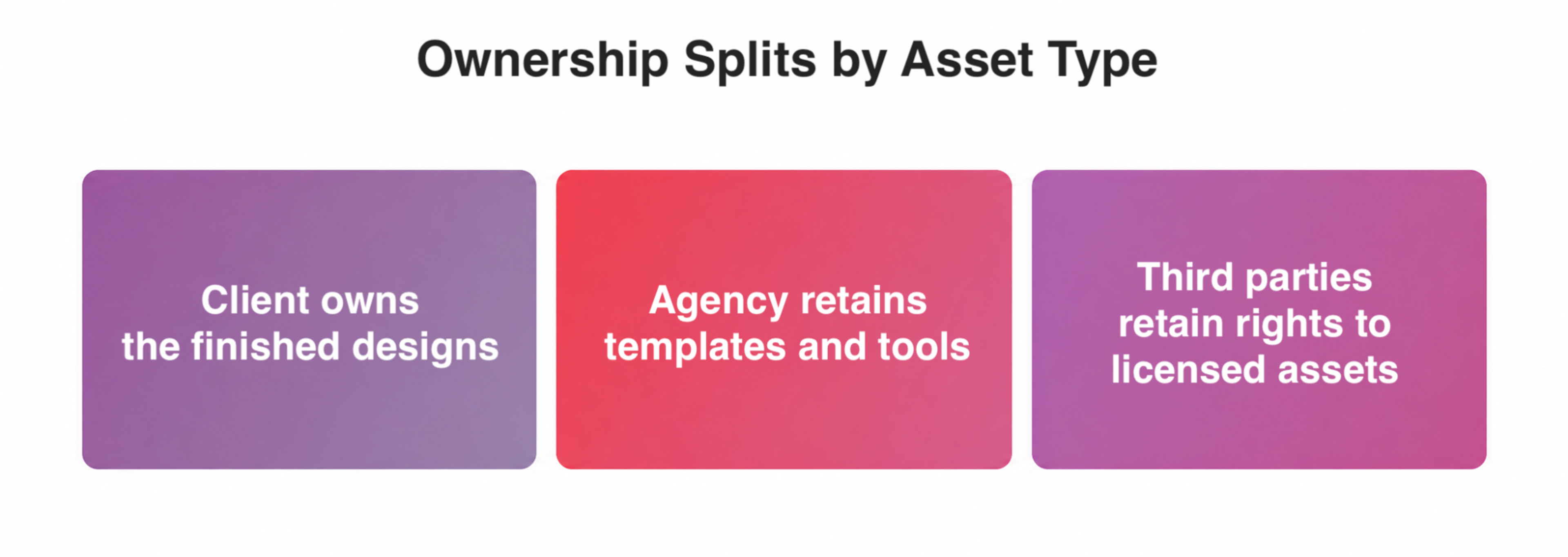
Spell out what you own, what's licensed, and what stays the agency's pre-existing property. The legal treatment depends on the jurisdiction and the contract itself, so bring in qualified counsel for anything unclear.
Accessibility. Name accessibility as its own line item in scope. 95.9% of the top one million home pages have at least one detectable accessibility failure. In our experience, requirements that never make it into the brief get skipped by default, and accessibility is one of the most common casualties.
Kick Off With Context
The kickoff sets the tone for everything after it. It's where both teams agree on goals, roles, the review rhythm, and the first milestones.
It's also where the agency starts learning what your company is really trying to do.
Our work for Art Bridges, a foundation working to expand access to American art through museum partnerships, is a good example of why that matters.
Website design for Art Bridges by Clay Global
Their Director of Web Operations, Colin Carmichael, described the collaboration this way:
"Clay took the time to fully understand our foundation and mission. The new site delivers an exceptional experience and beautiful design that represents the organization perfectly."
That quote puts understanding first, and the design follows.
An agency that understands your mission makes better calls on its own and needs fewer rounds of correction from you.
The most productive kickoffs we've run all had a client who arrived with the materials already gathered, so the first week went into real work.
Discovery and Research
Discovery is where the agency learns what you already know and tests your assumptions. Expect:
- stakeholder interviews
- a review of existing research and analytics
- competitor analysis
- sometimes user interviews or testing
The findings then shape decisions about information architecture, content, and priorities.
It's natural to want to move quickly through this stage. In our experience, time invested in discovery usually pays off later, since it helps the first concepts answer the right question.
Your most useful contribution here is access to people. Ideally, every stakeholder with veto power talks to the agency during discovery.
Input from someone who joins later is still valuable, but it's harder to include without revisiting earlier decisions.
Concepts and Iteration
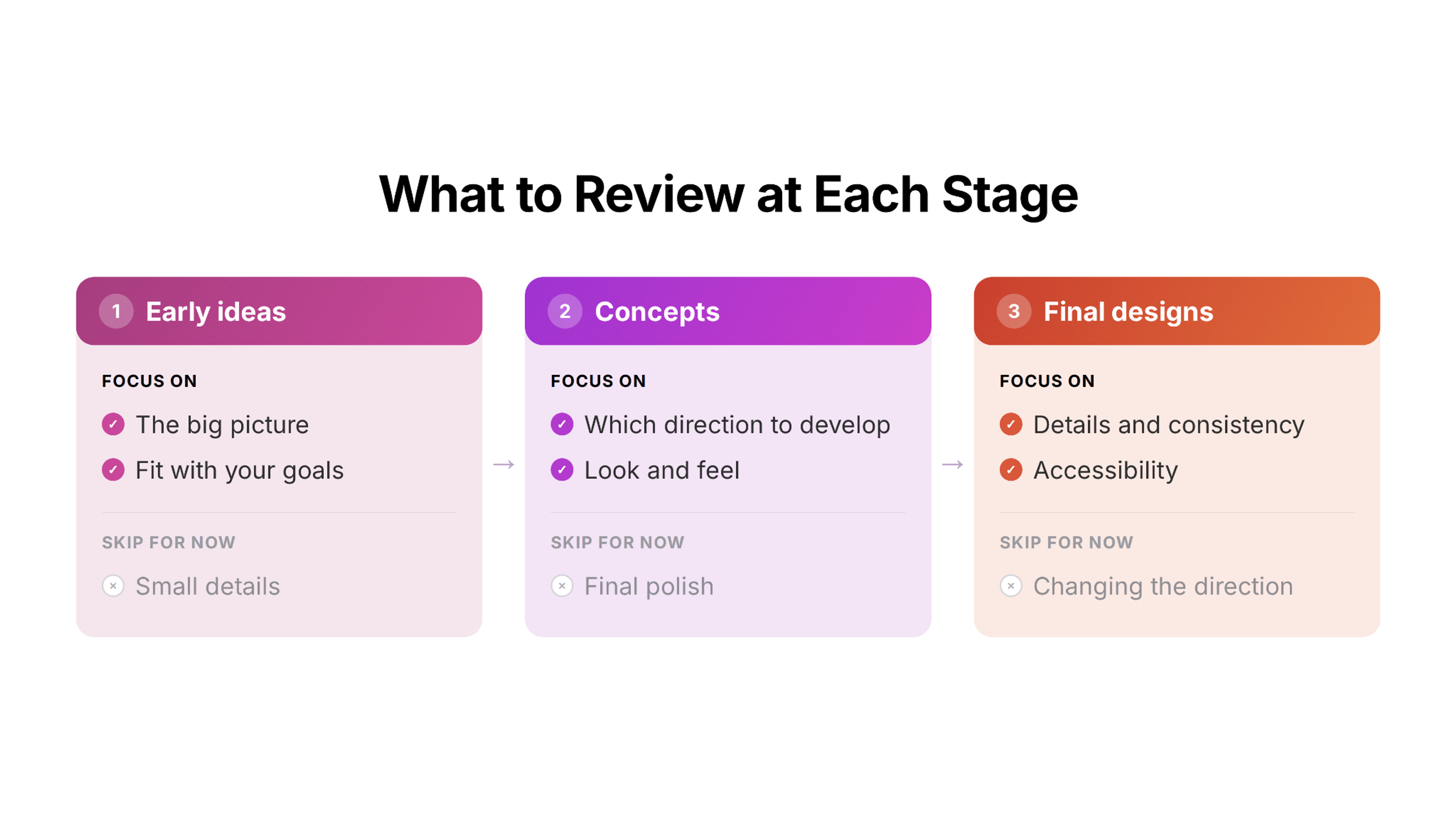
Design moves faster in short loops. Regular iteration makes it easier to test assumptions and change direction before anyone has invested weeks in a polished solution.
The goal is to catch misalignment while it's still cheap to fix. Your job at this stage is to give feedback that's timely, specific, and consolidated into one voice.
Matching Your Feedback to Each Stage of Iteration
Handoff and Launch
Handoff is where design meets engineering, and it's where a lot of value leaks out of a project.
Agree early on what the final package includes, such as source files, specs, a component library or design system, and documentation. Invite your engineering lead to review well before handoff, so feasibility questions come up early.
When the budget allows, we recommend keeping the agency involved through implementation QA. Small gaps between the approved design and the built product add up quickly, and the people who designed it spot them fastest.
What to Prepare Before Working With a Design Agency
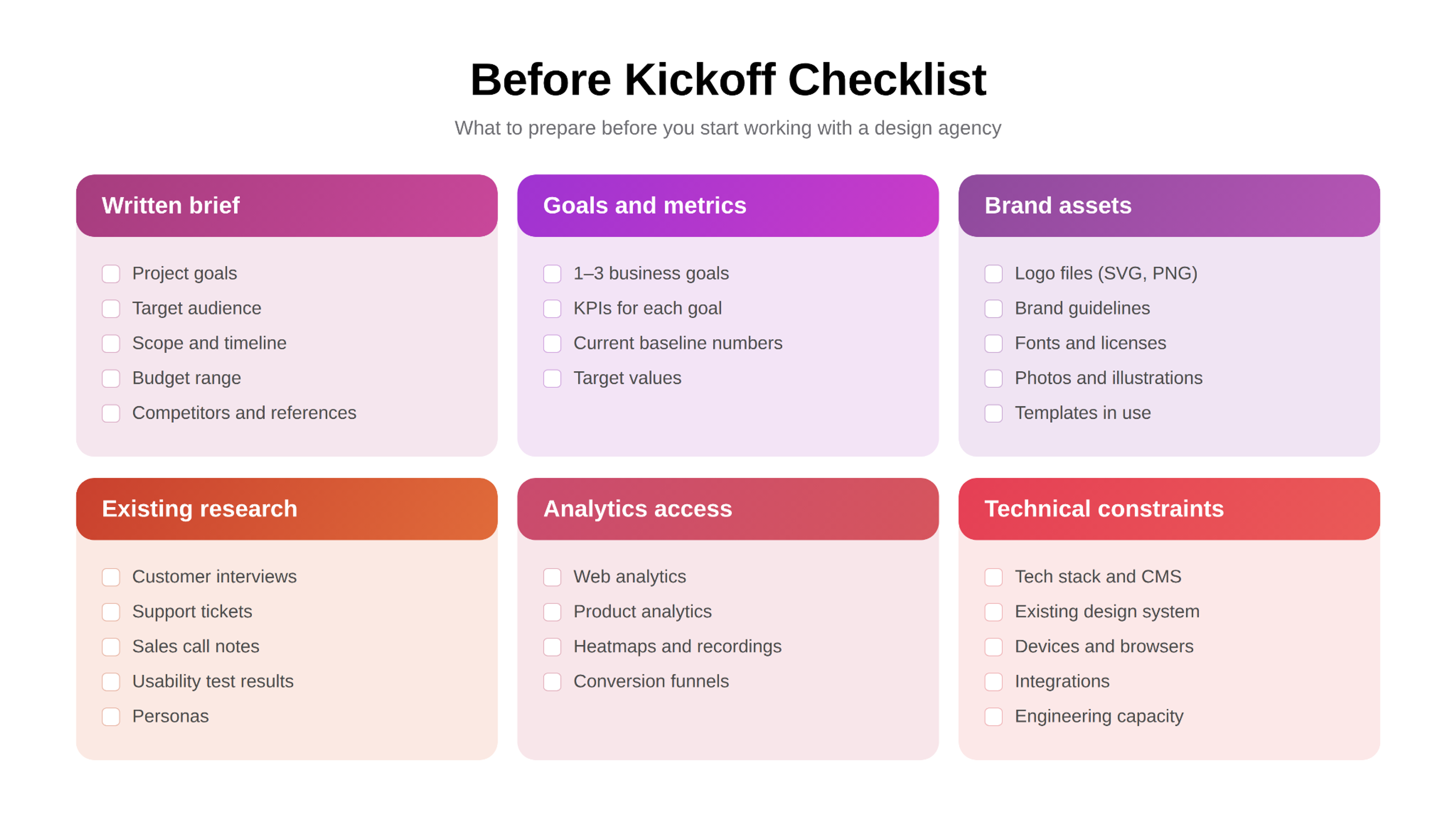
The fastest way to shorten a project is to hand over context on day one. Before kickoff, gather these materials.
- A written brief. It gives the agency one place to understand the project, so early conversations can focus on ideas and open questions.
- Business goals and success metrics. They show the agency what the design has to achieve and give both teams a fair way to judge the result after launch.
- Brand assets. Sharing them upfront keeps new designs consistent with what your customers already recognize and saves time on recreating existing files.
- Existing research. It shows what you've already learned about your customers, so discovery can build on that knowledge and focus on what's still unknown.
- Analytics access. Real data shows where users struggle today and gives you a baseline to measure improvements against.
- Technical constraints. Knowing them early keeps designs realistic and saves time on ideas your platform can't support.
Six Things to Prepare Before the Project Starts
Get the extended checklist: free printable PDF for your team. Download →
From our experience, clients who share an uncomfortable context early get better work.
A failed previous redesign, internal disagreement about positioning, or a tight runway are all things an agency can design around once it knows about them.
It also helps to share a realistic picture of your own team's capacity. Tell the agency who will give feedback, how quickly approvals can realistically happen, and when key people will be away.
Knowing about a key approver's vacation in advance, for example, lets both teams plan reviews around it.
Who Should Be Involved and How Decisions Get Made
Clear decision-making helps keep a project on schedule. When everyone knows who approves each part of the work, the project moves forward without unnecessary delays.
Here are the roles a client team usually needs for the project to run well.
- Decision-maker. One person with final say, often the founder, CEO, or head of product or marketing.
- Day-to-day project owner. The agency's main contact, who gathers feedback, schedules reviews, and answers questions.
- Subject-matter experts. Sales, customer success, or product people who know the users and join specific sessions.
- Engineering lead. Someone who can speak to feasibility early and own implementation later.
Founders often ask us how involved they should be. Our usual answer is to show up at the moments that set direction, such as the kickoff, discovery interviews, and concept reviews. Between those moments, trust your project owner with the details.
Then pick an approval model. Some teams give one person final authority. Others use a documented process with several approvers. Both can work, as long as the agency knows whose input is required, who signs off, and how conflicting feedback gets resolved.
A single approver moves faster. Several approvers can make sense in larger organizations, as long as there’s a clear tie-breaking rule.
What matters most is that the model is agreed on and written down so that every comment has a clear path to a decision.
How to Work Efficiently With a Design Team
How to work efficiently with a design team comes down to the quality of your feedback.
Fast-moving phases benefit from short, frequent check-ins. Later stages need fewer but deeper reviews.
Whatever the rhythm, consolidate feedback. When comments come through email, Slack, and meeting notes at once, it's easy for them to contradict each other.
Ask your project owner to collect input, settle conflicts internally, and send one clear set of notes.
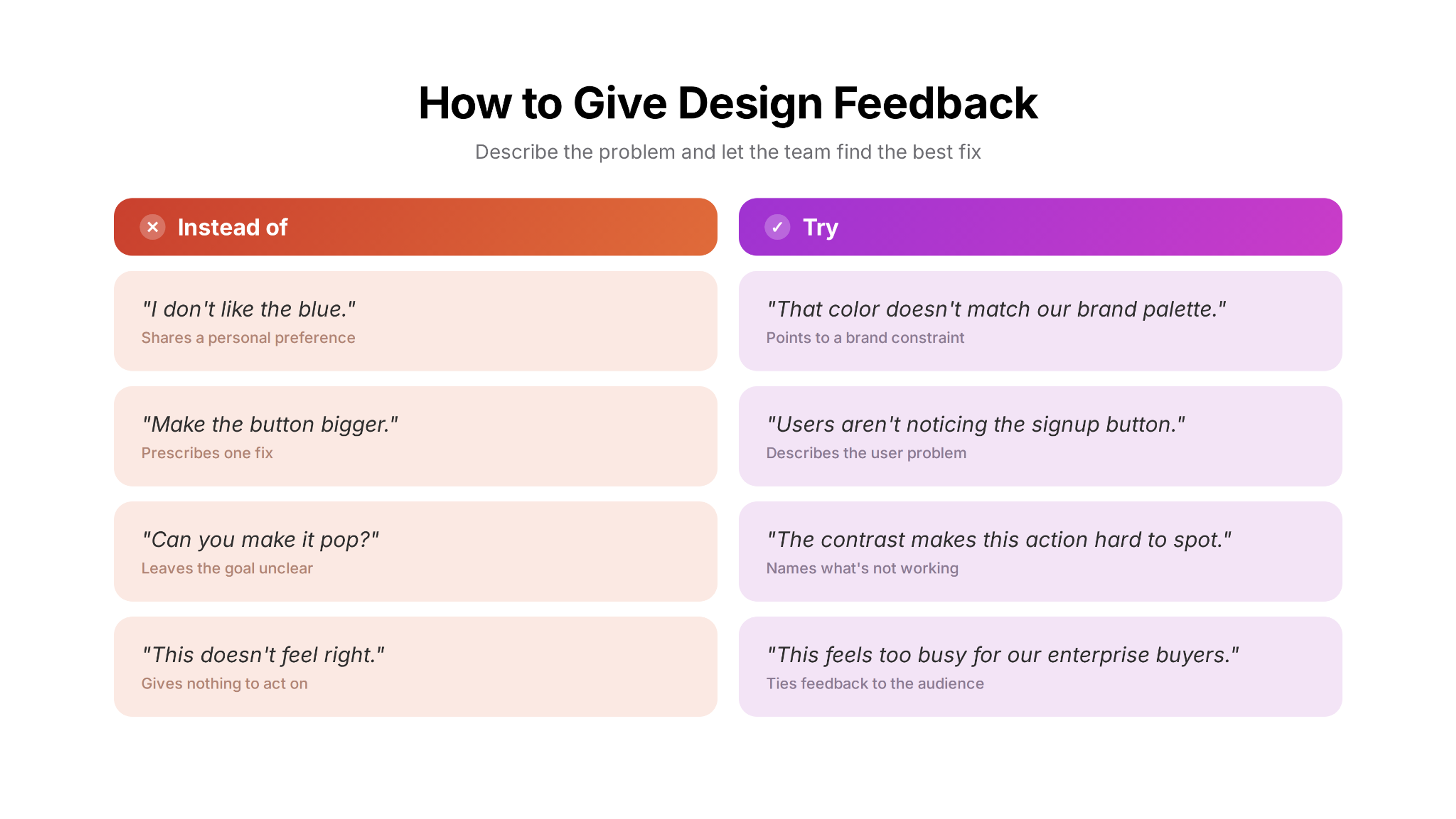
Tie each comment to a goal, a user need, a business requirement, a brand constraint, or an observed problem.
Describe the problem and leave the fix to the team. That way, designers can choose the best solution, which might be a change in placement, copy, contrast, or something you didn't expect.
General vs. Actionable Design Feedback
Common Client Mistakes and How to Avoid Them
Some challenges come up in projects across very different industries. They’re completely normal, and you can prevent each one with a bit of planning.
Underestimating the Brief
A detailed brief moves key thinking to the start of the project, where it's faster and less expensive. A few focused days on the brief before kickoff pay back quickly.
Design by Committee
When everyone gets an equal vote, the design drifts toward the safest compromise. Collect input widely, and then let one person decide.
Bringing Stakeholders In Late
When a senior leader first joins at the concept review, they often raise valuable new questions that reopen earlier decisions. Inviting everyone with veto power early, even for a single 30-minute interview, puts their input where it’s easiest to use.
Feedback Based on Personal Taste
Personal preferences are natural and worth sharing. Before you send a note, ask whether your customers would react the same way so the team knows how much weight to give it.
Scope Creep Through Small Asks
One extra page or one more animation seems harmless. Ten of them move a launch date. Route every new request through the change process you agreed on, including the small ones.
Long Gaps Between Feedback Rounds
Busy weeks happen on every team. Letting the agency know when feedback will be delayed helps it plan around the gap and keep the schedule intact.
Judging Early Concepts as Final Work
Early concepts are meant to be rough. At this stage, critique the direction, the structure, and the visual hierarchy. Polish comes later.
Focusing on the Wrong Things
Some results, such as revenue after a brand refresh, depend on many factors beyond design. Agree on metrics the design can actually influence.
Measuring Success After Launch
Design Project Success Metrics by Clay Global
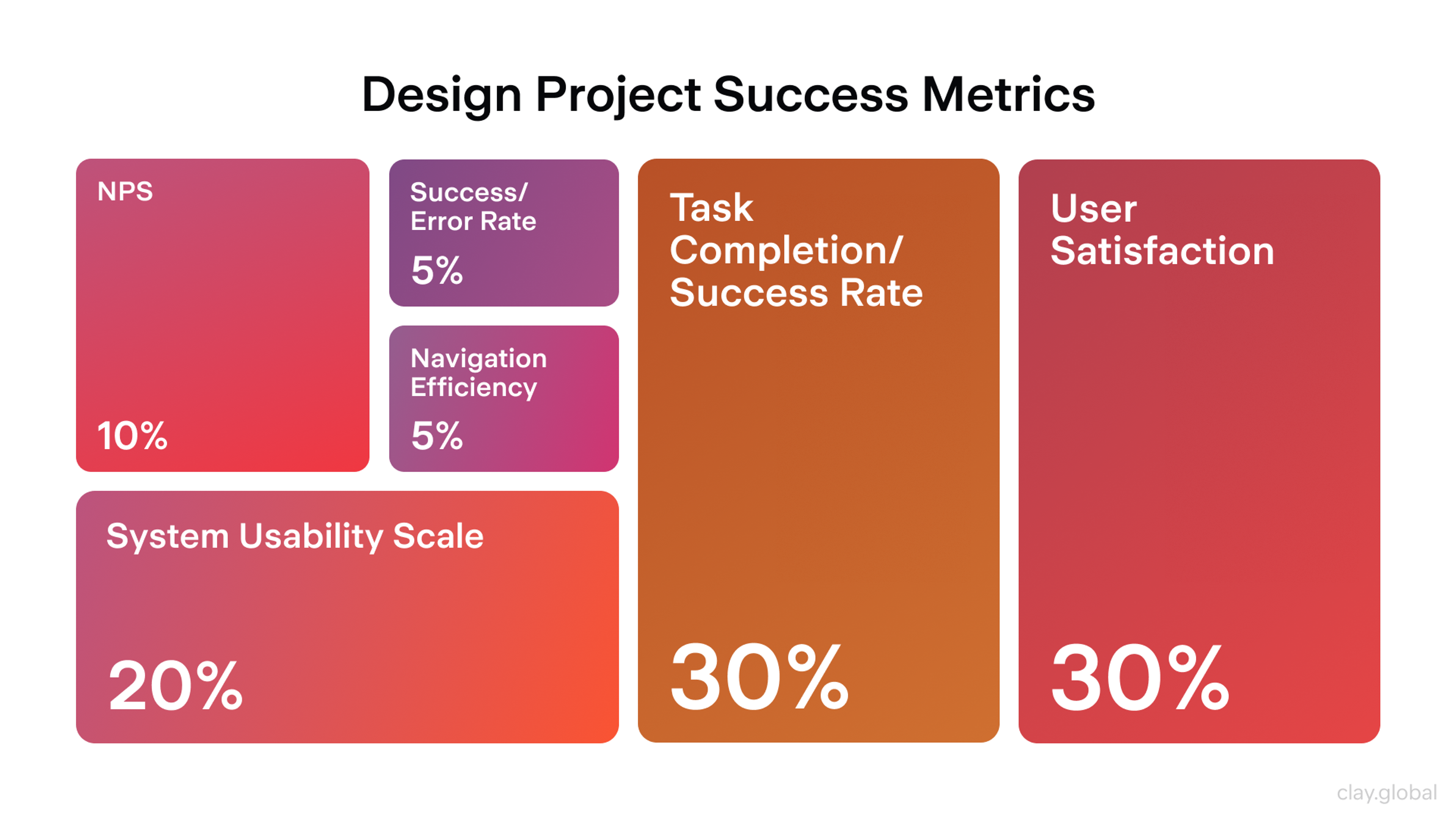
Agree on what success means before design starts. The right measures depend on the engagement.
- A product design engagement might focus on activation, task completion, retention, or user satisfaction.
- Brand work might call for a mix of qualitative and quantitative indicators, such as customer loyalty.
Good metrics are often small and easy to count. The average e-commerce checkout uses 11.3 form fields, and each extra field adds effort for the buyer. After a checkout or signup redesign, compare the field count before and after to see whether the flow actually got simpler.
After launch, we ask clients the same questions we ask ourselves. What worked, what didn't, which decisions paid off, and what should change next time? An agency that knows your product well can then offer a useful outside view on the next stage of the product or brand.
Still figuring out how to work efficiently with a design team? We're happy to share how we approach it at Clay. Let's talk.
Read More
FAQ
How do you work with design partners?
In an agency context, a design partner is an external firm that works alongside your internal team. Treat it as an extension of that team.
Share context openly, give it a single point of contact, and involve it early enough for its expertise to shape the solution.
What can a design agency help a startup with?
Most agencies cover branding, UI/UX, product design, websites, motion, or research, and multidisciplinary studios combine several of these. Some agencies now build their entire workflow around AI, so if your product relies on AI features, it's worth asking how an agency uses it in its own process.
How long does a typical design agency project take?
It depends on scope. A focused website or brand identity project often runs from several weeks to a few months, while product design engagements and design systems can stretch across quarters.
Client-side speed matters as much as agency speed, since approvals and feedback cycles set much of the pace.
What happens if we don't like the first design concepts?
That's a normal part of the process. Explain what doesn't work for you and connect it to goals, users, or brand constraints.
Good agencies expect early concepts to miss the mark in places, and that's exactly why they share early drafts before investing in polish.
Can a design agency work with our in-house designers?
Yes, and many engagements run this way. The agency might lead strategy and core design while your team owns ongoing production, or it might add specialist skills your team lacks.
Define ownership of files, components, and decisions early, so the two teams don't duplicate work.
Should we hire a design agency or build an in-house team?
An agency gives you specialized skills and extra capacity without permanently growing headcount. An in-house team offers continuity and deep product knowledge.
Many companies end up with a hybrid model, keeping ownership internal and bringing in an agency for major launches or specialist work.
Final Thoughts
Projects run best when the client prepares materials early, names one decision-maker, gives feedback the team can act on, and stays involved through launch.
Every project is different, so treat these steps as a foundation you can adapt. Shape them around your team, your timeline, and what you believe the product needs, and bring your own experience into the work with the agency.


About Clay
Clay is a UI/UX design & branding agency in San Francisco. We team up with startups and leading brands to create transformative digital experience. Clients: Facebook, Slack, Google, Amazon, Credit Karma, Zenefits, etc.
Learn moreAbout Clay
Clay is a UI/UX design & branding agency in San Francisco. We team up with startups and leading brands to create transformative digital experience. Clients: Facebook, Slack, Google, Amazon, Credit Karma, Zenefits, etc.
Learn more